by Karl Nehring
Move: The Westerlies. Nico Muhly: Move; Caroline Shaw: Entr’acte (arr. The Westerlies); Mason Bynes: For Rosa; Andy Clausen: This Is Water I: Carmel; This Is Water II: Lopez; This Is Water III: Harlem River. The Westerlies (Riley Muhlerkar, trumpet; Chloe Rowlands, trumpet; Andy Clausen, trombone; Willem de Koch, trombone. Westerlies Music WST012


Beethoven: Violin Concerto in D Major, Op. 61 (cadenzas by Jörg Widmann); Fragment from Violin Concerto on C Major, WoO 5. Veronika Eberle, violin; Sir Simon Rattle, London Symphony Orchestra. LSO Live LSO5094


by Karl Nehring
Beethoven for Three. Beethoven: Symphony No. 6 “Pastorale” (arr. for piano trio by Shai Wosner); Piano Trio No. 3 in C minor, Op 1, No. 3. Emanuel Ax, piano; Leonidas Kavakos, violin; Yo-Yo Ma, cello. Sony Classics 19658739372

Meanwhile, back to the present release, which is a sheer delight. The Pastoral Symphony is nothing if not tuneful, and having these tunes distributed among just three instruments brings remarkable clarity and energy to the score. From the very first measures, these three maestro amigos grab your attention and draw you into the music. The first time or two I listened I found myself wondering just how the piano was being used, or the cello – but after those first couple of times I listened to this reduced arrangment, I forgot about trying to compare the trio version to the original orchestral version and instead simply enjoyed the trio version on its own delightful sonic terms. The liner notes – well, there are no liner notes to speak of aside from thank-yous from the musicians along with the standard production credits. Sadly enough, there is nary a peep have about the arrangement (other than a thank-you), a discussion of which would have been fascinating to read. Oh well. Sonically, piano sounds overly wide, but not overly prominent, but this is not at all bothersome, at least to these charitable ears. Other than that, there are no audio nits worth picking. The trio that fills out then program is fun, full of drama, making this a highly recommendable release.
Haydn: String Quartets Op. 42, 77, & 103. Takács Quartet. Hyperion CDA68364

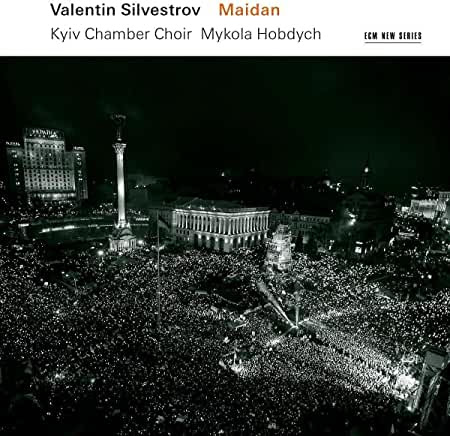
Maidan. Silvestrov: Maidan 2014 (Cycle of Cycles) – Cycle I | Cycle II | Cycle III | Cycle IV; Four Songs; Diptych; Triptych. Kyiv Chamber Choir, Mykola Hobdych, conductor. ECM New Series 2359

Ravel: Sonatine; Menuet sur le nom de Haydn; Valses nobles et sentimentales; Menuet antique; Pavane pour une infante défunte; Le Tombeau de Couperin. Clément Lefebvre, piano. Evidence EVCD083.
By Karl W. Nehring
French pianist Clément Lefebvre (b. 1989) has put together an absolutely marvelous Ravel disc. The opening piece on the program, Sonatine, is a composition with a name that may not be recognizable to a lot of classical music lovers. However, if you give it a listen, especially in such a fine performance and recording as this one, you may well have a new favorite to add to your list. Throughout its three brief movements, it will capture your imagination and hold you spellbound. His performance of Valses nobles et sentimentales is also worthy of special mention, as it seems to strike just the right balance of power and precision that keeps things exciting without taking them over the top.
My reference for Ravel piano recordings has long been that by the late American pianist Abbey Simon (1920-2019) on Vox, which is available at a bargain price and is truly that: a bargain. I also have owned at least two CD incarnations of an intriguing set recorded for the Nimbus label by the late Lithuanian-born French pianist Vlado Perlemuter (1904-2002). Wonderfully played, but distantly recorded, the piano almost seeming to be placed across the room from the listener. This new Evidence recording is better engineered than either of these two classic sets; let’s hope that Lefebvre records the rest of the Ravel piano works so that we can have a complete set from this remarkable musician. Highly recommended.
Beethoven: The Last Sonatas, Opp. 109, 110, & 111. Gerardo Teissonniére, piano. Steinway & Sons 30188.
Two installments ago I reviewed a CD that featured a performance of one of Beethoven’s late string quartets (https://classicalcandor.blogspot.com/2022/07/piano-potpourri-no-7-cd-reviews.html), then in my previous installment I did a review of a recording of his Diabelli Variations for solo piano (https://classicalcandor.blogspot.com/2022/07/piano-potpourri-no-7-cd-reviews.html), a review in which there was some discussion of his late piano sonatas, which have been recorded by just about every notable pianist. Here we have a new recording of his final three sonatas by an artist that many classical music fans may not be familiar with, the Puerto Rican-born pianist Gerardo Teissonniére (b.1961), a long-time faculty member at the Cleveland Institute of Music, who writes of these sonatas that “the drama, complex emotional charge, depth and range of expression in these works evoke the most poignant moments of the human experience in contemporary times, and have inspired a shared personal desire to convey messages of hope, gratitude, love and strength inherent in the music… These three extraordinarily diverse works present us with some of the composer’s most beautiful, innermost, surprising, and transcendental musical expression.”
That might sound to some like over-the-top prose, but for those who have really taken the time to experience the last three Beethoven piano sonatas, Teissonniére’s description may well sound much more straightforward. In any event, his performance is an excellent one. It is suitably bold when the music calls for it, as in those dramatic moments in Op. 109, but he could also make the instrument sing in the Op. 111 “Arietta.” The sound of his Steinway has been captured in vividly detailed and robust sound at the Sono Luminus Studios in Virginia by engineer Daniel Shores. Gerardo Teissonniére may not have an instantly recognizable name, but this a quality recording of important music and thus certainly recommendable.
Opening. Tord Gustavsen Trio (Tord Gustavsen, piano; Steinar Raknes, double bass; Jarle Vespestad, drums). ECM 2742.
Norwegian pianist Tord Gustavsen (b. 1970) returns to his standard trio format for his new album Opening – no added saxophone or trumpet this time around as on a few of his previous albums, just the classic piano trio format: piano, drums, and bass. Those familiar with his previous albums will pretty much know what to expect, music that is relaxing on the surface but never as simple as it first seems. Melodies twist and turn, chords shift and keys modulate, and the three musicians work together, with no extended solos, no displays of whizbang speedy playing for the sake of wowing the listener with overwhelming displays of blistering technique.
BBC Music Magazine has a feature in each issue titled “Music to my ears: What the classical world has been listening to this month” in which they ask several classical musicians what music they have been listening to recently. It is generally quite fascinating – and encouraging – to see the depth and breadth of the interests expressed by many of the musical luminaries who are featured. I was surprised this month by pianist Clare Hammond, who after mentioning listening to string quartets by Elizabeth Maconchy and a violin concerto by George Walker, had this to say: “After a day of practice, I don’t really want to classical music as I have reached saturation point, so I have been listening to jazz pianist Tord Gustavsen’s Opening, which is his latest album. I love the atmosphere he creates and the way his music takes me out of myself. I also use it when the children are screaming – I put Gustavsen on and they calm down. I don’t know if you should use music in such a utilitarian way!”
Yes, I can see how those Maconchy string quartets would get Ms. Hammond’s kids more than a touch stirred up, especially if they have not yet had their dinner. It’s nice to know that Opening is effective in calming them down, but I’d like to close by assuring my readers that the album has an abundance of musical as well as utilitarian value. It is beautifully recorded in the usual ECM house sound – full and clear with a dollop of reverb added to give a sense of air and ambience.
KWN
William Bolcom: The Complete Rags. Marc-André Hamelin, piano. Hyperion CDA683991/2.
By Karl W. Nehring
Many older listeners were likely first exposed to ragtime music by Marvin Hamlisch’s performance of Scott Joplin’s “The Entertainer” piano rag from the soundtrack to the 1973 hit film The Sting. Hamlisch’s performance was released as a single and became a radio hit; suddenly ragtime music was “in” and veteran ragtime piano players such as the late, legendary “Eubie” Blake enjoyed a sudden surge in media popularity. It turns out that American composer William Bolcom (b. 1938) had developed an interest in piano rags pre-The Sting, studying the rags of Scott Joplin in the late 1960s and trying his hand at writing some rags of his own.
“My growing familiarity around 1967 with Scott Joplin’s opera Treemonisha inspired my very first rag, Glad Rag, which quotes that opera in a transitional passage,” he recounts in his helpful, in-depth liner notes. “A very personal rag, Lost Lady is a lament for a failed marriage. But a real epiphany for me soon after that break-up was meeting James Hubert ‘Eubie’ Blake in 1966—at eighty-six, he was one of the few still-performing practitioners of the urbanized ragtime (called ‘stride piano’) of James P. Johnson and Thomas ‘Fats’ Waller. Bolcom goes on to recount that “Eubie and I became friends and gave concerts together frequently. (Purely by example Eubie was showing me how artificial was the division between composing and performing, which had become de rigueur in music; I consider him my last great teacher).”
Canadian pianist and composer Marc-André Hamelin (b. 1961) is widely known for his technical prowess and willingness to perform and record music outside the classical keyboard mainstream. Those qualities serve him – and us – well as he turns his attention in this release to the complete collection of Bolcom’s piano rags (27 in all, seven of which Bolcom wrote in collaboration with his friend William Albright) on this two-disc set. If this review communicates nothing else, let it get across these two points: First, this is serious music, written by a serious composer and played by a serious, gifted pianist. Not in any way is this some sort of novelty or crossover album. Second, this is an album of entertaining music that is entertaining precisely because it has been composed, performed, and recorded by serious professionals and can easily withstand the rigors of repeated listening. The album includes rags that will appeal to a broad spectrum of attitudes and emotions, from sad to glad and trad to rad and plenty of shades in between. Even for those unfamiliar with ragtime or stride piano, the piano rags of Bolcom as played by Hamelin and recorded by Judith Sherman and crew would be a great place to start.
Beethoven: 33 Variations Op. 120 on a Waltz by Diabelli. Mitsuko Uchida, piano. Decca 485 2731.
Last week’s New Releases No. 33 included a review of an ECM New Series CD by the Danish String Quartet that featured a performance of one of Beethoven’s late quartets. If you are familiar with those works, you know that they are both beautiful and sublime, at times seeming to originate from some realm almost beyond human comprehension, a world of timeless beauty with which Beethoven was somehow able to communicate. His late piano works, especially his final sonata, Op. 111, also have that sense of other-worldly beauty, a great performance evoking in the listener a sense of the transcendent.
Sometimes overlooked in the catalog of Beethoven’s late works for piano is his Diabelli Variations, a composition that was actually his final large-scale work for solo piano. The story behind the piece is a convoluted one. In brief, the composer and publisher Anton Diabelli had entered into a partnership in 1918 with an art dealer named Pietro Cappi. To call attention to their Vienna business, they hit upon the scheme of asking 50 notable musicians form throughout the Austro-Hungarian empire to provide a brief variation on a simple waltz tune that Diabelli had composed. The project wound up taking several years to pull together (no fax machines, no cell phones, no internet…), so the final version did not appear until 1824, in a printed volume that featured variations by the 50 composers, who were presented in alphabetical order. The variations included were of little lasting musical value, with the exception of a waltz by Schubert. Along with the volume containing the 50 variations, Cappi and Diabelli also published a companion volume: a reissued collection of Beethoven’s 33 variations of Diabelli’s waltz.
Wait, what? Reissued? Well, it seems that Beethoven thought the 50-composer idea was not something he wanted to be involved with, so he dismissed the idea of submitting a single variation out of hand. However, according to the liner notes, “Beethoven had in any case always been attracted by the challenge of building large edifices out of less than first-rate material, and he found Diabelli’s waltz a rich source for elaboration, setting to work on it almost as soon as he received it. Approximately two-thirds of the ‘Diabelli’ variations were written in 1819, before he laid the project aside in order to begin work on his Missa solemnis. By the time he returned to the variations, towards the end of 1822, Beethoven had not only finished the Mass, but had also composed his last three piano sonatas, Opp. 109, 110 & 111. The experience of the late sonatas clearly left its mark on those portions of the ‘Diabelli’ Variations that came after them. But more than that, the journey from the mundane to the sublime may be shorter than we imagine, and Diabelli’s innocuous little waltz tune, with its simple tonic-dominant harmony and its bass line giving out the falling interval of a fourth, from C to G, and then a fifth, D to G, is first cousin to the wonderfully serene ‘Arietta’ on which the finale of Beethoven’s last sonata, Op. 111, is based.” Cappi and Diabelli had received far more than they had requested from Beethoven, so in June of 1823 they published an advertisement for the score in the Weiner Zeitung (founded in 1703, still being published, one of the oldest newspapers in the world) that heralded:
We present here to the world variations of no ordinary sort, but a grand and important masterpiece, worthy of being added to the immortal creations of the old Classics, and in a manner that only Beethoven, the greatest living representative of true art, can supply. The most original structures and ideas, the boldest musical transformations and harmonies are here exhausted, every pianoforte effect based on a solid technique is employed; and this work is all the more interesting through the circumstance that it is elicited from a theme which no one would otherwise have supposed capable of a working-out of in the manner in which our exalted Master stands alone among his contemporaries. The splendid fugues, Nos. 24 and 32, will astonish all friends and connoisseurs of serious style, as will Nos. 2, 6, 16, 17, 23, etc. the brilliant players; and altogether all these variations, through the novelty of their ideas, care in working out, and beauty in the most artful of their transitions, will entitle the work to a place beside Sebastian Bach's famous masterpiece in the same form. [The Goldberg Variations]
Japanese-born British pianist Mitsuko Uchida (b. 1948) has long been one of my favorite musicians. Not only does she play wonderfully, but her modesty and charm are world-class, as you can see for yourself in this video from 2012 on the occasion of her being presented an award from the UK’s Royal Philharmonic Society: https://www.youtube.com/watch?v=zHh7pDApfCA. Perhaps even more indicative of her modesty and charm is this promotional video for her new recording of the Diabelli Variations: https://www.youtube.com/watch?v=z38Y8LfJHXY. Despite a long career throughout which she has been known primarily as a specialist in the Viennese masters who has won wide acclaim for her performances and recordings of Mozart, Schubert, and Beethoven, this new Decca release is Dame Mitsuko’s first recording of the Diabelli Variations. Her performance comes across as thoughtfully balanced, able to express depths of emotion without ever sounding forced; neither too excitable or rushed in the lighter moments nor overly drawn-out and melodramatic in the softer, more reflective passages. Particularly noteworthy is the way the recording closes out, Variations XXIX-XXXIII. These variations have a little bit of everytbing, blessed with some of the most sublime soft and slow passages extant. (unless you are perhaps quite young, XXXI will likely have you reflecting on mortality), culminating with Variation XXXIII, marked Tempo di Minuetto, moderato, and sounding like one final farewell dance. This is a truly first-rate recording of a sometimes-overlooked masterpiece.
Reynaldo Hahn: Poèmes & Valses. Contains selections from Le Rossignol Éperdu (53 Poèmes pour Piano) and Premières Valses. Pavel Kolesnikov, piano. Hyperion CDA68383.
Not having heard of either the composer or the performer before receiving this release for review, I really had no idea what to expect, but once again this is one of those cases of being most pleasantly surprised by what awaited me when I finally got around to giving this CD an audition. It turns out that Reynaldo Hahn (1874-1947) was born in Venezuela but his family moved to Paris when he was a child and he wound up spending most of his life in the City of Light. According to Wikipedia he was a composer, conductor, music critic, and singer who was most well-known during his lifetime for his songs, of which he composed more than 100. His portrait in the CD booklet bears a remarkable resemblance, at least to these eyes, to some I have seen of the famous French composer Claude Debussy.
As for the performer, Russian pianist Pavel Kolesnikov (b. 1989), a bit of digging around on my part quickly revealed that he has been gaining a reputation as a remarkable young pianist of exceptional sensitivity and touch, with an ability to tease out the poetry woven into the printed score. Although the Tchaikovsky concerto certainly is far different from Hahn’s music for solo piano, this brief video clip offers some insight into who Kolesnikov is both as a musician and as a person: https://www.youtube.com/watch?v=DkyPk6DHOX8.
Kolesnikov says that although at first he struggled to understand Hahn’s works, to get below the surface. It was the piece Éros cache dans les bois (“Eros hides in the woods”) that suddenly sparked his interest. “Gone were my initial reservation about these works; I surrendered myself to the music, which in itself is at once uncertain and precise, and was won over.” As he began to comb through Hahn’s piano pieces, finding that “some of the works left me unmoved, but others {a lot of them} took me back to those first impressions of mystery and apprehension, in which the listener is situated at the boundaries of familiarity” the COVID-19 lockdown suddenly hit, which for the pianist “seemed like the ideal moment to get started… After a few days of procrastination, I found the resolve to start conceiving this recording… for this recording I used a Yamaha CFX, whose sound is less textured than the usual concert Steinway. I specified that the piano be tuned in such a way as to maximize the extreme sensitivity of the keys, with closely positioned microphones. This serves to highlight a flurry of detail; but one has to be extremely attentive, for the downside of this placement is that it accentuates absolutely all the weaknesses, albeit microscopic.”
Hahn’s music is hard to pin down. It definitely sounds French, something like a mix of Satie, Debussy, perhaps Ravel – but not really just like any of those more familiar names. And when I say “Hahn’s music,” I need to point out that as you can see from the header above, the selections on this recording are taken from two different collections, the 53 Poèmes of Le Rossignol Éperdu (“The Bewildered/Distracted/Distraught/Ecstatic Nightingale”) and the Premières Valses (“First Waltzes”). There are 25 tracks in all: 9 Poèmes, 6 Valses, followed by 10 more Poèmes. The Poèmes have a more airy, other-worldly feel to them than do the Valses, which are livelier and more grounded, although still unmistakably French in character. Moreover, the Poèmes that Kolesnikov has chosen for the closing portion of the program are generally longer than those that he chose to open the program. Despite my clumsy attempts at describing it, this really is delightful music. If you like the piano music of Ravel, Satie, or Debussy, then I believe there is a good chance that you will find this music enjoyable. Kolesnikov is an impressive young pianist from whom I expect to we shall hear more from in the future. For now, we have this recording to savor.
KWN
Prism IV: Danish String Quartet. Bach: Fugue in G minor, BWV 861; Beethoven: String Quartet No. 15 in A minor op. 132; Mendelssohn: String Quartet No. 2 in A minor op. 13. Danish String Quartet (Frederik Øland, violin; Rune Tonsgaard Sørensen, violin; Asbjørn Nørgaard, viola; Fredrik Schøyen Sjölin, cello). ECM New Series 2564.
By Karl W. Nehring
My first encounter with the late string quartets of Beethoven – which was also my first encounter with string quartets, period (I had heard the were the pinnacle of the string quartet repertoire, and figured I might as well start with the very best, right?) – was a box set of LPs by the Yale Quartet on the Vanguard label that I picked up at a discount sale price during my last term as an undergraduate student. I was, as we often said in those days, “blown away” by the music emanating from my then-new Polk Audio Monitor 10s. I was simply amazed that anyone could write music like that, music that seemed to have come from some realm beyond mere human comprehension. My respect for Beethoven, already considerable, expanded exponentially. A day or two after purchasing the set, in fact, I stayed up all night writing papers for a couple of my philosophy classes, playing the late quartets of Beethoven over and over and over again. What greater philosophical inspiration could a young man hope for, I ask you?
Over the decades since I have listened to many and owned several sets of the late quartets on CD (the Yale, Emerson, Takács, and Tokyo box sets remain on my CD rack). Now in my later years I have suddenly found myself being taught a revelatory lesson by about the late quartets by a relatively young string quartet, and I must confess that it took me until their fourth lesson to finally “get it.”
As the statement on the back cover of this and each of the three preceding volumes of their “Prism” series of ECM New Series releases has stated: “Lines of connection are drawn in the Danish String Quartet’s five Prism volumes from a Bach fugue through one of the late Beethoven quartets to the music of a subsequent composer.” Although I had listened to two of the of previous three releases from this ECM “Prism” series by the Danish String Quartet, one a few times, the other just once (and cursorily, at that, I will admit, having not quite “gotten” the first), the “line of connection” never connected with me. This time, however: POW!
For whatever reason, from the opening notes of the Bach fugue from the Well Tempered Clavier, arranged for string quartet by Emanuel Aloys Förster, I felt the spirit of the late quartets. As the young Danes moved from Bach to Beethoven, the shift of gears was nearly imperceptible. Later, as the foursome turned from Beethoven to Mendelssohn, that shift, although more perceptible, was anything but abrupt. From start to finish, Prism IV is a rewarding musical experience that truly does reveal a line though genres and generations. You don’t have to read the liner notes to appreciate that Beethoven revered and studied the music of Bach and that Mendelssohn of course studied the music of Beethoven, but the notes are informative and helpful nonetheless in filling in some of the details. The engineering is up to the usual ECM standard, rich and resonant.
Corazón: The Music of Latin America. Brouwer: Canción de cuna*; Villa-Lobos: O canto do cisne negro, W 122; Carlos Guastavino: Pampamapa; Manuel Ponce: Par ti mi corazón; Egberto Gismonti: Água e Vinho;* Ponce: Estrellita (arr. by JIJI & Jascha Heifetz); Piazzolla: Le Grand Tango; Villa-Lobos: Pequeña Suite - Melodia; Ondulando; Ponce: Sonata in G minor for violincello and piano; Piazzolla: Oblivion. John-Henry Crawford, cello; Victor Santiago Asuncion, piano; *JIJI, guitar. Orchid Classics ORC100198.
My guess would be (to be honest, I’m often wrong, but bear with me) that for many classical music fans, when they see the phrase “the music of Latin America,” the cello is not the first instrument that comes to mind. Or even the second or third, for that matter. But as fate would have it, in the summer of 2019, the young American cellist John-Henry Crawford (b. 1993) traveled to Mexico to compete in an international cello competition, won first prize, wound uo returning to Mexico many times for performances, and as he recounts, “fell in love with the music of Latin America, the culture, the history, and the Spanish language. This album takes the listener on a musical tour through Argentina, Brazil, Cuba, and Mexico… spanning over 140 years of Latin American music culture.”
From the opening measures of Leo Brouwer’s Canción de cuna, arranged here for cello and guitar, you immediately get the sense that Crawford is out to communicate, not to bedazzle. This is playing of warmth and expressiveness, not of virtuosic excess. The cello/guitar combination also works well on Egberto Gismonti’s Água e Vinho, a dreamily lyrical piece from a composer whose name I best remember from his ECM guitar album Sol Do Meio Dia back in 1978, as well as on the next piece, Manuel Ponce’s Estrellita, on which Crawford’s cello just sings a tender love song, accompanied by JIJI’s guitar.
On the remaining pieces except for one, Crawford is accompanied by Victor Santiago Asuncion on piano. The “big” piece is the Ponce Sonata in G minor. Although it is of course the most formally structured composition on the album, it does not sound out of place, as it has its passages with the same lilt and flair heard in many of the other works herein. And it would be hard to imagine an album of Latin American music that did not include music by Villa-Lobos, represented here by three melodically gifted selections that tug at the heart, or Astor Piazzolla, represented here by two selections. The first is a composition in the style that made him famous, Le Grand Tango, which sounds suitably grand even when arranged for only cello and piano, with Crawford and Asuncion both playing with passion and power for eleven soulful minutes that are a highlight of the album.
Piazzolla’s Oblivion closes the album, the mood being more moody and reflective, the tango here having more of a last dance feeling in an arrangement for 14 cellos that gives Crawford an opportunity to let his cello sing in several registers simultaneously through the miracle of digital engineering. Because I was curious about just how this track might have been recorded, I inquired of Crawford through his PR agency and received his helpful explanation: “Yes, the last track is a cello choir plus solo line that is made up of only my playing layered over itself. The pizzicato replicates the double bass, and required the cello to be scordatura, and then there are three to a part on a quartet plus the solo cello line imitating the bandoneón." (Note that “scordatura” refers to an alternate tuning.) A quick note about the engineering, then, which is by the redoubtable Adam Abeshouse, a name that seems to pop up fairly often on fine-sounding recordings, of which this is an example. For cello lovers and/or fans of Latin American music, Corazón is an easy recommendation.
Brahms: Cello Sonata No. 1 in E minor Op. 38; 7 Songs (arr. Norbert Salter [1868-1935] & David Geringas [b. 1946]); Cello Sonata No 2. in F Op. 99. Antonio Meneses, cello; Gérard Wyss, piano. AVIE AV2493.
Are you in the mood for some more music for cello and piano? If so, let’s take a trip across the Atlantic from Latin America to Germany (or, if you are really in the mood for some fun, travel, and adventure, we could always set sail across the Pacific and then hike across Asia on our way to Europe) for an encounter with the music of Johannes Brahms (1833-1897). Brahms is sometimes referred to as the third “B” of that pop-culture classical music composer trinity: Bach, Beethoven, and Brahms. Interestingly enough, all three of these musical icons composed landmark works for the cello – Bach with his suites for solo cello (I reviewed a recent recording of a couple of these here ???), Beethoven with his sonatas for cello and piano (you can see a review of a recent recording here ???), and Brahms with the two sonatas included in this new recording by the Brazilian cellist Antonio Meneses (b. 1967) and Swiss pianist Gérard Wyss (b. 1944).
These two sonatas come from different periods in Brahms’s career. He began working on Sonata No. 1 in the summer of 1862, relatively early in his career, completing what we now have as the first two movements plus an Adagio movement that may or may not have been adapted many years later into the slow movement of his Sonata No. 2. For whatever reason, he then put the piece aside for three years before writing the finale and deeming it complete in 1865 (publishing it in 1866) with only three rather than the usual four movements. The first movement, however, is quite substantial, longer than the following two movements combined. As a result, this is not a brief sonata. Moreover, that first movement is not only long (14:43 in this performance), it is a musical composition that could seemingly stand on its own as a complete piece, so eloquent and moving is it, especially as played here with such warmth of tone and fluidity of line by Meneses and Wyss. I must confess – without shame, to be honest – that while auditioning this CD for review, I often found myself returning to this movement and playing at least parts of it, especially the opening few minutes, just to enjoy the sheer beauty of the music.
Brahms did not start work on another cello sonata for another 20 years, composing it in 1886 and publishing it in 1887. This work is in the more traditional four movements, with the opening movement again being the longest, but at just over nine minutes as performed here, not as extended as in the previous sonata. One of the things that the attentive listener will notice is how skillfully Brahms writes for both the cello and the piano, giving both instruments distinctive voices. Perhaps the highlight of the piece is the second movement, marked Adagio affettuoso, music that should be able to bring consolation to the most forlorn of souls. Note the way that Brahms employs his familiar device of playing competing rhythms against each other at times to create a feeling of tension, here of course with only two instruments. Hear also how the cello plays at times very low notes, at other times very high notes – all within the same short movement.
Between the two sonatas, the disc is filled out generously (total time is 75:12) with seven songs by Brahms arranged for cello and piano. Among these seven is Wiegenlied Op 49 No. 4, better known by it popular title as the “Brahms lullaby.” These songs contain some lovely melodies, but are played here as serious music, not as pop kitsch. Something that stands out about this release is a sense of warmth, both in the playing and in the engineering. For comparative purposes, I pulled down from my CD rack a Sony recording from 1992 of the two sonatas made by Yo-Yo Ma and Emmanuel Ax. The sound seemed just a bit thinner and colder, and the playing seemed just not quite as expressive – a bit cooler, if you will. For both performance and sonics, my preference is for this new AVIE release, which is definitely a keeper.
KWN
Also, Stucky: Silent Spring. Manfred Honeck, Pittsburgh Symphony Orchestra. Reference Recordings FR-7475SACD.
By John J. Puccio
Beethoven wrote nine symphonies, at least five of which (Nos. 3, 5, 6, 7, and 9) are probably the best known and most popular. But if I had to guess further, I’d say that today’s average non-classical music listener might only know the first four notes of the Fifth and the finale of the Ninth (oh, yeah, they’d say, that’s from Die-Hard). Yet thanks in part to Disney’s Fantasia, they might also recognize most any part of the Sixth. Which brings us to a dilemma faced by any conductor undertaking a new recording of the “Pastoral”: how to make it different enough to distinguish it from the 800 other recordings currently available and make it worthwhile enough for potential buyers to consider adding it to their music library.
Face it: There are already some great recordings of the Sixth Symphony from distinguished conductors like Bruno Walter, Fritz Reiner, Karl Bohm, Otto Klemperer, Eugene Jochum, Jordi Savall, and many others. What would set Manfred Honeck’s rendition with the Pittsburgh Symphony Orchestra apart from the rest? Well, certainly, Maestro Honeck chose a symphony with as great a variety of interpretations as any in the catalogue.
First, of course, there’s the matter Honeck discusses in the booklet notes. Should one approach the “Pastoral” as program or absolute, abstract music? He reasons that Beethoven gave us enough explanation of each movement that it is inevitable the composer meant for us to picture in our minds the scenes and events he’s describing. Honeck goes on to say, however, that there is a good deal of feeling in the music, Beethoven indicting in the score that the music should be played with “more sensation than painting.” So, one must not overlook the nuances of the score and create more than simply a cursory overview of the image. Honeck goes on in his extraordinarily thorough booklet notes to identify the various passages that he felt needed further clarification through extended contrasts or an emphasis on certain instruments.
Then there is the matter of tempos. Ah, yes, those tempos. Beethoven, it seems, fell in love with the newfangled metronome and added detailed tempo markings throughout his music. This was not to the liking of every conductor, as they preferred the broader Latin markings of Allegro, Andante, Largo, etc., which gave them more leeway in adopting a pace they preferred. An actual, specific tempo many of them felt was too restrictive. What’s more, just as many musical scholars believed (and some still believe) that Beethoven’s metronome may have been faulty because the speeds are so much more uniformly fast that most conductors were used to. Whatever, with the popular introduction of historically informed performance practice (HIP) and the period-instrument era of the mid-twentieth century, the adoption of Beethoven’s own tempo markings became more widespread. Ensembles like Roger Norrington and the London Classical Players, John Eliot Gardiner and the Orchestre Révolutionnaire et Romantique, and Jordi Savall and Le Concert des Nations among others helped put Beethoven’s own tempo markings back on the map. Still, these were period-instrument bands, and Honeck leads a modern-instrument one. Would he follow traditional big-orchestral practice or adopt Beethovent’s markings? It appears Honeck chose Beethoven. His timings for each of the Sixth Symphony’s movements are consistently as fast or even faster than Norrington, Gardiner, or Savall and clearly faster than most modern-orchestra recordings.
So, how does all of this work out for Maestro Honeck and the listener? That may depend of what you’re looking for in the work and, especially, what you’re used to. Let’s take the recording one movement at a time.
The first movement Beethoven marks as an Allegro ma non troppo (fast but not too fast) and calls it the “Arrival in the country.” Well, Honeck certainly got the “fast” part right, but the “not too fast” seems to elude him. Fortunately, the wide dynamcs and the dramatic pauses help to make the music vigorous and noteworthy. But I’m not sure an arrival in the country should be this hurried, despite the composer’s tempo marks.
The second movement is the “Scene at the brook,” marked Andante molto mosso (moderately fast). Traditionally, this would actually be a “slow” movement, but following Beethoven’s lead, Honeck again takes it rather briskly. Still, Honeck’s brook bubbles away in perfect harmony with Nature, and it appears as though the company of people at the stream are enjoying themselves.
The third movement Beethoven called the “Merry assembly of country folk” and labeled it an Allegro. Here, Honeck is clearly in his element. “It is said the peasants are revolting.” “You said it! They stink on ice!” --Mel Brooks, History of the World, Part I. The country folk do, indeed, appear to be having a good time.
The fifth movement, the “Thunderstorm,” Beethoven also labeled an Allegro. The storm is undoubtedly noisy, with the recording’s wide dynamics practically knocking you out of your chair. Honeck clearly achieves the impact the composer probably desired.
Then, the final movement is the “Shepherd's Song,” with the additional description “Benevolent feelings of thanksgiving to the deity after the storm.” Beethoven tags it an Allegretto (moderately fast but not so fast as an Allegro). Because the indicated tempos are significantly different from those we usually hear from modern orchestras, Honeck’s approach doesn’t seem fully to capture the merrymakers’ gratitude to the Lord at the passing of the thunder and lightning. It doesn’t project the exalted serenity we normally hear.
Now, whether my several qualms are justified, given Beethoven’s own intentions, or whether I am basing them on personal expectations due to years of listening to more conventional performances, I’m not sure. I do know that, for instance, I disliked Roger Norrington’s HIP approach of the Sixth, finding it rather antiseptic, but found Jordi Savall’s equally HIP approach totally delightful. All I can say about Honeck’s interpretation is that it may be a matter of acquired taste.
Coupled with the Beethoven is Steven Stucky’s Silent Spring, commissioned by and premiered in 2012 by Manfred Honeck and the Pittsburgh Symphony. Mr. Stucky (1949-2016) wrote his four-movement composition as a tribute to Rachel Carson’s best-selling 1962 wake-up call for environmentalism. Taking Carson’s own titles for the four movements, Stucky’s music reflects the themes of the book: “The Sea Around Us,” “The Lost Woods,” “Rivers of Death,” and “Silent Spring.” Honeck and the orchestra would seem to reflect these moods perfectly, and Stucky’s tone poem comes over as a wake-up call of its own.
Producer Dirk Sobotka and engineer Mark Donahue recorded the music live at Heinz Hall for the Performing Arts in June 2017 (Symphony No. 6) and April 2018 (Silent Spring). They recorded it for SACD 5.0 and 2-channel stereo playback as well as regular CD stereo, using five omnidirectional DPA 4006 microphones as the main array, supplemented by “spot mics” to clarify the detail of the orchestration. The recording itself was made in DSD256 and post-produced in DXD 352.8kHz/32 bit. I listened in SACD two-channel.
For a live recording, the sound of the Sixth is remarkably lifelike, meaning it’s not as close-up, bright, or one one-dimensional as are most live recordings. If anything, it’s a touch soft. Miked at a moderate distance, it sounds big and full, warm and natural. The wide dynamics help it seem even more realistic, although some listeners may object to the abrupt changes in playback levels. I enjoyed it. The sound of Silent Spring is more hi-fi oriented, a tad sharper and clearer and in-your-face.
JJP
Kristian Bezuidenhout, fortepiano; Pablo Heras-Casado, Freiburg Baroque Orchestra. Harmonia Mundi HMM902412.
By John J. Puccio
With Concertos 1 and 3, pianist Kristian Bezuidenhout, conductor Pablo Heras-Casado, and the Freiburg Baroque Orchestra complete their cycle of all five Beethoven Piano Concertos for Harmonia Mundi. For now, their recordings are the best period-instrument accounts of the complete cycle put to disc.
The first selection on the album is the more-popular and more-mature of the pieces, the Piano Concerto No. 3 in C minor, Op. 37, which Beethoven wrote around 1800 and published in 1804. It still retains some evidence of its Mozartean predecessors, but begins to show a creativity of its own that would bloom in the Fourth and Fifth Concertos.
The main thing you have to remember about the recording, though, is that the solo instrument used for this period-instrument production is a copy of an 1824 Conrad Graf fortepiano. The fortepiano hit its prime in the late eighteenth and early nineteenth centuries. It’s the instrument Haydn, Mozart, and Beethoven would have written for until it evolved into the modern grand piano. While the sound of the fortepiano is not as tinkly or ringing as a harpsichord, it isn’t quite as powerful or well-rounded as that of a modern grand, not as rich or mellow, the lows in particular not as plush or resonant. Nonetheless, Bezuidenhout teases some beguiling sounds from it, and the Freiburg ensemble accompany him with an easy precision, Maestro Heras-Casado ensuring that the playing never sounds feverish or rushed.
After an extended introduction from the orchestra, the piano enters with a flourish, then a gentle lyricism that clearly belongs to the early Romantic tradition. The tempos vary but both the soloist and the conductor steadily adhere to Beethoven’s marking of Allegro con brio, with liveliness and vigor. Yet the presentation remains relaxed and confident throughout. Bezuidenhout manages an elegant yet exciting performance using the ancient fortepiano replica, and within moments one forgets it’s not a grand. The Largo that follows is hushed and serene, a gentle interlude before the more playfully tempestuous Rondo finale. Given the varied and plentiful contrasts involved in the concerto, you won’t find a better clarification of it than here.
The second selection on the disc is the Piano Concerto No. 1 in C major, Op. 15, written in 1795 and more clearly a descendent of the Classical Haydn and Mozart era. Beethoven actually wrote his Second Piano Concerto before the First, but he didn’t publish it until later, so if you like it better than the numbered 2, it might be because it’s a slightly later work. Whatever, it’s always been among my favorites, and Bezuidenhout and Heras-Casado give it the same detailed attention they provided the other concertos in the set, meaning the playing is radiant, scintillating, and effervescent throughout. I would count these performances of all five Beethoven piano concertos among the very best available, regardless of period or modern instruments.
Producer and editor Martin Sauer and engineer Tobias Lehmann recorded the music for Teldex Studio Berlin at the Ensemblehaus Freiburg, Freiburg, Germany in December 2017. The recording projects just the right amount of hall ambience and a reverberance that flatters the sound yet still provides good definition and a realistic setting at the same time. The piano is well positioned in the center of the sound field, not too far in front of the orchestra, with a modest degree of depth to the rest of the cast.
JJP
By Karl W. Nehring
One of the most fascinating conductors of modern times was the late Leopold Stokowski (1882-1987), whose life story is one of the most colorful imaginable. If you have never read about this now largely-forgotten conductor, do some web browsing and prepare to be entertained. For example, Stokowski was in the audience in Vienna in when Gustav Mahler conducted the premiere of his Symphony No. 8. With the political situation in Vienna deteriorating, Stokowski obtained a copy of the score and managed to smuggle it in his luggage and bring it back to Philadelphia with him, where he was at that time the newly appointed conductor of the then relatively unknown Philadelphia Orchestra. He insisted that the orchestra present the work and demanded on staging it with a choral force of 950(!) singers – an expense that the orchestra’s board thought way too financially risky. Through sheer force of will and his magnetic personality, Stokowski prevailed and he conducted the U.S. premiere of the work – leading a force of 1,069 musicians – in March, 1916. The concert proved such a sensation that it was repeated several times in March and April to standing-room-only crowds and thrusting the orchestra into international prominence. Some may remember that it was Stokowski who famously shook hands with Mickey Mouse in Walt Disney’s movie Fantasia. As I started to get seriously interested in both classical music and audiophile sound and equipment in the 1970s, I found myself enjoying many recordings by the Maestro, who continued to make records into his 90s.
Stokowski was always fascinated by the sound of the orchestra and how to capture it in recording. He had always been one to embrace new sound technologies, and in 1931 he worked with Dr. Harvey Fletcher of Bell Labs on the original stereophonic orchestral recordings. If I may be allowed to insert a personal note, in his later life, Harvey Fletcher was married to my wife's grandmother, and in the mid-1970s, we spent many interesting times with “Uncle Harvey,” who even in his 90s was still fascinated by sound and still actively working on acoustics research. He loved to tell us tales of his work, and he showed us many pictures of him with Leopold Stokowski from those pioneering recording sessions.
For a time, it seemed as though Stokowski recordings were getting harder and harder to find, and some of the recordings listed below have drifted in and out of availability at various times. Still, there have been numerous releases over the years of recordings conducted both by the Maestro himself and by some of his disciples that have kept his legacy alive. As you will see when you browse through the selections outlined below, the man was engaged in an amazing variety of musical styles. Summing up his outlook toward music in his autobiography, he wrote “I believe that music is spontaneous, impulsive expression – that its range is without limit – that music is forever growing.” In light of that statement, I should warn listeners now – if you are the type of person who is concerned about strict adherence to the printed score, and I am sure there are few of you out there, the Stokowski is not your man. As he said above, he believed in spontaneous expression, and his conducting reflected that attitude. For an entertaining look at the career and conducting style of the Maestro, there is a documentary video about his life and career that can be seen here: https://www.youtube.com/watch?v=L4tIqRpUwnA
Leopold Stokowski: Complete Decca Recordings.
CD1 Great Music for Chorus and Orchestra (Devotional/Spiritual/Hymns) Norman Luboff Choir/New Symphony Orchestra of London; CD2 Rimsky-Korsakov: Scheherazade/London Symphony Orchestra (LSO); CD3 Mussorgsky: Pictures at an Exhibition/New Philharmonia Orchestra (NPO); CD4 Tchaikovsky: Swan Lake & Sleeping Beauty Selections/NPO; CD5 Vivaldi: The Four Seasons/NPO; CD6 Wagner: Orchestral Music from “The Ring”/LSO; CD7 Tchaikovsky: Symphony No. 5/NPO CD8 Handel: Messiah Excerpts/LSO & Chorus; CD9 Mussorgsky: Night on the Bare Mountain; Stravinsky: Firebird Suite/LSO; CD10: Beethoven: Symphony No. 9/LSO & Chorus; CD11 Berlioz: Symphonie Fantastique/NPO; CD12 Tchaikovsky: Romeo & Juliet; Mussorgsky: Boris Godunov Symphonic Synthesis/L’Orchestre de la Suisse Romande; CD13 Tchaikovsky: 1812 Overture; Borodin: Polovstian Dances; Stravinsky: Pastorale/RPO; CD14 Beethoven: Symphony No. 5; Schubert: Symphony No. 8/London Philharmonic Orchestra; CD15 Debussy: La Mer; Ravel: Daphnis et Chloe; Ives: Orchestral Set No. 2; Messiaen: L’Ascension/LSO; CD16 Franck: Symphony in D Minor; CDs 17-18 Sixtieth Anniversary Concert (Wagner, Brahms, Debussy Glazunov, Tchaikovsky, Schubert, Chopin, Byrd, Clarke, Duparc, Rachmaninov/LSO); CD19 Elgar: Enigma Variations/ Czech Philharmonic Orchestra (CPO); CD 20 Bach: Orchestral Transcriptions/CPO; CD21 Scriabin: La Poeme de L’Extase; Rimsky-Korsakov: Capriccio Espagnol/CPO/NPO; CD22 Beethoven: Symphony No. 7/RPO; CD23 Bonus Disc: Leopold Stokowski – A Memoir (Interviews with musicians who knew Stokowski plus musical examples and rehearsal excerpts taken from recording sessions). Decca 483 2504.
For those who really want to dive deeply into the Stokowski sound, the most comprehensive collection can be found in this 23-CD boxed set from Decca that gathers together the “Phase 4 Stereo” recordings he made for that label in the 1960s-70s. For those unfamiliar with Phase 4 recordings (they were sold as “London Phase 4” here in the USA), they were recorded using a multiplicity of microphones, then mixed down into stereo to produce a vivid, spotlighted sound. It was not real, but it was spectacular. Purists would of course blanch, but in its defense, it did bring out many exciting details of orchestration, and was not always as garish as the concept might lead one to believe. Highlights from this big collection include his La Mer, Daphnis et Chloe, the Ring highlights, Scheherazade (although to be honest, I prefer his RCA version with the Royal Philharmonic), the Bach orchestral transcriptions, the Messiaen L’Ascension, and although in general his Beethoven is not all that outstanding, his recording of the Symphony No. 9 is well worth a listen.
Original Masters: Leopold Stokowski, Decca Recordings 1965-1972. CD 1 Orchestral Transcriptions of works by Bach, Byrd, Clarke, Schubert, Chopin, Tchaikovsky, Duparc, Rachmaninov, and Debussy/Czech Philharmonic Orchestra (CPO)/London Symphony Orchestra (LSO)/New Philharmonia Orchestra (NPO); CD 2 Tchaikovsky: Symphony No. 5/NPO; Scriabin: Le Poeme de Extase/CPO; (CD 3) Franck: Symphony in D minor (Hilversum Radio Philharmonic Orchestra [HRPO]); Elgar: “Enigma” Variations/CPO; CD 4/ Berlioz: Symphonie Fantastique/NPO; Ballet des Sylphes/LSO; Ravel: Fanfare L’Eventail de Jeanne/HRPO); Daphnis et Chloé - Suite No. 2/LSO & Chorus; CD 5 Stravinsky: Firebird Suite (1919 version); Debussy: Prelude to the Afternoon of a Faun; La Mer; Messiaen: L’Ascension/LSO. Decca 475 145-2.
As you can see, this smaller box is something of a subset of the larger Decca box discussed above; however, some of the selections are not quite the same. And again, the highlights include Stokowski’s interpretations of French music, especially Debussy and Ravel. John Puccio reviewed this release some time back, his take can be found here: https://classicalcandor.blogspot.com/2012/05/original-masters-leopold-stokowski-cd.html
Mahler: Symphony No. 2; Brahms: Symphony No. 4. Brigitte Fassbaender, mezzo-soprano; Margaret Price, soprano; London Symphony Chorus; Leopold Stokowski, London Symphony Orchestra. RCA Victor Gold Seal 09026-62606-2.
Although he frequently conducted Mahler in concert, Maestro Stokowski made few Mahler recordings, but this one is a definite keeper. It was made in 1974, when Stokowski was in his 90s. In terms of performance, Stokowski's Mahler is a bit on the slow side, but very expressive – this is a powerful, moving performance. With its excellent sound and majestic performance, this version of the "Resurrection" is one of the finer ones that I have ever heard. No, it would not be my first choice (but to be honest, my first choice varies from time to time – those on the list include Mehta, Slatkin, Fischer, Walter, and Klemperer). If you are a fan of this symphony but have never heard this recording, well, you might want to put it on your want list. By the way, Stokowski's Brahms 4th is also powerful, but in the opposite way -- it is performed at breakneck speed! A quick comparison: Mackerras's performances with the Scottish Chamber Orchestra (Telarc) are generally regarded as fast and lively. In the first movement, Mackerras clocks in at 12:02, Stokowski at 10:48. In the final movement, a set of dramatic theme and variations, Mackerras clocks in at 10:06, while Stokowski comes in at 9:51. Again, this may not be my favorite performance of this symphony, but it is certainly one of my favorites (others include Walter, Solti, Honeck, and Mackerras). This is one of those “sleeper” recordings that is well worth seeking out.
Wagner Weekend: The Ride of the Valkyries. Wagner: The Ride of the Valkyries; Dawn and Siegfreid’s Rhine Journey; Siegfried’s Death and Funeral Music; Entrance of the Gods into Valhalla; Forest Murmurs; Prelude to Der Meistersinger. Leopold Stokowski, London Symphony Orchestra. London Weekend Classics 421 020-2.
If you are lucky enough to find this one in a bin at a used record store, Goodwill, yard sale, or wherever, snatch it up, for it is big fun in a small package. Stokowski loved the music of Wagner, which perfectly suited his imaginative, expressive, technicolor music-making. The London Symphony is responsive to his direction, making this disc something you can put on and just lose yourself in for nearly an hour, if not quite a weekend. Hard to find, easy to love…
Wagner: Symphonic Syntheses by Stokowski. Das Rheingold: Entrance of the Gods into Valhalla (ed. Stokowski); Tristan und Isolde: Symphonic Synthesis (arr. Stokowski) -- Prelude to Act 1, Liebesnacht, Liebestod; Parsifal: Symphonic Synthesis from Act III (arr. Stokowski); Die Walkure: Magic Fire Music (arr, Stokowski): Die Walkure: Ride of the Valkyries (arr. Stokowski). Jose Serebrier, Bournemouth Symphony Orchestra. Naxos 8.570293.
Uruguayan conductor Jose Serebrier was a devoted disciple of Stokowski who has done much to carry forward the late Maestro’s banner. On this well-recorded Naxos release, he presents a case for these “symphonic syntheses” of some of Wagner music, arrangements that Stokowski made to present in the concert hall of music that was originally meant to serve as operatic accompaniment. In his liner notes, Serebrier discusses Stokowski’s life-long fascination with Wagner’s music as well as the conductor’s motivations and methods for arranging the music into these symphonic forms. Furthermore, Maestro Serebrier offers a discussion of how Stokowski worked to obtain a specific kind of sound no matter which orchestra he might be conducting. In any event, if you are a fan of the music of Wagner, you really owe it to yourself to give this release an audition, for it is quite a luscious treat.
The Stokowski Sound. Bach: Toccata & Fugue in d minor; Boccherini: Menuet; Bach: Little Fugue in g minor; Debussy: Clair de lune; Beethoven: Adagio Sostenuto from Moonlight Sonata; Albeniz: Fete-Dieu a Seville; Debussy: La cathedrale engloutie; Rachmaninoff; Prelude in c# minor; Moussorgsky: A Night on Bald Mountain. Erich Kunzel, Cincinnati Pops Orchestra. Telarc CD-80129.
Although the Telarc label has gone away, this disc is still out there, not all that hard to track down. Hooray! Of all the CDs discussed here, this is the most exciting, rewarding, entertaining release in terms of engineering, and hey, the performances are pretty darn good, too. The late Erich Kunzel was an excellent conductor (and tremendous human being), the Cincinnati Pops (Cincinnati Symphony Orchestra in pops guise) was/is an excellent ensemble (and, by the way, the first orchestra that Stokowski led in the USA), and the Telarc engineering team had the drill nailed down: they knew how to capture the power and impact of the orchestra, especially on the bottom end. The sound is the opposite of the Phase 4 sound. Rather than close-up, multi-miked sound, the Telarc engineers used a minimal microphone approach (typically a 3-mic array), producing a warm spacious sound with plenty of dynamic range. As you can see from the header, the program is varied, from Bach to Beethoven and beyond, popular pieces in orchestral transcriptions by Stokowski, delivered in knockout Telarc sound that will impress you and possibly your neighbors as well.
Stokowski: Philadelphia Rarities. Two Ancient Liturgical Melodies - “Veni Creator Spiritus,” “Veni Emmanuel''; De Falla: Spanish Dance from La Vida Breve; Turina: Sacred Mountain from Five Gypsy Dances; Arcady Dubensky: Edgar Allen Poe’s “The Raven” (Benjamin de Loache, narrator); Etenraku, Ceremonial Japanese Prelude (arr. Hidemaro Konoye); Harl McDonald: The Legend of the Arkansas Traveler (Alexander Hilsberg, violin); Dance of the Workers from Festival of the Workers Suite; Rhumba from Symphony No. 2; Henry Eichheim: Japanese Nocturne from Oriental Impressions; Bali, Symphonic Variations; McDonald: Concerto for Two Pianos and Orchestra (Alexander Hilsberg & Jeanne Behrend, pianos); John Philip Sousa: Manhattan Beach; El Capitan. Leopold Stokowski, Philadelphia Orchestra. Cala Signum SIGCD2033.
From the best sound and perhaps most familiar music of this brief survey we jump immediately to a release featuring the worst sound and without a doubt some of the least familiar music. As the liner notes point out, “with the advent of of the microphone during the 1920s, Stokowski and the Philadelphia Orchestra made an enormous number of 78rpm records, which became landmarks in recording history. For much of the time, Stokowski concentrated on basic repertoire, such as the orchestral music of Beethoven, Brahms, Tchaikovsky, Sibelius, Debussy, Mussorgsky and many others, as well as excerpts from Wagner’s operas and, above all, his own orchestrations of Bach’s keyboard works. Side-by-side with familiar pieces, however, went a number of works which no-one else had recorded before or, indeed, has recorded since! And, although Stokowski was to record certain compositions several times over during his long career, there were a number which he recorded only once – on 78s made with the Philadelphia Orchestra. This unique collection (which previously appeared on a “Limited Edition” CD in 1993, issued exclusively for members of the Leopold Stokowski Society) brings together just those items which fall into this “rarities” category, and it demonstrates Stokowski’s incredibly wide-ranging musical sympathies. It covers many periods and styles, from melodies centuries old to colourful Iberian and Oriental works, together with music of 20th century America.” The recordings were done in the 1920s-30s; of course they have their sonic limitations. Still, it is fascinating to listen to musicians who were making music nearly a century ago, playing music that in most cases we have never heard before and most likely will never hear again. The piece that sticks out like the proverbial sore thumb is the Poe: my goodness, the dramatic recitation of “The Raven” is something you will have to hear to believe. Trust me, they just don’t recite poetry like this anymore. Certainly this is not a record for everyone; however, as a historical document, it has some value, especially to devoted Stokowski fans.
KWN
John J. Puccio, Founder and Contributor
Understand, I'm just an everyday guy reacting to something I love. And I've been doing it for a very long time, my appreciation for classical music starting with the musical excerpts on the Big Jon and Sparkie radio show in the early Fifties and the purchase of my first recording, The 101 Strings Play the Classics, around 1956. In the late Sixties I began teaching high school English and Film Studies as well as becoming interested in hi-fi, my audio ambitions graduating me from a pair of AR-3 speakers to the Fulton J's recommended by The Stereophile's J. Gordon Holt. In the early Seventies, I began writing for a number of audio magazines, including Audio Excellence, Audio Forum, The Boston Audio Society Speaker, The American Record Guide, and from 1976 until 2008, The $ensible Sound, for which I served as Classical Music Editor.
Today, I'm retired from teaching and use a pair of bi-amped VMPS RM40s loudspeakers for my listening. In addition to writing for the Classical Candor blog, I served as the Movie Review Editor for the Web site Movie Metropolis (formerly DVDTown) from 1997-2013. Music and movies. Life couldn't be better.
Karl Nehring, Editor and Contributor
For more than 20 years I was the editor of The $ensible Sound magazine and a regular contributor to both its equipment and recordings review pages. I would not presume to present myself as some sort of expert on music, but I have a deep love for and appreciation of many types of music, "classical" especially, and have listened to thousands of recordings over the years, many of which still line the walls of my listening room (and occasionally spill onto the furniture and floor, much to the chagrin of my long-suffering wife). I have always taken the approach as a reviewer that what I am trying to do is simply to point out to readers that I have come across a recording that I have found of interest, a recording that I think they might appreciate my having pointed out to them. I suppose that sounds a bit simple-minded, but I know I appreciate reading reviews by others that do the same for me — point out recordings that they think I might enjoy.
For readers who might be wondering about what kind of system I am using to do my listening, I should probably point out that I do a LOT of music listening and employ a variety of means to do so in a variety of environments, as I would imagine many music lovers also do. Starting at the more grandiose end of the scale, the system in which I do my most serious listening comprises Marantz CD 6007 and Onkyo CD 7030 CD players, NAD C 658 streaming preamp/DAC, Legacy Audio PowerBloc2 amplifier, and a pair of Legacy Audio Focus SE loudspeakers. I occasionally do some listening through pair of Sennheiser 560S headphones. I miss the excellent ELS Studio sound system in our 2016 Acura RDX (now my wife's daily driver) on which I had ripped more than a hundred favorite CDs to the hard drive, so now when driving my 2022 Accord EX-L Hybrid I stream music from my phone through its adequate but not outstanding factory system. For more casual listening at home when I am not in my listening room, I often stream music through the phone into a Vizio soundbar system that has tolerably nice sound for such a diminutive physical presence. And finally, at the least grandiose end of the scale, I have an Ultimate Ears Wonderboom II Bluetooth speaker for those occasions where I am somewhere by myself without a sound system but in desperate need of a musical fix. I just can’t imagine life without music and I am humbly grateful for the technology that enables us to enjoy it in so many wonderful ways.
William (Bill) Heck, Webmaster and Contributor
Among my early childhood memories are those of listening to my mother playing records (some even 78 rpm ones!) of both classical music and jazz tunes. I suppose that her love of music was transmitted genetically, and my interest was sustained by years of playing in rock bands – until I realized that this was no way to make a living. The interest in classical music was rekindled in grad school when the university FM station serving as background music for studying happened to play the Brahms First Symphony. As the work came to an end, it struck me forcibly that this was the most beautiful thing I had ever heard, and from that point on, I never looked back. This revelation was to the detriment of my studies, as I subsequently spent way too much time simply listening, but music has remained a significant part of my life. These days, although I still can tell a trumpet from a bassoon and a quarter note from a treble clef, I have to admit that I remain a nonexpert. But I do love music in general and classical music in particular, and I enjoy sharing both information and opinions about it.
The audiophile bug bit about the same time that I returned to classical music. I’ve gone through plenty of equipment, brands from Audio Research to Yamaha, and the best of it has opened new audio insights. Along the way, I reviewed components, and occasionally recordings, for The $ensible Sound magazine. Most recently I’ve moved to my “ultimate system” consisting of a BlueSound Node streamer, an ancient Toshiba multi-format disk player serving as a CD transport, Legacy Wavelet DAC/preamp/crossover, dual Legacy PowerBloc2 amps, and Legacy Signature SE speakers (biamped), all connected with decently made, no-frills cables. With the arrival of CD and higher resolution streaming, that is now the source for most of my listening.
Ryan Ross, Contributor
I started listening to and studying classical music in earnest nearly three decades ago. This interest grew naturally out of my training as a pianist. I am now a musicologist by profession, specializing in British and other symphonic music of the 19th and 20th centuries. My scholarly work has been published in major music journals, as well as in other outlets. Current research focuses include twentieth-century symphonic historiography, and the music of Jean Sibelius, Ralph Vaughan Williams, and Malcolm Arnold.
I am honored to contribute writings to Classical Candor. In an age where the classical recording industry is being subjected to such profound pressures and changes, it is more important than ever for those of us steeped in this cultural tradition to continue to foster its love and exposure. I hope that my readers can find value, no matter how modest, in what I offer here.
Bryan Geyer, Technical Analyst
I initially embraced classical music in 1954 when I mistuned my car radio and heard the Heifetz recording of Mendelssohn's Violin Concerto. That inspired me to board the new "hi-fi" DIY bandwagon. In 1957 I joined one of the pioneer semiconductor makers and spent the next 32 years marketing transistors and microcircuits to military contractors. Home audio DIY projects remained a personal passion until 1989 when we created our own new photography equipment company. I later (2012) revived my interest in two channel audio when we "downsized" our life and determined that mini-monitors + paired subwoofers were a great way to mate fine music with the space constraints of condo living.
Visitors that view my technical papers on this site may wonder why they appear here, rather than on a site that features audio equipment reviews. My reason is that I tried the latter, and prefer to publish for people who actually want to listen to music; not to equipment. My focus is in describing what's technically beneficial to assure that the sound of the system will accurately replicate the source input signal (i. e. exhibit high accuracy) without inordinate cost and complexity. Conversely, most of the audiophiles of today strive to achieve sound that's euphonic, i.e. be personally satisfying. In essence, audiophiles seek sound that's consistent with their desire; the music is simply a test signal.
Mission Statement
It is the goal of Classical Candor to promote the enjoyment of classical music. Other forms of music come and go--minuets, waltzes, ragtime, blues, jazz, bebop, country-western, rock-'n'-roll, heavy metal, rap, and the rest--but classical music has been around for hundreds of years and will continue to be around for hundreds more. It's no accident that every major city in the world has one or more symphony orchestras.
When I was young, I heard it said that only intellectuals could appreciate classical music, that it required dedicated concentration to appreciate. Nonsense. I'm no intellectual, and I've always loved classical music. Anyone who's ever seen and enjoyed Disney's Fantasia or a Looney Tunes cartoon playing Rossini's William Tell Overture or Liszt's Hungarian Rhapsody No. 2 can attest to the power and joy of classical music, and that's just about everybody.
So, if Classical Candor can expand one's awareness of classical music and bring more joy to one's life, more power to it. It's done its job. --John J. Puccio
Contact Information
Readers with polite, courteous, helpful letters may send them to classicalcandor@gmail.com
Readers with impolite, discourteous, bitchy, whining, complaining, nasty, mean-spirited, unhelpful letters may send them to classicalcandor@recycle.bin.