Showing posts with label Saint-Saens. Show all posts

March 9, 2022

Recent Releases, No. 25 (CD reviews)

By Karl W. Nehring

Poems & Rhapsodies
Saint-Saëns: La muse et le poète, Op. 132; Chausson: Poème symphonique, Op. 25; Vaughan Williams: The Lark Ascending; Anatoly Kos-Anatolsky: Poem for Violin and Orchestra in D Minor; Kenneth Fuchs: American Rhapsody (Romance for Violin and Orchestra); Myroslav Skoryk: Carpathian Rhapsody. Solomiya Ivakhiv, violin (all tracks); Sophie Shao, cello (Saint-Saëns); Volodomyr Sirenko, National Symphony Orchestra of Ukraine. Centaur CRC 3799.
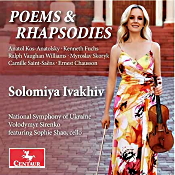
On the morning that I discovered that the long-feared invasion of Ukraine by Russian forces had finally begun, I was so upset by the news that my immediate reaction was to find something to do to take my mind off the conflict. After a few brief moments of indecision, it suddenly hit me that the best thing to do would be to switch into reviewing mode: pop a CD into the player, settle down in the listening chair, do some serious listening, take some notes, and forget about the war in Ukraine, at least for a while. So, of course, the first CD I found waiting for me to audition was this one: Ukrainian musicians recording in Kyiv. Now I was pretty much just an emotional wreck, not fit for much of anything except a shower and then some calming conversation with my wife. Only then could I get back to life, the universe, and everything, including that ominous pile of what seem to be at least 42 CDs awaiting review, starting with this one.

The program is a mix of the familiar (The Lark Ascending, Poème symphonique), the relatively unfamiliar (American Rhapsody, La muse et le poète), and the truly unfamiliar (Poem for Violin and Orchestra,  Carpathian Rhapsody). A common thread among them is that they are all lyrically beautiful; moreover, they are presented with both skill and feeling by the assembled performers. At first I had some reservations about seeing The Lark Ascending in the list of titles (come on, Centaur, did we REALLY need yet another recording of RVW’s lovely piece to add to the umpteendiddlymillion already on the market), but this is a perfectly fine version that fits right in with the rest of the program and in the end I was grateful that it was included. (And, yes, Centaur, I guess we did, so thanks!). From beginning to end, this is just a splendid disc, starting with the interplay among violin, cello, and orchestra in the Saint-Saëns, which is just a lovely composition by that French master who seem to be so sadly underrated these days (and  I must confess that listening to Ivakhiv and Shao wend their way through La muse et le poète have brought me to the brink of repentance of that very sin –I shall be embarking on a Saint-Saëns spree post haste) all the way through the newly unearthed Carpathian Rhapsody by Myroslav Skoryk, a composer whose name is doubtless unfamiliar top all but a very few.

I also had wondered why the University of Connecticut had been involved in the recording; as it turns out, the featured violinist, Ukrainian-born Solomiya Ivakhiv, along with cellist Sophie Chao and composer Kenneth Fuchs, are all UConn faculty members. Along with Volodomyr Sirenko, National Symphony Orchestra of Ukraine, they recorded this program back in July, 2019, in Kyiv, but because of the COVID-19 pandemic, the recording was not released until late in 2021. The engineering is excellent, the liner notes give some background on both the music and the performers, and this is an excellent release all the way around. In addition, it is most generously filled, timing out at more than 78 minutes. I hope and pray for the safety of the members of the Ukrainian musicians and their families during this horrific ordeal,

Francesco Tristano: On Early Music
Tristano: Toccata; On Bull Galliard in D; Peter Philips:  Fantasia in D Minor; Tristano: Serpentina; John Bull: Let ons met herten reijne; Tristano: On Girolamo Frescobaldi's Quattro correnti; Girolamo Frescobaldi: Partita sopra l’Aria la folia; Tristano; Ritornello; On Cristobal de Morales Circumdederunt Me; Orlando Gibbons: Pavan; Air & Alman; Italian Ground; Ground; Tristano: Ciacona seconda; Frescobaldi:  Cento partite sopra passacaglie; Tristano: Aria for RS. Francesco Tristano, piano. Sony Classical 19439917392.

As I do with most recordings that I review, I start by listening. Yes, I look at the CD package front and back to see what I can glean about the musical program and the performer(s), but other than to extract the CD so I can pop it into one of my CD players, I try to avoid reading any of the information contained within. In this case, however, being completely unfamiliar with pianist Francesco Tristano,  and given that the scandalously skimpy liner insert (one sheet: the cover photo with brief notes on the reverse. Th-th-that’s all, folks), I had to turn to Wikipedia for more information to find that Francesco Tristano is the stage name of Luxembourg-born Franscesco Tristano Schlimé (b. 1981), who composes both classical and electronic music and also plays the clarinet. He is a Julilliard graduate who has gone on to study keyboard with Emile Naoumoff, Rosalyn Tureck, and Mikhail Pletnev. Well, that confirmed several things I had suspected from listening to the CD several times. First, that Tristano had some serious chops, along with a serious regard for and interest in early music. Also, that he must have some experience in the electronic manipulation of sound, of what could be done in a studio.

The musical program consists of Tristano originals written in the style of early music masters, Tristano’s “takes” on pieces by some of these masters, along with some more straightforward interpretations of their music. Although there is some variation in style and sonority, largely due to studio manipulation of the sonics and some generally subtle although occasionally surprising electronic effects, Tristano’s musical vision is coherent from beginning to end. Highlights include the persuasive dance rhythms Tristano creates in track 6, On Girolamo Frescobaldi's Quattro correnti, the mysterious but energetic atmosphere created by track 8, Ritornello, the stately elegance of Orlando Gibbons’s Italian Ground, and some of the surprising, presumably deeply personal sounds that Tristano has included in his closing track, Aria for RS, which is at times jolting, but only briefly, set against a backdrop of deep tenderness, a moving end to an musical program that was clearly labor of love.

The sonic perspective is very close to the piano. On the opening cut, for example, you can hear every little (and big!) sound of the Yamaha cfx. As the album continues, with its expanding sonic palette of acoustic sounds and electronic colorations, the engineering is up to the task of presenting every sonic hue and cue. I’ve not yet tried it on headphones but imagine it would be quite the experience… In any event, my only quibble with this truly remarkable release is the liner insert, which put me in a John McEnroe “You cannot be serious!” frame of mind. C’mon, Sony, surely you can do better than this! Or was this what Tristano wanted? In any event, the lack of any useful information about the music is a real disappointment.

I was going to hold off and include this review in my next installment of Piano Potpourri, but despite my reservation about the liner notes, this release is so musically appealing that I want to get the word out as quickly as possible. If you enjoy piano music – especially if you are a fan of Early/Baroque keyboard music – then this is a release you really ought to consider giving an audition. It’s a knockout both musically and sonically.

Saint-Georges: Symphonies concertantes
Symphonies conertantes, Op. 9; Symphonies concertantes, Op. 10*; Symphony in G major, Op. 11, No. 1. Yuri Revich, solo violin I; Libor Jezek, Solo violin II; *Pavla Honsová, solo viola; Michael Halász, Czech Chamber Philharmonic Orchestra Pardubice. Naxos 8.574306.

This CD is one of those that I picked up at the library on a whim. Although the music was not from an era that I usually gravitate toward, there were several things about the cover that grabbed my attention. First was the name of this composer, printed on the cover as “Joseph Boulogne, Chevalier de SAINT-GEORGES.” Quite a moniker, that. Then there was the cover portrait of a distinguished-looking Saint-Georges (1745-1799) holding what I at first glance took to be a conductor’s baton but then quickly realized was not a baton but rather a sword. I also noted that the picture of Saint-Georges revealed a man with large shoulders, arms, and hands, a dignified, confident countenance, and most likely some African ancestry. Flipping over the cover I quickly read that he was “a brilliant swordsman, athlete, violin virtuoso and gifted composer, with a claim to being the most talented figure in an age of remarkable individuals. He was an early exponent of the hybrid symphonie concertante – a genre that draws on both the symphony and concerto traditions ”    

Having discussed the composer (but more on him to come), it is time to consider his music as recorded here by these Czech musicians. It is fresh, lively, and vigorous. The two Symphonies Concertantes both feature prominent roles for the solo instruments, violins in Op. 9 and the violins being joined by a viola in Op. 10. Note that “Concertantes” is plural: both Op. 9 and Op. 10 consist of two parts. Op.9 No. 1 in C major has an Allegro and a Rondeau, as does No. 2, which is A major. Op. 10. No. 1 in F major varies the pattern by having two Allegros, but No. 2 in A major returns to the Allegro then Rondeau form. Both works are reminiscent of Mozart, and both sound as though they must have been fun for the musicians both in 18th century Paris as well as 21st century Pardubice. The program concludes with the brief Symphony in G major, which is three movements, each barely over four minutes long. Although it hardly strikes modern ears as weighty or profound, that is not what it was meant to be; it was meant to be entertaining and pleasant, and that it is in abundance.

Having greatly enjoyed the music on this release as well as the biographical information included in the liner notes, I decided to do a bit of quick research, so I turned to Wikipedia, where I found quite a wealth of information. Should anyone be interested, the entry on Chevalier de Saint-Georges is quite fascinating, but for  the sake of brevity, I will quote just a few sentences form Wikipedia’s account: Saint Georges “was a Guadeloupean Creole classical composer, virtuoso violinist, a conductor of the leading symphony orchestra in Paris, and a renowned champion fencer. Born in the then French colony of Guadeloupe, he was the son of Georges de Bologne Saint-Georges, a wealthy married planter, and Anne, dite (called) Nanon, an African slave woman of his wife. When he was young, his father took him to France, where he was educated. During the French Revolution, the younger Saint-Georges served as a colonel of the Légion St.-Georges, the first all-black regiment in Europe, fighting on the side of the Republic. Today the Chevalier de Saint-Georges is best remembered as the first known classical composer of African ancestry. He composed numerous string quartets and other instrumental pieces, Violin concertos as well as operas. He knew many composers including Salieri, Gossec, Gretry, Gluck and Mozart.” A remarkable man, about whom I must confess I was completely ignorant until that chance encounter with this Naxos CD in my public library. I now recommend that CD with enthusiasm to those who would like to learn more about the remarkable man and his enjoyable music.

KWN

February 20, 2022

Saint-Saens: Symphony No. 3 “Organ” (CD review)

Also, Piano Concerto No. 4. Daniel Roth, organ; Jean-Francois Heisser, piano. Francois-Xavier Roth, Les Siecles. Harmonia Mundi 905348.

By John J. Puccio

Les Siecles (“The Centuries”) is a period-instrument orchestra founded by Francois-Xavier Roth in 2003. On the current disc, organist Daniel Roth plays an instrument built 1862. Pianist Jean-Francois Heisser plays a piano built in 1874. They perform the “Organ Symphony” of Camille Saint-Saens from 1886 and the Fourth Piano Concerto from 1875. The results are probably as close as we can get to something Saint-Saens’s audiences of the day might have heard.

A question arises, however, about why Harmonia Mundi held off for a decade or more in releasing these live recordings. They answer that question in the liner notes, saying “As partner of Les Siecles since 2017, Harmonia Mundi felt it was a must to reissue these fiery readings of two masterpieces in the great French Romantic tradition, for which Francois-Xavier Roth invited two eminent soloists.” So, basically, during the pandemic HM went into the Les Siecles archives and found two older live recordings they felt they should rerelease on their own label. The performances are certainly worthwhile, although I’m not convinced the live sound is up to Harmonia Mundi’s usual studio standards.

The first selection on the album is the Symphony No. 3 in C minor, “Organ,” Op. 78. Saint-Saëns called the work “a symphony with organ” and said "I gave everything to it I was able to give. What I have here accomplished, I will never achieve again." Apparently he knew what he was talking about because even though he lived for another thirty-five years, he never wrote another symphony, organ or otherwise.

Saint-Saens divided the work into two major parts, with two divisions in each part. It’s an odd arrangement, but it essentially works out to a conventional four-movement symphony. What’s more, although most people today know the work as the “Organ Symphony,” Saint-Saens himself labeled it Symphonie No. 3 "avec orgue" (with organ). In fact, the organ only plays a part in two of the four movements, the second and the last. But it makes enough of an impression for folks to remember it.

After an introductory first movement, the second-movement Adagio always reminds me of soft, warm waves flowing over and around one’s body on a tropical beach somewhere. Here’s where the organ makes its first entry, coming in with what should be huge, gentle, undulating washes of sound. Maestro Roth and his forces handle both movements pretty well, generating some interest in the otherwise rather bland Allegro and providing a gentle, poignant, comforting Adagio.

The two sections that comprise the finale can be fiery and exhilarating, if not a little bombastic, with the organ blazing the trail. Here, again, Maestro Roth, with his father, organist Daniel Roth, and Les Siecles do a fine job capturing the excitement of the score with a good forward thrust, a driving beat, and a wonderfully pulsating rhythm. When the organ enters in the final movement, it is as grand and imposing as we would expect it to be; it is also passionate and vibrant, pretty much dominating the orchestra, as it should. Overall, a good performance.

The second item on the agenda is the Concerto for Piano No. 4 in C minor, Op. 44. Although it is not the most popular of Saint-Saens’s five piano concertos (that honor probably goes to No. 2), it is surely one of his most-original, most-imaginative works. Featuring pianist Jean-Francois Heisser, one must first become accustomed to the deeper yet less-mellifluent sound of the period piano. Together with the stormy, close-up recording, the music makes a grand sweep across the stage. One clearly hears the elements of traditional Classicism as well as (for Saint-Saens, anyway) contemporary Romanticism in Heisser’s playing. It’s a lovely performance.

Artistic Director Jiri Heger and sound engineer Anne-Sophie Versneyen recorded the music live at the eglise Saint-Sulpice, Paris (symphony) in May 2010 and at the Opera-Comique, Paris in June 2009. The sound is typically “live”; that is, it’s precise, close-up, enormously dynamic, and a trifle edgy. Imaging seems kind of all over the place, with little dimensionality and a limited stereo spread. (For being so close, it’s not very wide.) The organ, though loud enough, doesn’t seem deep enough; and the piano appears much too close (the recording a little louder, too). On the plus side, we hear no extraneous noises from the audience, and the engineers mercifully edited out any applause. As these older recordings do not quite meet Harmonia Mundi’s usual studio standards, perhaps the company will consider re-recording the pieces themselves (with much the same performers but without the live audience).

JJP

To listen to a brief excerpt from this album, click below:

September 5, 2021

Saint-Saens: Symphonies Nos. 1 & 2 (SACD review)

Also, Symphony in A major. Jean-Jacques Kantorow, Orchestre Philharmonique Royal de Liege. BIS BIS-2460 SACD.

By John J. Puccio

The Third Symphony
, the “Organ” Symphony of French composer Camille Saint-Saens (1835-1921) so overshadowed most of his other work that one would hardly know he even wrote three previous symphonies. Of course, his other music like the Second Piano Concerto, the Introduction and Rondo Capriccioso, the Danse macabre, the Samson and Delilah opera, and The Carnival of the Animals also became famous. But they didn’t quite take on the life his “Organ” Symphony did. So, here we have his first three symphonies, which I admit I could hardly remember, it had been so long since I last heard them. Accordingly, I took down my old recordings by Jean Martinon (EMI and Brilliant Classics) of the works to refresh my memory, and I can honestly say that these new readings by French violinist and conductor Jean-Jacques Kantorow and the Royal Liege Philharmonic Orchestra do the music proud.

So, Saint-Saens wrote his Symphony No. 1 in E flat major, Op. 2 in 1853 at the ripe old age of eighteen. He had been a child prodigy at the piano and wrote his First Symphony at about the time he graduated from the Paris Conservatoire. It’s filled with youthful ambition and military gestures (particularly in the Finale), all the popular musical idioms of the time. While Maestro Kantorow takes the music a little faster than Martinon did, it’s not excessively quick. It does, however, provide an extra bounce to the score, especially noticeable in the second-movement Scherzo. Even the lovely little Adagio benefits from Kantorow’s hand. Not that it displaces the Martinon recording, but it certainly more than holds its own.

It would be another half dozen years before Saint-Saens would write his Symphony No. 2 in A minor, Op. 55 (in 1859, although he would not publish it until 1878). It’s a cyclical work, linking several themes in different movements by using several common elements. The piece is compact and orchestrated lightly, sounding much like a sinfonietta. However, because of the criticism he received for these early symphonies, Saint-Saens would not return to the composition of a symphony for close to thirty years and then created his masterpiece. Anyway, in No. 2 we get an appropriately reserved performance from Kantorow, with the final two movements enlivened by a properly upbeat spirit. Nevertheless, despite the conductor’s best efforts, these are not masterpieces of the Romantic Age but merely Saint-Saens’s youthful imitations of it, so we cannot expect silk purses. They are, however, fun to listen to, if sparingly, and under Kantorow’s direction (or Martinon’s) represent as good interpretations as you’ll likely to find.

Accompanying the Symphonies Nos. 1 and 2 (and opening the program) is an even earlier work, the Symphony in A major, which Saint-Saens wrote in 1850, while fifteen years old and still in school. Musical scholars believe it was probably a classroom exercise. Still, it has a noteworthy Romantic spirit to it, borrowing as it does from Beethoven, Mendelssohn, Schumann, even Mozart. Saint-Saens didn’t see much merit to it, though, and, consequently, it probably never got a public performance in the composer’s lifetime, or at least not one we know of. It was only finally published in 1974. Again Kantorow gives us a smooth, polished reading that, if anything, reveals how lightweight the material is. I couldn’t help being reminded that I’ve always found the music “cute.” That is, it’s almost comical in its imitation of other composers. It is, in fact, cotton candy for the ear (a sticky metaphor at best), which, regardless, makes for pleasant, noncritical listening.

Producer Jens Braun and engineer Ingo Petry of Take5 Music Production recorded the symphonies for hybrid SACD at the Salle Philharmonique, Liege, Belgium in April and December 2019. You can play the disc in SACD two-channel stereo and multichannel surround sound from an SACD player or in two-channel stereo from a regular CD player. I listened to the SACD two-channel stereo layer.

As with many other BIS productions, this one is warm and smooth, with a natural feel to the hall and its environs. The miking appears a tad farther away from the players than one usually finds, but it adds to the recording’s sense of realism. One is simply a bit farther back in the concert hall and not in the first row. Accordingly, the orchestral spread is also a touch narrower than we normally hear. More important, it’s realistic and doesn’t take much away from the clarity of the reproduction. It’s a welcome change of pace from most of today’s close-up recordings.

JJP

To listen to a brief excerpt from this album, click below:

February 3, 2021

Saint-Saens: Piano Quintet in A minor, Op. 10 (CD review)

Also, String Quartet 1 in E minor, Op 112. Andrea
Lucchesini; Quartetto di Cremona. Audite LC04480.

By Bill Heck

John Puccio recently reviewed a release (Italian
Postcards
) from the Quartetto di Cremona, and in that review he provided
some background information on the ensemble. I won’t repeat it all here: feel
free to read that review if you want more details
(https://classicalcandor.blogspot.com/2020/12/italian-postcards-cd-review.html).
What I will say is that the performance reviewed here does nothing to detract
from their stellar reputation--read on for those details.

Piano Quintet
The Piano Quintet in A minor, Op. 10 is an early,
though not immature, work. It opens with a dramatic series of chords on the
piano in a minor key that keeps trying to switch to major; that pattern repeats
multiple times with variations as the strings join in. Things soon settle into
a sunnier mood with quiet back-and-forth among the instruments. The figures
used in development are relatively simple, but the interplay is enjoyable.

The second movement builds on a slow, quiet theme, which
receives some lovely playing from all involved. The short third movement
features long, dramatic runs up and down the scale, mostly on the piano, with
the strings taking turns adding emphasis.
 
The fourth movement starts with a canon in the strings;
the strings soon abandon that melody, but the piano picks it up briefly before
launching a new theme, which is in turn echoed by the strings. The initial
canon returns in the strings, only to be recycled multiple times. The first and
second themes appear alternately with variations until the pace quickens,
taking us to the end of the movement and the work.

The playing here is nuanced and superbly executed. Of
particular note is the energy that the Quartetto brings to the work: in their
hands, the music is dramatic, although not overly so. They clearly find the
work worth the effort of playing well.

Although the quintet is a relatively youthful work, it
really is quite enjoyable. Thus, I was surprised to find only a few other
recordings. (To avoid confusion, I should note that there are two later Piano
Quartets and two Piano Trios, all of which seem to have been more frequently
recorded than the Quintet.) Thus, this well-played version is a welcome
addition to the catalog.

String Quartet No. 1
While the String Quartet 1 in E minor, Op. 112 was
Saint-Saens' first in that genre, it can hardly be called an early work, as the
composer was 64 years old at the time of its composition. Compared to the piano
quintet, the quartet is noticeably more mature and complex, but still quite
accessible.

The music starts out with a single note held on the violin
and harmonized by the viola, twice repeated, as if a plaintive cry. The work
then breaks into a minor key melody in a loping rhythm, again halting for a
sustained, repeated note. The instruments answer each other with ascending and
descending scales, and swap melodies, sliding back and forth between major and
minor keys as if trying to bring light to a gloomy picture. After further
development, the scales return, eventually bringing the listener to an
emotionally ambiguous conclusion.

The second movement begins with a simple, quick four-note
figure repeated over and over as it is handed back and forth between the
instruments. The players really dig in, and the result is almost frantic, an
effect that one presumes was just what Saint-Saens was going for. The music
calms down a bit as the movement continues, only to return with quick nervous
energy to those four-note figures. Again, the music demands energy, and the
Quartetto supplies it, keeping the sense of drama going until Saint-Saens has
them play a few final notes more slowly and quietly, as if exhausted by their
labors.

The third movement could hardly be more different,
beginning slowly with a beautiful, winding melody carried by the violin. The
intertwining voices of the instruments reminds me of nothing so much as the
intertwining voices that one might hear in an operatic duet by, say, Puccini.
The playing in this movement is the only one that gives me slight pause:
perhaps that Quartetto is a little too dynamic, giving the lovely
chant-like sound almost a pulsing quality. That’s a quibble, though, that
occurred to me only on repeated hearing when I was looking for issues.
Listeners who are just relaxing rather than reviewing should be quite
satisfied.

Entering the finale, the music takes a breath and then
launches into another rhythmically complex and passionate, even agitated,
development that returns several phrases from the first movement. Saint-Saens
again whips up the pace toward the finish line, with the music ending as it
began in a minor key. Again, the Quartetto is fully up to the task, the music
crackling with energy to the end.

All in all, I found this work quite enjoyable and
rewarding, thoroughly romantic and spirited, but with enough musical interest
to hold attention.

There are plenty of performances of this work out there,
so let me pick just a couple for comparison. The Quatuor Girard plays nicely,
although slightly less energetically and dynamically than the Cremona crew. To
my ears, though, they are sabotaged by an over-reverberant recording that
obscures some of the passage work, and sound that tends to collapse onto the
speakers in the more dynamic passages. The Fine Arts Quartet plays well and
offers both the first and second quartets on a Naxos disk for those who crave
completeness. Their account of the first is not so highly strung as that that
of the Cremona players; for example, the Quartetto plays the second movement
much faster than the Fine Arts group, at the same time really digging in to
their instruments, so much so that returning from the Naxos disk to this one
gives the impression of a completely different work. To my ears, the Quartetto
di Cremona makes the music more exciting – even the word “spooky” comes to mind
at points in the second movement – and more interesting.

I suspect that some listeners will find this performance a
little too much, a little too dramatic. For my money, though, the intensity
brought by the Quartetto di Cremona is just what’s needed for the music here.

Conclusion
Both performances in this release are enhanced by the
recorded sound, which is quite clear and places the instruments in believable
space, with no trace of harshness. Some room reverberation is retained, but
with the music emerging from an absolutely silent background. If pressed for
some negative, I might quibble that the sound of the cello displays the
slightest trace of thinness, but a mere quibble and hardly can detract
from the overall quality of the recording.

BH

To listen to a brief excerpt from this album, click below:

January 31, 2021

Saint-Saens: Symphony No 3 “Organ Symphony” (SACD review)

Also, Poulenc: Concerto for Organ, Strings and Timpani;
Wider: Symphony for Organ No. 5. Christopher Jacobson, organ; Kazuki Yamada,
Orchestre de la Suisse Romande. Pentatone PTC 5186 638.

By John J. Puccio

If you went to the catalogue of classical recordings, I’m
sure you’d find that the “Organ” Symphony of Saint-Saens ranks right up there
in popularity with the symphonies of Beethoven, Brahms, and Tchaikovsky. It’s
that well liked. So it’s inevitable that we get new recordings of it every
year. This new one under review is an international affair: the music is, of
course, French. The conductor, Kazuki Yamada, is Japanese. The organist,
Christopher Jacobson, is American. And the ensemble, the Orchestre de la Suisse
Romande, is the Swiss orchestra co-founded by Ernest Ansermet in 1918. Whether
this array of global talent does any better a job of interpreting the music
must be left to the individual listener, naturally, but I can tell you after
having sat through most of the recordings currently available, the new one does
a pretty good job with it.

The French composer, organist, pianist, and conductor
Camille Saint-Saens (1835-1921) wrote his Symphony No. 3 in C-minor,
“Organ,” Op. 78, in 1886. It is probably the most-popular thing he ever wrote
and, as I say, remains one of the most popular pieces of classical music of any
kind.

Saint-Saëns called the work “a symphony with organ,” and
he remarked, "I gave everything to it I was able to give. What I have here
accomplished, I will never achieve again." Apparently he knew what he was
talking about because even though he lived on for thirty-five more years, he
never wrote another symphony, organ or otherwise.

The composer divided the work into two major parts, with
two divisions in each part. It’s an odd arrangement, but it essentially works
out to a conventional four-movement symphony. What’s more, although most people
today know the work as the “Organ Symphony,” Saint-Saens himself labeled it Symphonie
No. 3 "avec orgue"
(with organ). In fact, the organ only plays a
part in two of the four movements, the second and the last. But it makes enough
of an impression for folks to remember it.

The first movement has always seemed to me the least distinguished,
the least characterful, but Maestro Yamada and the orchestra do the best they
can. They establish a sweet, leisurely tempo in this section, which, if
anything, leads effectively into the second, slow movement.

The second movement Adagio always reminds me of
soft, warm waves flowing over and around one’s body on a tropical beach
somewhere. Here’s where the organ (Christopher jacobson, organist) makes its
first entry, coming in with what should be huge, gentle, undulating washes of
sound. Unfortunately, I didn’t really hear or feel those waves from the organ,
which stays remarkably aloof from the proceedings. While it’s not unpleasant,
it’s not what I expected, either. Actually, Saint-Saens labels this movement Poco
Adagio
, or a little bit slow. In other words, not quite as slow as a
traditional Adagio. Yet Yamada and his team take it at a pace that seems
almost drowsy compared to many other recordings.

The two movements that comprise the finale can be fiery
and exhilarating, if not a little bombastic, with the organ blazing the trail.
Here, Yamada maintains the unhurried atmosphere he set in the beginning, giving
us a relaxed, almost tranquil close. Again, not what I expected and not at all
unpleasant, but different. Some listeners will no doubt find the reading
lyrically rewarding. However, I found it a far cry from the more electrifying
performances by Louis Fremaux and the City of Birmingham Symphony Orchestra
(Warner Classics/EMI), Charles Munch and the Boston Symphony (RCA/JVC), or the
steady yet still heady version by Jean Martinon and the National Orchestra of
France (EMI or Brilliant Classics), all of which remain my first-choice
recommendations.

Coupled with the Symphony are two more organ works
by French composers: Francis Poulenc’s Concerto for Organ, Strings, and
Timpani
; and Charles-Maria Widor’s Toccata from his Symphony for
Organ No. 5
. The Poulenc work seems especially well suited to the
understated style of Yamada and Jacobson, and it comes off with an
appropriately energetic, yet spiritual and inspirational tone. Well done. As an
encore, Jacobson gives the Widor Toccata a good, healthy flourish.

Producer Job Maarse and engineers Erdo Groot and
Jean-Marie Geijsen recorded the music at Victory Hall, Geneva, Switzerland in
August 2017. They made the recording for hybrid multichannel SACD, two-channel
SACD, and two-channel CD playback. I listened in two-channel SACD.

The hall nicely complements the sound of the orchestra,
giving it a degree of depth and resonance that some venues lack. The sonics are
smooth and natural, not particularly transparent or “audiophile” but lifelike
in their presentation. The SACD recording ensures that dynamics are there when
needed, both in range and impact, although here, too, it isn’t quite in the
audiophile class of clarity but more subtle. The organ makes a different
impression on the ears in each of the three works on the disc. It’s restrained
and a tad recessed in the Saint-Saens, more aggressive in the Poulenc, and
finally comes into its own in the solo Widor piece. Of more important note, the
organ is always well balanced with the orchestra, and that’s good to hear.

JJP

To listen to a brief excerpt from this album, click below:

April 5, 2020

Incantation (CD review)

Music of Bruch, Vitali, Saint-Saens, Tchaikovsky, Bloch, Chausson, and Umebayashi. Virgil Boutellis-Taft, violin; Jac Van Steen, Royal Philharmonic Orchestra. Aparte Music AP234.


Nobody tells me anything.


I learn about thousands of classical CD titles and listen to hundreds of classical recordings every year, but I still don't know who all the rising young classical artists are in the world. Take, for example, French violinist Virgil Boutellis-Taft. His biography reads, "Hailed by critics as an 'outstanding violinist,' 'of fiery temperament,' with 'intense, brilliant, sumptuous sound' and 'impressive virtuosity,' Virgil Boutellis-Taft performs as soloist and chamber musician in major international concert halls." From Wikipedia we learn that he "began studying violin and piano at the age of 6...and gave his first concerts at the age of 9."


Incantation is Boutellis-Taft's second record album, taking its title from the word meaning "the chanting or uttering of words purporting to have magical power; the formula employed; a spell or charm," according to Dictionary.com. The accompanying booklet notes that "'Incantation,' from the Latin word incantare, ranges in meaning from ordinary singing that is 'enchanting' to music in a religious context with a ritual function, as in Gregorian plainchant, then to the unsettling use of magic or demonic spells or charms." Apparently, Mr. Boutellis-Taft in this album is going for the "spiritual, magical, mesmerizing aspects of incantation."


I would have preferred he had just said, "Here are a few of my favorite short violin pieces that let me display my fiery temperament, brilliant sound, and impressive virtuosity." Whatever, the following is a list of what's on the album:


1. "Kol Nidrei" by Max Bruch

2. "Chaccone in G minor" by Tomaso Antonio Vitali

3. "Danse macabre" by Camile Saint-Saens

4. "Serenade melancolique" by Peter Tchaikovsky

5. "Nigun" by Ernest Bloch

6. "Poeme for violin and orchestra" by Ernest Chausson

7. "Yumeji's Theme" by Shigeru Umebayashi


Virgil Boutellis-Taft

The opening number, Kol Nidrei ("All Vows"), which German composer Max Bruch (1838-1920) wrote in 1880 is a good example of "incantation." It's a series of variations on mostly Jewish liturgical themes. It has a beautifully lyrical character, and Boutellis-Taft invests it with much personality. The piece is a plaintive expression of religious themes, originally intended for cello but here transcribed for violin. In addition, Boutellis-Taft has elected to omit the middle section, which gets a bit flowery Romantic, and instead repeats the central theme in keeping with the Jewish service it represents. The soloist creates a refreshing new look at an old favorite.


And so it goes, with Boutellis-Taft endowing each work with much expressive distinction and beauty. The Chaconne in G minor, ascribed to Italian composer and violist Tomaso Vitali (1663-1745), continues in that vein, making an almost seamless segue from the Bruch piece. Boutellis-Taft's playing is fluid, effortless, and eloquent, and the Royal Philharmonic's accompaniment sounds as rich as ever.


The Danse macabre (1874) by French composer Camille Saint-Saens (1835-1921) may seem like a giant leap from the preceding two more contemplative pieces, but, in fact, Boutellis-Taft makes the leap with consummate ease, taking the work a little less demonically than some interpreters do and filling it with much poetic beauty. I would note here, too, that Boutellis-Taft uses a new violin-and-orchestra rendering of the piece, not Saint-Saens's original orchestral version.


My own favorite among the seven selections was the Poeme pour violin et orchestre by French composer Ernest Chausson (1855-1899). Boutellis-Taft brings out all the exotic color of the work without resorting to any hint of over sentimentalizing or romanticizing. It's quite lovely.


Incantation lives up to its name, manifesting much magic, mystery, beauty, enchantment, and angelic intensity thanks to Boutellis-Taft's heartfelt execution. He is a performer to be reckoned with, and I expect we will be hearing more good things from him from here on out.


Producers Hugo Scremin and Nicolas Bartholomee and engineer Francois Eckert recorded the music at Henry Wood Hall, London in July 2019. The sound is very clean, if a bit one-dimensional. Definition is precise, and the violin appears well integrated with the orchestra, not too far in front yet not overpowered by the orchestral forces. The frequency response is nicely balanced as well, although the highest treble and deepest bass seem a tad lacking. Nevertheless, most listeners should find it more than satisfactory. Ditto for the dynamic range and impact. Very cleanly executed.


JJP


To listen to a brief excerpt from this album, click below:

March 22, 2020

Escales: French Orchestral Works (SACD review)

Music of Chabrier, Durufle, Saint-Saens, Debussy, Ibert, Massenet, and Ravel. John Wilson, Sinfonia of London. Chandos CHSA 5252.


The last few times I reviewed albums from conductor John Wilson, he was conducting the BBC Philharmonic in music of Aaron Copland; and the Royal Liverpool Philharmonic in the music of John Ireland; and his own John Wilson Orchestra in the music of Cole Porter and Rodgers and Hammerstein. Now he's back, this time at the helm of the reconstituted Sinfonia of London, an on-and-off-and-on-again session ensemble originally formed in 1955. Whatever, Escales is an ebullient romp from Maestro Wilson and his players through several well-known (and some less well-known) French light pieces.


The program begins with the ever-popular Espana by Emmanuel Chabrier (1841-1894), the composer's French take on all things Spanish. Wilson gives us a sparkling presentation of Chabrier's colorful music, yet with few surprises. It's a well-crafted performance without offering much we haven't heard before.


The next two items are not quite as famous: Trois Danses by Maurice Durufle (1902-1986) and Le Rouet d'Omphale by Camille Saint-Saens (1835-1921). The Durufle piece comes through quite well, perhaps helped by the fact that there aren't too many previous recordings with which to compare it. Wilson handles the dynamic contrasts and tonal shadings smoothly, the second, slow dance standing out. "The Spinning Wheel of Omphale" is a piece Saint-Saens based on a Greek legend, and Wilson does a good job helping it come alive for us in highly descriptive fashion.


Following them is the perennial hit Prelude a L'apres-midi d'un faune by Claude Debussy (1862-1918). "The Prelude to an Afternoon of the Fawn" is probably as renowned as the composer's La Mer. It is the most atmospheric work on the disc, and the listener probably already has multiple versions of it. Still, its sinuous moods can be captivating, even if Wilson's interpretation brings little that's new to the table.


John Wilson

Then there's the album's title music, Escales ("Ports of Call"), by Jacques Ibert (1890-1962). Each of its three sections evokes the sounds and flavor of a different location: Sicily, Tunisia, and Valencia. These were my favorite pieces, with Wilson recreating the sensations of the three locales vividly


The program wraps up with two prominent numbers, the "Meditation" from Thais by Jules Massenet (1842-1912) and Rapsodie espagnole by Maurice Ravel (1875-1937). The beauty of the "Meditation" never grows old, and while Wilson's rendering may not be as delicately wrought as some others, it effectively communicates the composer's expression of serenity and sensuality. The Ravel piece seems appropriate as it bookends the agenda with another French composer's idea of Spain. Wilson gives it fair due.


In sum, although John Wilson's take on this celebrated music breaks no new ground, everything is enthusiastically presented and meticulously performed. There is also enough variety in the selections to please most listeners and perhaps even to uncover a hidden gem or two the listener had not heard before. Fair enough.


Producer Brian Pidgeon and engineer Ralph Couzens recorded the music at the Church of St. Augustine, Kilburn, London in January and September, 2019. They recorded it for playback via hybrid SACD 2-channel and multichannel or regular CD 2-channel. As usual, I listened in SACD 2-channel via a Sony SACD player.


A mild hall resonance tells us where we are, and it's not unpleasant. Dynamics are good, with adequate impact for the big numbers like the Chabrier. Orchestral depth, too, is sufficient, though not entirely audiophile. While ultimate transparency is merely OK, the sound does project a reasonably lifelike presence. In other words, it's good, modern digital sound with a fairly well balanced frequency response, the kind of sound we're used to getting from Chandos.


JJP


To listen to a brief excerpt from this album, click below:

October 6, 2019

Pianissimo! (CD review)

The Chicago Debut Concert. Pianists Svetlana Belsky, Elena Doubovitskaya, Irina Feoktistova, and Susan Merdinger. Sheridan Music Studio.


Yes, Pianissimo in music refers to a passage or movement played softly or very softly. But Pianissimo! also refers to an ensemble of four very talented pianists. As described in the disc's accompanying booklet, "Pianissimo! was first formed in December 2014, and recently appeared in several venues for "Make Music Chicago." As soloists and duo pianists, the four women have appeared in major concert halls and on TV and radio around the world, recorded a number of CD's, "and won numerous awards and honors, as well as accolades and rave reviews from major publications for their outstanding performances and programming."


The four members of Pianissimo! consist of Dr. Svetlana Beisky, critically acclaimed as "a passionate pianist and scholar," performing extensively in Europe, Asia, and the U.S. Next is Dr. Elena Doubovitskaya, "a native of Russia who established herself as a solo and collaborative musician after moving to the US in 1998." In addition, there is Irina Feoktistova, "a graduate of the Petersburg Conservatoire, Russia," who has performed in the major halls of Russia, Europe, and the United States. And Susan Merdinger, a Steinway Artist who has been hailed as "tender and impassioned" (Glasgow Herald) and "breathtaking" (Frankfurter Allgemeine Zeitung).


On the current album they present their Chicago debut concert, which includes selections for piano two hands, piano four hands, two pianos four hands, two pianos eight hands, and four pianos, three of the pieces being world-premiere performances. The track list follows:


  1. Beethoven: Egmont Overture (arr. T. Herbert)

  2. Rimsky-Korsakov: Fantasy on Scheherazade (arr. M. Zelenaia; world premiere)

  3. Saint-Saens: Danse Macabre

  4. Tchaikovsky: Capriccio Italienne (arr. A. Ton/S. Belsky)

  5. Gershwin: Fantasy on "The Man I Love" (arr. A. Tsafsman)

  6. Lutoslawski: Variations on a Theme by Paganini

  7. James Stone: Rip Current

  8. Ilya Levinson: Fireball (world premiere)

  9. Ilya Levinson: Broadway Medley for Classical Pianists (world premiere)


Pianissimo

The opening overture from Beethoven shows off what can happen with eight hands at two pianos, and it's a rich and rewarding experience. The performers are brilliant in their own right, each a virtuoso, but together they are unmatched, and the playing produces an enriching few minutes.


The next item, the Rimsky-Korsakov fantasy, displays the talents of all four players on four pianos, making the number that much plusher and more opulent in sound and content, and making for a touching and exciting interpretation. And so it goes through the familiar repertoire of names like Beethoven, Saint-Saens, Tchaikovsky, Gershwin, and Rachmaninov in fantasies, variations, and single numbers. (The Danse Macabre for two pianos, eight hands, is particularly thrilling.)


Then there are the two newer selections from the Russian-born composer Ilya Levinson, selections that receive world-premiere performances. They have a more modern sensibility, of course, yet they take us back to an earlier period of twentieth-century American music, too, especially the Broadway medley arranged for four pianos. It pairs up favorite Broadway show tunes with seamless transitions to produce a rollicking good time. The four skilled pianists will make one forget all about Broadway pit orchestras in their lush and luxurious readings.


I should add, as well, that the disc offers a healthy seventy-six minutes of playing time, making the concert not only entertaining but also good value for the dollar.


Engineer Edward Ingold recorded the concert live at the Merit School of Music, Anne and Howard Gottlieb Hall in September 2015. Would I rather have heard Pianissimo recorded in a studio than live? Of course, it would no doubt have sounded even better without the constraints of a live audience present. Nevertheless, we have what we have, and I'm sure Pianissimo fans will enjoy the experience of the live moment. Besides, the wide dynamics of the presentations help to make up for any minor live deficiencies. For example, while there could be more presence, more high-end sheen, more brilliance, and more hall ambience on offer, the intensity of the music making always shines through and lights up the room.


Still, I really could have done without the applause at the end of each selection.


JJP


To listen to a brief excerpt from this album, click below:

June 16, 2019

French Cello Concertos (CD review)

Saint-Saens, Lalo, Milhaud, Offenbach, Massenet. Hee-Young Lim, cello; Scott Yoo, London Symphony Orchestra. Sony Classical S80425C.


Her current recording, "French Cello Concertos," is the debut album for Korean cellist Hee-Young Lim, who has made quite a name for herself in the past few years. Not only has she won major international competitions, she is Principal Solo Cellist of the Rotterdam Philharmonic Orchestra and the first Korean cello professor at the Central Conservatory of Music in Beijing. She tours as a soloist and recitalist and performs with the world's leading orchestras. It's no wonder, then, that so big and prestigious a record label as Sony Classical wanted to promote her first release.


Supported by conductor Scott Yoo and the London Symphony Orchestra, Ms. Lim performs five well-known cello pieces by French composers: Saint-Saens, Lalo, Milhaud, Offenbach, and Massenet. Not that there is exactly a surplus of cello concertos to play, though. The poor cello, a descendent of the bass violin, didn't find a serious place for itself until well into the Baroque period, and even then it held a limited position. Bach wrote his six cello suites, of course; later Haydn wrote a couple of cello concertos and Beethoven a few cello sonatas. Yet it wasn't until the later Romantic period that the cello began to flourish, with Schumann, Dvorak, and Brahms writing concertos for it. Then, the twentieth century saw a greater blossoming of material for the instrument. Anyway, the major attraction here, Saint-Saens's cello concerto, came somewhat late in the Romantic era, 1872, by which time the cello had firmly established itself as a commonly accepted part of the orchestral picture.


So, the first thing up is the Concerto for Violin and Orchestra No. 1 in A by Camille Saint-Saens (1835-1921). Written in one continuous movement split into three separate sections with interrelated ideas, Saint-Saens's concerto was unconventional for its time. Nevertheless, it became a favorite of cellists and composers everywhere, some of them like Rachmaninov and Shostakovich declaring it the greatest of all cello concertos.


Hee-Young Lim

The concerto keeps the solo instrument in the foreground almost the whole time, and Ms. Lim takes advantage of this situation with playing of steadfast command. Yet unlike so many other soloists, she never tries to dominate the music with the force of her personality. The musical lines are always clean and direct, the passion expressed through the score itself, not her own virtuosity. This is not to say she isn't a marvel to listen to; she is an accomplished musician and the concerto's finale is an amazing whirlwind of notes. But she is also a delicate, introspective musician, and much of her talent is in the nuances of her playing. In other words, while there are more bravura performances you can find, there are none more sensitively committed.


Next, and maybe equally famous, is the Concerto for Cello and Orchestra in d minor by Edouard Lalo (1823-92), which he wrote in 1876. He arranged it in a more traditional style than Saint-Saens did his concerto a few years earlier, and perhaps because of its strong hints of Spanish flamenco music, it gets its fair share of performances and recordings. Ms. Lim takes the first two movements at a slightly more leisurely pace than one often hears, and it adds a sweet tone that complements the nature of this Spanish-influenced French music. It's an elegant reading, full of operatic color and character in its first two movements and a whole lot of zest in its final moments.


After that we find the Cello Concerto No. 1 by Darius Milhaud (1892-1974). Written in 1934, its more modern and jazz-inflected disposition is notably different from that of the more Romantic Saint-Saens and Lalo pieces. Milhaud's work relies less on pure melody and more on displays of seemingly indiscriminate mood swings from lyrical tenderness to somber reflection to a nearly cheerful giddiness. The oddness of the music continues despite a lovely opening stretch that Ms. Lim makes the most of before Milhaud starts going in all directions at once. Give Ms. Lim credit for holding the work together so well and having it come through so engagingly.


Following the three concertos, we get two shorter pieces: Les larmes de Jacqueline ("The Tears of Jacqueline") by Jacques Offenbach (1819-80) and the familiar "Meditation" from the opera Thais by Jules Massenet (1842-1912). They are the icing on the cake and bring the program to a satisfying end.


Producer Michael Fine and engineer Jin Choi recorded the music at Abbey Road Studios, London in July 2018. And what a pleasure it is to hear the London Symphony back recording at Abbey Road, the scene of so many of their previous successes. As I said earlier, the cello is in the forefront of the musical activity, which is, I suppose, the way it ought to be. In any case, the sound is precise, well defined, solid, and robust. The cello carries plenty of weight and makes a firm impression on the ear. The orchestra is almost secondary, but it, too, sounds splendid, with clean detailing, strong dynamics, and a realistic sense of presence. In fact, the sound of the LSO reminded me a lot of the sound of their EMI recordings of the late Sixties and Seventies, and that is high praise, indeed.


JJP


To listen to a brief excerpt from this album, click below:


April 7, 2019

Saint-Saens: Symphony No. 3 "Organ" (CD review)

Also, Trois tableaux symphoniques d-apres La foi; Bacchanale from Samson et Dalila. Thierry Fischer, Utah Symphony. Hyperion CDA68201.


This disc looked pretty promising when it arrived for review. The "Organ" Symphony is always a crowd pleaser; in my experience Hyperion produces good-sounding recordings; and I had heard good things about Swiss conductor Thierry Fischer's previous work with Saint-Saens. So it was a little disappointing that I wasn't entirely knocked out by Hyperion's live sound or by Maestro Fischer's somewhat reserved reading of so flamboyant a score.


Let's get to the main subject first, the Symphony No. 3 in C-minor, Op. 78, written in 1886 by French composer, organist, pianist, and conductor Charles-Camille Saint-Saëns (1835-1921). It's no doubt the most-popular thing Saint-Saens ever wrote and to this day remains one of the most popular pieces of classical music of any kind.


Saint-Saëns called the work "a symphony with organ," and remarked, "I gave everything to it I was able to give. What I have here accomplished, I will never achieve again." Apparently he knew what he was talking about because even though he lived another thirty-five years, he never wrote another symphony, organ or otherwise.


The composer divides the work into two major parts, with two divisions in each part. It's an odd arrangement but essentially works out to a conventional four-movement symphony. The first movement has always seemed to me the least distinguished, the least characterful, but Maestro Fischer and the Utah Symphony do their best to make it seem as purposeful as possible. Nevertheless, it still comes off a bit mundane compared to the rest of the work. For his part, Fischer increases the tempo and dynamic contrasts as he goes along and builds a decent head of steam by the end of it.


Thierry Fischer

The second movement Adagio always reminds me of great, warm, soft waves flowing over and around one's body on a sunny, tropical beach. Here's where the organ (Paul Jacobs, organist) makes its first entry, coming in with what are usually huge, gentle, undulating washes of sound. Fischer makes it warm and gentle enough, to be sure, he's a most-sensitive conductor, but I didn't think the organ carried the weight it could have to make much of an impression. Plus, Fischer's relaxed pace may be too slow for a lot of listeners. It's one thing to be sensitive and another to be lax.


The two movements that comprise the finale should be fiery and exhilarating, if not a little bombastic, with the organ blazing the trail. Here, Fischer comes to life, yet without exaggerating the music. Those folks who think Saint-Saens overdid himself in the final passages may appreciate Fischer's calmer demeanor in taming and refining the score. Then, too, the organ finally makes its presence known (what with its going into hiding in the recording's second movement). That being said, I wasn't exactly thrilled or inspired by Fischer's performance as I have been by conductors like Louis Fremaux, Charles Munch, or Jean Martinon. Fischer is a little too overly refined, too sedate, too serious for my taste.


Accompanying the symphony are a couple of other items by Saint-Saens, and they actually precede the main course. They are Trois tableaux symphonique d'apres La foi ("Three symphonic scenes from The Faith") and the Bacchanale from the Samson et Dalila. The first of these, the "Scenes," the composer took from his incidental music to the play The Faith, although one should not take them as literally describing any specific action from the play. Whatever, I enjoyed these "Scenes" best of all on the program because Fischer's natural sensitivity seems perfectly suited to their content, and I also admired the exotic color Fischer effected in the Bacchanale.


Producer and engineer Tim Handley recorded the music live at Abravanel Hall, Salt Lake City, Utah in December 2017. The audience is either unusually silent or the engineer carefully removed all evidence of audience noise, including applause, so the sound doesn't suffer much from people's presence. There is, however, a degree of smooth roundness to the sound that may have something to do with noise reduction; I don't know. Audio levels are on the low side, perhaps to accommodate the wide dynamics. Still, the actual dynamic impact seems a tad muted except in the Bacchanale. Depth perception is good; detailing is fine without being harsh or steely; orchestral hall bloom is moderate at best; and bass, while slightly limited, is at least adequate. The whole thing, though, appears more than a bit soft and veiled, again maybe to reduce the effects of the audience's presence.


JJP


To listen to a brief excerpt from this album, click below:


February 17, 2019

Saint-Saens: Piano Concertos Nos. 2 & 5 (CD review)

Also, etudes, mazurka, Allegro appassionato, and valse. Bertrand Chamayou, piano; Emmanuel Krivine, Orchestre National de France. Erato 0190295634261.


French composer, conductor, organist, and pianist Camille Saint-Saens (1835-1921) wrote five piano concertos. Of the five, the Second and Fifth are probably the most famous, which, by no coincidence, is what we have on the present disc, played by French pianist Bertrand Chamayou, accompanied by French conductor Emmanuel Krivine and the French National Orchestra, and recorded by the French record label Erato. You might say it's all-French affair.


Saint-Saens wrote the Piano Concerto No. 2 in G minor, Op. 22 in 1868, and, as I say, it remains among the most-popular of his piano concertos. Oddly for a modern concerto, Saint-Saens begins the work with a relatively slow movement, followed by a faster second movement that resembles a scherzo, and finishes with a very quick Presto. These mercurial tempo changes prompted the Polish pianist and composer Zygmunt Stojowski to joke that the piece "begins with Bach and ends with Offenbach."


I should tell you here that up until hearing Chamayou my favorite recordings of the concertos have been with Jean-Philippe Collard on EMI/Warner Classics, as well as Stephen Hough on Hyperion. Now I have to reconsider those top choices, at the least adding Chamayou to them. His dazzling, detailed finger work in the opening section of No. 2 is hard to resist from the start. He then goes on to produce more excitement than most other pianists combined in this work, if not quite as much lyrical beauty. In all, I'd give Collard the nod in poetry and Chamayou the edge in warmth and fervor.


Bertrand Chamayou

Piano Concerto No. 5 "Egyptian" Saint-Saens wrote in 1896, some twenty years after his fourth piano concerto. It has the nickname "Egyptian" because the composer wrote it in Luxor, Egypt, and because the music is among his most exotic, displaying Spanish, Asian, and Middle-Eastern influences. Saint-Saens explained that the music represented a sea voyage.


The opening Allegro alternates between slow and fast segments; the central Andante begins with an introductory blast before settling into its more lyrical section; and the piece ends with an energetic Molto Allegro, the opening of which simulates the sound and feeling of a paddle-wheel boat up the Nile.


As with the Second Concerto Chamayou is consistently faster than most of his rivals, sometimes surprisingly so. If you regard Saint-Saens as a master of dramatic contrasts, juxtaposing sections of sheer, luxuriant composure with passages of intense, almost riotous passion, then Chamayou's interpretation should appeal to you. It did to me.


In addition to the two piano concertos, Chamayou provides seven short, lesser-known solo pieces: Etude Op. 111 No. 4 "Les Cloches de Las Palmas"; Etude Op. 52 No. 6 "En forme de valse"; Mazurka Op. 66 No. 3; Etude Op. 111 No. 1 "Tierces majeures et mineures"; Allegro appassionato Op. 70; Etude Op. 52 No. 2 "Pour I'independance des doigts"; and Valse nonchalante Op. 110. Chamayou's playing is as brilliant here as it is in the concertos, with buoyancy, ebullience, detail, and opulence aplenty.


Producers Daniel Zalay and engineer Catherine Derethe recorded the concertos at the Auditorium, Radio France, Paris (concertos) in December 2017 and April 2018. Producer Vincent Villetard and engineer Catherine Derethe recorded the solo pieces at the same location as the concertos in April 2018. The clarity of the piano is superb, among the best I've heard. Moreover, in the concertos the engineer integrated the piano fairly well with the orchestra instead of the soloist being a mile out in front. The orchestral accompaniment is also nicely transparent, without being too strident or hard. The whole affair is miked a trifle close for my liking, but it's a minor concern and no doubt accounts for the recording's excellent clarity. Because of the closeness, too, there is not quite so much natural hall resonance present (for some reason more noticeable to me in the Second Concerto than the Fifth), but again it's a small price to pay for the overall lucidity of the production.


JJP


To listen to a brief excerpt from this album, click below:


November 21, 2018

The Fantastic Philadelphians (CD review)

Eugene Ormandy, the Philadelphia Orchestra. RCA High Performance 09026-63313-2.


By the late Nineties, the folks at RCA had finally figured out what to do with all those old quadraphonic recordings they made in the early Seventies. If this disc was any indication, they probably thought they could remaster the whole lot of them in Dolby Pro Logic and 24-bit technology and market them in their "High Performance" series. But apparently they thought better of the idea. Although the sonic results here are not bad, they are a far cry from audiophile quality.


The disc is filled with showstoppers, things like Saint-Saens's Dance Macabre, Chabrier's Espana, and Falla's Ritual Fire Dance, some of them making a good impression, others not so much. And the sound is equally up and down. The single most outstanding characteristic of the album is the quality of the Philadelphia Orchestra, which sounds wonderfully lush and lustrous.


Eugene Ormandy

Eugene Ormandy was at the helm of the Philadelphia Orchestra for an amazing forty-four years, yet his catalogue of recordings restored to CD remains relatively meager, especially his output for RCA, a little better for Sony (CBS/Columbia). One can understand why, though. He simply did not produce enough critically celebrated albums. OK, I know that statement is not going to go over well with Ormandy's multitude of fans, but unlike some of Ormandy's contemporaries in America during hi-fi's golden age of stereo--Reiner, Fiedler, Bernstein, Solti, et al--Ormandy, with his fairly foursquare rhythms and conservative phrasing, was rather conventional in his approach to music making. These performances demonstrate the fact. They are perfectly acceptable and perfectly ordinary to the last. Which isn't, as I say, bad, just not good enough to endure very well the test of time.


RCA's sound, too, has its pluses and minuses. Producer Max Wilcox and engineer Paul Goodman recorded the material in 1971-72, and RCA digitally remastered it in 1998 in 24-bit Dolby Surround. In its favor, it is extremely dynamic, with occasional thunderous lows and clean, clear highs. Counting against these merits are its multi-miked two-dimensionality and its sometimes over-spacious acoustic when played back in regular two-channel stereo.


Some of the tracks sound reasonably free of this property--Ponchielli's Dance of the Hours, for instance, and Kabalevsky's Galop, probably the best piece on the disc. Nevertheless, much of the music sounds like it's adjusted to one of those overactive "Stadium" settings that hardly anybody uses on a surround-sound receiver.


In short, I wasn't exactly bowled over by Ormandy or his newfound sound of the day.


JJP


To listen to a brief excerpt from this album, click below:


November 26, 2017

Saint-Saens: Organ Symphony (CD review)

Also, Carnival of the Animals. Daniele Rossi, organ; Martha Argerich, Antonio Pappano, pianos; Antonio Pappano, Orchestra dell-Accademia Nazionale di Santa Cecilia. Warner Classics 0190295755553.


There's always room, I suppose, for another recording of an old warhorse, in this case the Saint-Saens Third Symphony, know popularly as the "Organ Symphony." Whether the newcomers measure up to old favorites, it's always good to hear what different conductors can do with a work, and, to be sure, Maestro Antonio Pappano, organist Daniele Rossi, and the Orchestra dell-Accademia Nazionale di Santa Cecilia give it a good shot.


As you may know, French composer Camille Saint-Saens (1835-1921) wrote the Symphony No. 3 in C minor, Op. 78 "Organ" in 1886. Because it is a colorful, sometimes bombastic, and thoroughly pleasing piece of music, it has enjoyed enormous popularity over the years. Although audiences recognize the piece by its nickname, the "Organ Symphony," the organ really only has a part in the second-movement Adagio and the later half of the Finale. Saint-Saëns called the work "a symphony with organ," and said of it, "I gave everything to it I was able to give. What I have here accomplished, I will never achieve again." Apparently, he knew whereof he spoke (or he was too contrary to go back on his words) because even though he lived another thirty-five years, he never wrote another symphony, organ or otherwise.


The first movement of the symphony has always seemed to me the least distinguished, the least characterful, and I can't say that Pappano makes it any the more distinctive. Still, he injects as much life as possible into the affair, so there is no want of thrills.


The second movement Adagio always reminds of great, soft warm waves flowing over and around one's body on a sunny, tropical beach. The organ comes in with these huge, gentle washes of sound. Here, Pappano makes it warm and gentle enough but the organ doesn't carry the weight it should to make much of an impression.


The two movements that comprise the finale should be fiery and exhilarating, and it's here that Pappano carries the day. The Presto abounds with energy, and when the organ enters at the last, it may not be as deep or rich as it could be, but it is loud and it does generate a good deal of excitement.


Coupled with the symphony is Saint-Saens's humorous Carnival of the Animals suite, which he wrote the same year, 1886, as the Third Symphony. He scored it for two pianos, two violins, viola, cello, double bass, flute and piccolo, clarinet, glass harmonica, and xylophone, and here's where this recording shines. Both Pappano himself and Martha Argerich take the piano parts. While Pappano is a fine pianist, no doubt, Argerich is universally acclaimed as a great pianist, one of the finest pianists in the world. So it's a treat having her in on the festivities.


Antonio Pappano

Saint-Saens considered the work too light for him to publish, that if he did it would distract from his more serious compositions. He did, however, leave instructions that it might be published after his death, so the first public performance didn't occur until 1922. Today, of course, audiences have come to love the piece, and there are numerous recordings of it by just about everyone. Still, this one's got Argerich, and that counts for something.


Saint-Saens subtitled the work "A Zoological fantasy for 2 pianos & ensemble," and the soloists are splendid. Each of the fourteen little segments comes off beautifully, with plenty of life and sparkle. While they all shine, the "Aquarium" is particularly atmospheric, the "Fossils" are fun, and, of course, the famous "Swan" (cello solo by Gabriele Geminiani) is as lovely as ever.


The thing about this album is, though, no matter how many new recordings we keep getting of the Organ Symphony, so far none of them have challenged my own personal favorites: Louis Fremaux with the City of Birmingham Symphony Orchestra (Warner Classics or Klavier), Charles Munch with the Boston Symphony (RCA or JVC), and Jean Martinon with the Orchestre National de l'ORTF (Brilliant Classics). And, I might add, the folks at Warner Classics already offer the same coupling as here--Third Symphony and Carnival of the Animals--with Fremaux at a bargain price. With the Fremaux disc having wonderful performances and excellent sound, it makes it hard for any newcomer to compete; indeed, if this new entry didn't involve Martha Argerich, it probably wouldn't be a contender at all.


Producers Giacomo De Caterini and Michael Seberich recorded the music live in April and November 2016 in the Sala Santa Cecilia (Organ Symphony) and Sala Petrassi, Auditorium Parco della Musica, Rome. Warner Classics mark the issue as "Santa Cecilia Live," so one must assume they recorded both works live; however, for reasons unknown, a loud outburst of applause accompanies the close of the Organ Symphony, while the Carnival of the Animals ends in dead silence. Maybe they didn't do the Carnival live? I don't know. But I preferred the silence.


Anyway, the sound in the Organ Symphony is a little close, as we might expect from a live recording, providing a reasonably quiet response, with a huge dynamic range and good impact. It also produces a touch of brightness, edge, and glare, however, and a small degree of fuzz. There seems little depth to the orchestra as well, which is unfortunate, so things are rather one-dimensional. Timpani are prominent in the symphony, which is good, but as I mentioned earlier the organ is not especially deep, just loud. In the Carnival, which the composer scored for around a dozen instruments, the sound is better--cleaner, warmer, smoother, more transparent, and, while still fairly close-up, not so obviously flat.


JJP


To listen to a brief excerpt from this album, click below:


Meet the Staff

Meet the Staff
John J. Puccio, Founder and Contributor

Understand, I'm just an everyday guy reacting to something I love. And I've been doing it for a very long time, my appreciation for classical music starting with the musical excerpts on the Big Jon and Sparkie radio show in the early Fifties and the purchase of my first recording, The 101 Strings Play the Classics, around 1956. In the late Sixties I began teaching high school English and Film Studies as well as becoming interested in hi-fi, my audio ambitions graduating me from a pair of AR-3 speakers to the Fulton J's recommended by The Stereophile's J. Gordon Holt. In the early Seventies, I began writing for a number of audio magazines, including Audio Excellence, Audio Forum, The Boston Audio Society Speaker, The American Record Guide, and from 1976 until 2008, The $ensible Sound, for which I served as Classical Music Editor.

Today, I'm retired from teaching and use a pair of bi-amped VMPS RM40s loudspeakers for my listening. In addition to writing for the Classical Candor blog, I served as the Movie Review Editor for the Web site Movie Metropolis (formerly DVDTown) from 1997-2013. Music and movies. Life couldn't be better.

Karl Nehring, Editor and Contributor

For more than 20 years I was the editor of The $ensible Sound magazine and a regular contributor to both its equipment and recordings review pages. I would not presume to present myself as some sort of expert on music, but I have a deep love for and appreciation of many types of music, "classical" especially, and have listened to thousands of recordings over the years, many of which still line the walls of my listening room (and occasionally spill onto the furniture and floor, much to the chagrin of my long-suffering wife). I have always taken the approach as a reviewer that what I am trying to do is simply to point out to readers that I have come across a recording that I have found of interest, a recording that I think they might appreciate my having pointed out to them. I suppose that sounds a bit simple-minded, but I know I appreciate reading reviews by others that do the same for me — point out recordings that they think I might enjoy.

For readers who might be wondering about what kind of system I am using to do my listening, I should probably point out that I do a LOT of music listening and employ a variety of means to do so in a variety of environments, as I would imagine many music lovers also do. Starting at the more grandiose end of the scale, the system in which I do my most serious listening comprises Marantz CD 6007 and Onkyo CD 7030 CD players, NAD C 658 streaming preamp/DAC, Legacy Audio PowerBloc2 amplifier, and a pair of Legacy Audio Focus SE loudspeakers. I occasionally do some listening through pair of Sennheiser 560S headphones. I miss the excellent ELS Studio sound system in our 2016 Acura RDX (now my wife's daily driver) on which I had ripped more than a hundred favorite CDs to the hard drive, so now when driving my 2022 Accord EX-L Hybrid I stream music from my phone through its adequate but not outstanding factory system. For more casual listening at home when I am not in my listening room, I often stream music through the phone into a Vizio soundbar system that has tolerably nice sound for such a diminutive physical presence. And finally, at the least grandiose end of the scale, I have an Ultimate Ears Wonderboom II Bluetooth speaker for those occasions where I am somewhere by myself without a sound system but in desperate need of a musical fix. I just can’t imagine life without music and I am humbly grateful for the technology that enables us to enjoy it in so many wonderful ways.

William (Bill) Heck, Webmaster and Contributor

Among my early childhood memories are those of listening to my mother playing records (some even 78 rpm ones!) of both classical music and jazz tunes. I suppose that her love of music was transmitted genetically, and my interest was sustained by years of playing in rock bands – until I realized that this was no way to make a living. The interest in classical music was rekindled in grad school when the university FM station serving as background music for studying happened to play the Brahms First Symphony. As the work came to an end, it struck me forcibly that this was the most beautiful thing I had ever heard, and from that point on, I never looked back. This revelation was to the detriment of my studies, as I subsequently spent way too much time simply listening, but music has remained a significant part of my life. These days, although I still can tell a trumpet from a bassoon and a quarter note from a treble clef, I have to admit that I remain a nonexpert. But I do love music in general and classical music in particular, and I enjoy sharing both information and opinions about it.

The audiophile bug bit about the same time that I returned to classical music. I’ve gone through plenty of equipment, brands from Audio Research to Yamaha, and the best of it has opened new audio insights. Along the way, I reviewed components, and occasionally recordings, for The $ensible Sound magazine. Most recently I’ve moved to my “ultimate system” consisting of a BlueSound Node streamer, an ancient Toshiba multi-format disk player serving as a CD transport, Legacy Wavelet DAC/preamp/crossover, dual Legacy PowerBloc2 amps, and Legacy Signature SE speakers (biamped), all connected with decently made, no-frills cables. With the arrival of CD and higher resolution streaming, that is now the source for most of my listening.

Ryan Ross, Contributor

I started listening to and studying classical music in earnest nearly three decades ago. This interest grew naturally out of my training as a pianist. I am now a musicologist by profession, specializing in British and other symphonic music of the 19th and 20th centuries. My scholarly work has been published in major music journals, as well as in other outlets. Current research focuses include twentieth-century symphonic historiography, and the music of Jean Sibelius, Ralph Vaughan Williams, and Malcolm Arnold.

I am honored to contribute writings to Classical Candor. In an age where the classical recording industry is being subjected to such profound pressures and changes, it is more important than ever for those of us steeped in this cultural tradition to continue to foster its love and exposure. I hope that my readers can find value, no matter how modest, in what I offer here.


Bryan Geyer, Technical Analyst

I initially embraced classical music in 1954 when I mistuned my car radio and heard the Heifetz recording of Mendelssohn's Violin Concerto. That inspired me to board the new "hi-fi" DIY bandwagon. In 1957 I joined one of the pioneer semiconductor makers and spent the next 32 years marketing transistors and microcircuits to military contractors. Home audio DIY projects remained a personal passion until 1989 when we created our own new photography equipment company. I later (2012) revived my interest in two channel audio when we "downsized" our life and determined that mini-monitors + paired subwoofers were a great way to mate fine music with the space constraints of condo living.

Visitors that view my technical papers on this site may wonder why they appear here, rather than on a site that features audio equipment reviews. My reason is that I tried the latter, and prefer to publish for people who actually want to listen to music; not to equipment. My focus is in describing what's technically beneficial to assure that the sound of the system will accurately replicate the source input signal (i. e. exhibit high accuracy) without inordinate cost and complexity. Conversely, most of the audiophiles of today strive to achieve sound that's euphonic, i.e. be personally satisfying. In essence, audiophiles seek sound that's consistent with their desire; the music is simply a test signal.

Mission Statement

It is the goal of Classical Candor to promote the enjoyment of classical music. Other forms of music come and go--minuets, waltzes, ragtime, blues, jazz, bebop, country-western, rock-'n'-roll, heavy metal, rap, and the rest--but classical music has been around for hundreds of years and will continue to be around for hundreds more. It's no accident that every major city in the world has one or more symphony orchestras.

When I was young, I heard it said that only intellectuals could appreciate classical music, that it required dedicated concentration to appreciate. Nonsense. I'm no intellectual, and I've always loved classical music. Anyone who's ever seen and enjoyed Disney's Fantasia or a Looney Tunes cartoon playing Rossini's William Tell Overture or Liszt's Hungarian Rhapsody No. 2 can attest to the power and joy of classical music, and that's just about everybody.

So, if Classical Candor can expand one's awareness of classical music and bring more joy to one's life, more power to it. It's done its job. --John J. Puccio

Contact Information

Readers with polite, courteous, helpful letters may send them to classicalcandor@gmail.com

Readers with impolite, discourteous, bitchy, whining, complaining, nasty, mean-spirited, unhelpful letters may send them to classicalcandor@recycle.bin.

"Their Master's Voice" by Michael Sowa

"Their Master's Voice" by Michael Sowa