January 29, 2023

Migration (CD Review)

 By Karl Nehring


Adam Schoenberg: Symphony No. 2: Migration;
John Corigliano: Concerto for Clarinet; Jennifer Jolley: The Eyes of
the World are Upon You;
Stephen Montague: Intrada 1631. Jonathan
Gunn, clarinet; Brian Lewis, violin; The University of Texas Wind Ensemble,
Jerry Junkin, Artistic Director. Reference Recordings RR-150


Migration
From the outset, the Reference Recordings label has
enjoyed a well-deserved reputation for outstanding sound quality, and within
the first few measures of Adam Schoenberg’s Symphony No. 2: Migration,
it should be abundantly clear to most listeners that “Professor” Johnson has
delivered yet again. A brass fanfare followed in quick order by some BIG bass drum
whacks are impressive enough, but what really seals the deal, at least for
those with woofers and/or subwoofers sufficient for the sound, is the deep rumbling
resonant sound that lingers in the wake of the initial notes from the drum.
Such a rare but sublime surprise it is to enjoy such a sound in your very own
listening
space! So yes, Migration can be counted as an audiophile
release, but thank goodness, it is a release with substantial musical virtues
as well. As you can see from the header above, this is music for wind ensemble,
and the wind band from the University of Texas ranks as one of the very best in
the world. No, we are not talking about a small wind ensemble as might perform
chamber music, but rather a full-blown wind band comprising 60 or so members
including woodwinds, brass, and percussion – something like an orchestra
without the strings but with more sheer blowing power. Migration the
composition was commissioned for the ensemble and dedicated to Jerry Junkin. It
is in five relatively brief movements: I. March, II. Dreaming,
III. Escape, IV. Crossing, V. Beginning. From the dramatic
opening measures described above, the piece is a dramatic, lively, colorful,
and entertaining symphony that bears repeated listening,


Next on the program is a work from a composer
whose name is probably more familiar to our readers. Actually, however, the
surname “Schoenberg” is quite likely more familiar than “Corigliano,” although
the American composer of Migration, Adam Schoenberg (b 1981, is surely
much less well-known than either the Austrian-American composer Arnold
Schoenberg (1874-1951) or American composer John Corigliano (b. 1938), who originally
wrote this piece for full symphony orchestra. According to the liner notes, “the
original ‘Concerto for Clarinet and Orchestra’ was written for Stanley Drucker,
the first clarinetist of Corigliano’s youth, and was premiered on December 6,
1977 by the New York Philharmonic under Leonard Bernstein. Craig B. Davis
created the wind ensemble version, and conducted its premiere on February 19,
2015 with Nicholas Councilor, clarinet, and The University of Texas Wind
Ensemble.” The concerto consists of three movements: i: Cadenzas, II. Elegy,
III. Antiphonal Toccata. Of special note is the second movement, Elegy, which
is a deeply moving tribute to his father wherein the sound of the clarinet
soloist is joined by the sound of a solo violin. Corigliano’s father served as concertmaster
of the New York Philharmonic for 23 years. The outer movements feature more
virtuosic and colorful playing, not just from Gunn on clarinet but the whole
ensemble, but it is that second movement that is the emotional heart of the
piece. The liner notes are adapted from Corigliano’s original program notes for
that original New York Philharmonic performance, a nice touch from Reference
Recordings.


UT Wind Ensemble
Following these two longer multi-movement works
are a pair of shorter single-movement pieces, beginning with The Eyes of the
World Are Upon You
by American composer Jennifer Jolley (b. 1981), which
according to the composer is a celebration of life to those who died in the
1966 University of Texas Tower shootings as well to those who survived that
awful tragedy. As you might expect from that description, it is a
serious-sounding piece, but not morose. There is a section that seems to depict
the shooting itself, or at least evoke its violent memory, but there is also
music of comfort and hope to be heard withing the composition’s nearly 12
minutes. As an aside, I was excited to read in the liner notes that Ms. Jolley
is a professor at Ohio Wesleyan University, for the campus is a mere 15 minutes
from my home and I immediately fixated upon the possibility of a face-to-face interview.
How exciting! However, a quick check of the OWU website did not yield any
information about her, and a quick web search revealed that since the CD had
gone into production, she had taken a new faculty position in New York. In any
event, judging from her work on this release, she is certainly a talented
composer and a name to look out for in the future.


Closing out the program is Intrada 1631
by the American composer and conductor Stephen Montague (b. 1943) who now lives
in England. Montague writes of his 10-minute composition that it “was inspired
by a concert of early South American liturgical music directed by Jeffery
Skidmore at the Darlington Summer Music School in the summer of 2001. One of
the most moving and memorable works in the program was a Hanacpachap
cussicuinin, a 17th century Catholic liturgical chant written in
Quechua, the native language of the Incas. The music was composed by a
Franciscan missionary priest named Juan Pérez
Bocanegra, who lived and worked in Cuzco (Peru), a small village east of Lima
in the Jauja Valley during the early 17th century. Intrada 1631 uses
Bocanegra’s twenty-bar hymn as the basis for an expanded processional scored
for the modern forces of a symphonic brass choir with field drums.” The music
is stately, formal, and powerful. What it lacks in tunefulness, it makes up for
in solemnity and impact.


As I mentioned at the beginning of this review, Migration
is an audiophile recording, not only for bass extension and dynamic impact,
but also for the excellent sense of soundstage depth and width that it
presents. How rewarding it is to have a true audiophile recording with genuine
musical value; moreover, the liner notes are also excellent, with each of the
composers commenting on their works, plus biographical information on the
composers, soloists, and conductor as well as information about the University
of Texas Wind Ensemble. The good folks at Reference Recordings have done
themselves proud with this outstanding release.

January 25, 2023

Albeniz: Iberia


By Bill Heck

Iberia. Nelson Goerner. Alpha Classics 829


Although Isaac Albeniz was from Spain and is thought of as a
“Spanish” composer, during much of his composing career he lived in Paris and was
strongly influenced by impressionism. It’s hardly surprising, then, that his
masterwork, Iberia, although often using Spanish-sounding themes, sounds
more like something by Debussy than anything by de Falla, Granados, or other
typically Spanish composers.


Any review of Iberia must start with Alicia de Larrocha, widely acknowledged as the queen of
this music, and of Spanish piano music in general. (This view is not mere Spanish provincialism, as there is no doubt about her command of the repertoire.)
So far as I can tell, she recorded Iberia three times, but each of these
versions has appeared in multiple re-releases, so keeping track of what's what
can be quite the challenge. In any case, her readings are thoughtful, extremely
well played, and evocative; we might think of them as forming a baseline for
comparison for all others.


Generally, de Larrocha’s interpretation stayed reasonably
constant, although I find that her 1961 take was, by a slight margin, the most spirited
of the three, more dynamic and a shade quicker than her last recording. Subsequent
versions seem to emphasize the dreamy aspect: tempos are slow-ish and free, and
dynamics are wide. At the same time, the playing seems precise if anything,
almost tight at times.


But all of these earlier recordings suffer from less than wonderful sound. The
first version just sounds dated, with a boxy, mid-range heavy tone lacking in
high-end. The last version is sonically acceptable, but nothing to write home
about, at least in comparison to newer recordings, with the piano presented a
bit distantly in a reverberant space that truly sounds like an empty hall, the
upper registers a bit clangy in louder passages, and the bottom registers lacking
weight.


Well, there are plenty of other choices. In just one well-regarded example, Jean-Francois
Heisser gets through the work more quickly than de Larrocha, but still with
much of that dreamlike quality, in a recording that seems to have been the same
as the one attributed to Joyce Hatto[1].
But here again, the recorded sound feels dated, more close up and less
reverberant than the de Larrocha, but sharing the same restrictions in range
and the same tendency toward unpleasant clanginess in the louder passages.


Nelson Goerner
We finally reach the album under review. Aside from the recorded sound, which
I'll get to shortly, the first thing I noticed about Goerner's performance was
a feeling of freedom, of playfulness, an almost casual (in a good sense)
approach to playing. I certainly don't mean superficial, but rather a sense of
love for the music, of interacting with joyously with the composition as with
an old friend. You can hear this, for instance not only in the very first
section of Book 1: Evocation, but in many other sections,
such as in the third of Book 2, Triana.


An interesting aspect of this sense of freedom is that some dissonances at
first sound like mistakes, but no, the dissonances are what Albeniz wrote. Take
for example the third section of Book 3, Lavaples. De Larrocha plays it
straight, and sounds as though she's trying to hold things together in spite of
a certain insanity in the music. Goerner doesn't shy away, but seems to embrace
the craziness, if not emphasizing it. Both approaches are valid, and it's
wonderful to hear the contrasting interpretations.


Goerner also employs a huge dynamic range, not only pounding it out when the
music calls for that, but playing in an almost whispering way when that's
appropriate.  The technical ability to
play this music, difficult as it is, is obvious. Technical chops are not rare
these days, but still it's reassuring to hear everything coming out right.


Which is a nice segue to talking about the sound of the recording. In less well-done
recordings, those extremely soft passages might be lost and noise or muddled in
reverberation. Not so here. The piano is recorded more closely than in some
older recordings, including de Larrocha’s, not dry but without obvious
reverberation, an approach that suits Albeniz’ densely packed scoring quite
well. With some earlier recordings, sadly including de Larrocha’s, one must
listen through the vagaries of the recorded sound; with the fine job done by the
engineers at Alpha, one engages easily with the sound that seemingly is brought
into one's own room. By the way, the extensive liner notes, which include an
informative discussion of the composition, indicate that this is a live
recording from July of 2021. How Alpha managed a live recording during the pandemic
– with an utterly silent audience – is a mystery. But with these results, who
cares?


So is this CD the one, the only, the best, the replacement for de Larrocha’s (or
anyone else's)? There’s never really a “one and only” version of anything, and
if you're new to the music I certainly urge you to hear at least one of de Larrocha's
recordings. But Goerner’s is a version that definitely stands on its own merits,
a very worthwhile take on the infinite possibilities in Albeniz' masterpiece.


[1] An interesting if squalid story of apparent fraud in the classical music world.


January 22, 2023

Recent Releases No. 42 (CD Reviews)

by Karl Nehring

Beethoven for Three. Beethoven: Symphony No. 6 “Pastorale” (arr. for piano trio by Shai Wosner); Piano Trio No. 3 in C minor, Op 1, No. 3. Emanuel Ax, piano; Leonidas Kavakos, violin; Yo-Yo Ma, cello. Sony Classics 19658739372


We previously encountered these three all-star musicians in a Beethoven for Three recording of Beethoven’s energetic Symphonies Nos. 2 and 5, a review that can be read here. Now we have this new recording that features their rendition of the colorful “Pastoral” Symphony, which I must confess is perhaps my least favorite of Beethoven’s symphonies. What?! KN says he does not like Beethoven’s Symphony No. 6?! No, that’s not what I said. I like it. I like it quite a bit, in fact.  At one time, it was one of my favorites of his symphonies, perhaps the favorite for a time. But over the years, most of the other Beethoven symphonies have elbowed their way past it in the race for my affection. However, hearing what these three musicians have accomplished with only three instruments has really given me a burning desire to go back and listen again to some full orchestral recordings, so expect more anon. As I noted in my previous review, it was fairly common back in Beethoven’s time for arrangements for small chamber ensembles, or even solo piano, of orchestral scores. For example, the trio arrangement of the Beethoven Symphony No. 2 on that previous recording was done by Ferdinand Ries, one of Beethoven’s disciples. 


Meanwhile, back to the present release, which is a sheer delight. The Pastoral Symphony is nothing if not tuneful, and having these tunes distributed among just three instruments brings remarkable clarity and energy to the score. From the very first measures, these three maestro amigos grab your attention and draw you into the music. The first time or two I listened I found myself wondering just how the piano was being used, or the cello – but after those first couple of times I listened to this reduced arrangment, I forgot about trying to compare the trio version to the original orchestral version and instead simply enjoyed the trio version on its own delightful sonic terms. The liner notes – well, there are no liner notes to speak of aside from thank-yous from the musicians along with the standard production credits. Sadly enough, there is nary a peep have about the arrangement (other than a thank-you), a discussion of which would have been fascinating to read. Oh well. Sonically, piano sounds overly wide, but not overly prominent, but this is not at all bothersome, at least to these charitable ears. Other than that, there are no audio nits worth picking. The trio that fills out then program is fun, full of drama, making this a highly recommendable release.


Haydn: String Quartets Op. 42, 77, & 103. Takács Quartet. Hyperion CDA68364


The Austrian composer Joseph Haydn (1732-1809) is a hugely influential figure in Western classical music who somehow manages often to be underestimated, underappreciated, or even worse, overlooked. Classical music lovers revere the symphonies of Mozart and Beethoven; well, Haydn pretty much is the father of the form. Likewise, the string quartet – although he did not create it out of whole cloth, “Papa” Haydn was also the father of the modern version of the form that many feel Beethoven later polished to perfection in his late string quartets. Speaking of those late Beethoven quartets, by the way, many critics have judged the recording by the Takács Quartet to be one of the finest sets available, an opinion with which I concur. So here we have the Takács Quartet playing three string quartets from among the 67 that Haydn from among Haydn completed during his lifetime (Op. 42 [1785], which is quartet 35; Op. 77 Op, Nos. 1 and 2 [1799], which are 66 and 67, plus the two movements Haydn completed of Op. 103 [1803], which is 68. The end result here is a disc filled with more than 72 minutes of thoroughly delightful, engaging, vigorous, and entertaining music. My goodness, Haydn just has a knack for blending the sound of the four instruments that sounds utterly effortless. Listening to these string quartets of his, you can just sit back and enjoy what seems to be nothing less than pure. sweet, glorious music. The melodies are easy enough to follow, whether slow or quick, but they are never so simple as to become obvious or boring. As a bonus with this release, the playing is so precise and the engineering so adept that the sound coming from your speakers (assuming you have a reasonably good system that you have set up with some care in terms of speaker placement and seating position) will come across as perfectly balanced and lifelike. As usual with Hyperion, the liner notes and cover art are first-rate, making this a highly desirable release in every respect. Please note: If you are relatively new to classical music and have never really listened to string quartet music before, this release would be a great place to start. Try it, you might like it!

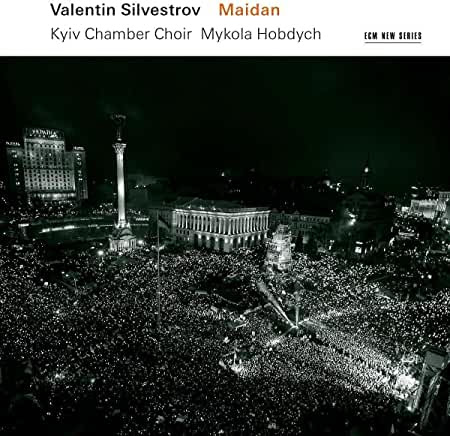
Maidan. Silvestrov: Maidan 2014 (Cycle of Cycles) – Cycle I | Cycle II | Cycle III | Cycle IVFour SongsDiptychTriptych.  Kyiv Chamber Choir, Mykola Hobdych, conductor. ECM New Series 2359


The Ukrainian composer Valentin Silvestrov was born in Kyiv in 1937. In March of 2022, at the age of 84, he left his home city with his daughter, granddaughter, and a suitcase full of manuscripts to make a difficult three-day journey to Berlin. He found himself and his family refugees, victims of the brutal attack on their home country ordered by Russian leader Vladimir Putin. As the liner notes point out, however, the disaster had begun years earlier, in 2014, the year of the “Euromaidan” or “Revolution of Dignity,” a Ukrainian “protest against the surprising failure, by the Russophile government of the time, to sign the association agreement with then European Union.” Silvestrov’s composition Maidan 2014 was his response to these events, his witness of this Revolution. Although the work was originally performed only in Ukraine, the invasion of Ukraine has brought attention to this and other works by Silvestrov, which have been performed more often in more countries around the world. The music has a haunting yet powerful quality. Recorded in St. Michael’s Cathedral in Kyiv (in 2017, well before the invasion), the voices resonate powerfully within that large space. The harmonies are relatively simple, as you might expect from music intended to communicate settings of the Ukrainian anthem combined with liturgical intonations. Also included on the CD are three smaller song cycles that have a similar sonic and musical profile. The liner booklet helpfully provides texts in both Ukrainian and English; some of the poetry is quite moving, especially in light of current events. This is a powerful recording – sonically, musically, and emotionally.


January 18, 2023

Weinberg: Symphonies Nos. 3 & 7; Flute Concerto No. 1 (CD Review)

By Karl Nehring

Symphonies Nos. 3 & 7Flute Concerto No. 1. Kirill Gerstein, harpsichord; Marie-Christine Zupancic, flute; Mirga Gražinytè-Tyla, City of Birmingham Symphony Orchestra, The Deutsche Kammerphilharmonie Berlin (Symphony No. 7). Deutsche Grammophon DG 486 2402 (CD review)


Long-time followers of Classical Candor might possibly recall our previous encounter with symphonies penned by the composer Mieczyslaw Weinberg (1919-1996), a Polish Jew who fled Warsaw in 1939 and in the 1940s found himself living in Moscow and becoming friends with Shostakovich (see review here). Like Shostakovich, Weinberg and his music became targets of Stalin’s ire. Of the Symphony No. 3 included on this release, for example, the liner notes relate that “it appears from the manuscript score that the original version of the Third Symphony was submitted to the censor and accepted for performance and publication. And yet it seems that critical voices in the Union of Soviet Composers protested against its release since Weinberg declared after a run-through that the work contained “errors” that required his attention. The implication is that the symphony had been heavily criticized. But it was only much later that Weinberg made these alterations. It required the changed political climate of the Kruschev Thaw for Weinberg to resume work on his Third Symphony and finally to complete it in 1959.” 


We shall return to Symphony No. 3 below, but first let us consider Symphony No. 7 (1964), for that is the work with which the disc opens. The work is specified as being for string orchestra and harpsichord; unusually enough, the opening measures are played by then harpsichord alone. It is in five movements, which alternate between slow and more sprightly in tempo. Although the mood is never quite tragic, neither is it what most listeners would find to be happy or optimistic. Instead, the music sounds guarded, nervous, perhaps even frightened at times. Despite that – or possibly because of it – it is captivating, drawing the listener in. The sound of the harpsichord provides moments of musical punctuation and seasoning. The overall impression is of a large work for small forces.


Sandwiched between the two symphonies is the Flute Concerto No. 1. Composed in 1961, it icast in the traditional three movements, fast-slow-fast. The opening movement, marked Allegro molto, gallops right along, sounding like something Shostakovich could have written. That is not meant as a putdown, but as praise; the movement has an infectious, almost nervous energy that demands attention. The following Largo movement slows things down, but does not really calm things down. There is a nervous undercurrent lurking beneath the calm surface that breaks through in the third movement, marked Allegro commodo, which whirls and swirls with nervous energy.


Closing this generously filled disc is Symphony No. 3, which is scored for large orchestra. Hearing it now, even in its revised version, listeners can still get an inkling of why the original version may have rankled the Soviet thought police back in the 1940s. It’s a big, bold work, opening with some compelling sounds from woodwinds in the opening, to be joined later by the brass as the music grows more and more agitated. My guess is that the original version had more agitation, perhaps abetted by some dissonance here and there that was smoothed out in Weinberg’s revision of the score. Of special note is the third movement, marked Adagio, which is searchingly, sorrowfully sublime. You can feel Weinberg’s soul striving for something it knows it cannot quite reach, yet the quest must continue, even with head bowed. It is a magnificent nine minutes of music. The finale, as you might expect, is energetic – Allegro vivace – but as with the finale of the Shostakovich Fifth, there is some ambiguity as to whether the ending should be understood as signifying triumph or something more troubling. In the final few bars, the Lithuanian conductor Mirga Gražinytè-Tyla (b. 1986) seems to hold back just enough to suggest that in the case of this symphony by Weinberg, she leans toward the latter interpretation. It is a convincing performance of a remarkable symphony, a work that surely deserves wider exposure.


Captured in convincing stereo sound quality, this program builds from the quiet notes of a harpsichord at the opening to the full blast of a large orchestra in the final minutes. The soloists, conductor, and musicians of both orchestras all combine to present the music of this still largely overlooked composer in the best possible light. Let’s hope that there are more recordings of Weinberg symphonies forthcoming from these forces in the future.  


January 15, 2023

TÁR: Music from and Inspired by the Motion Picture (CD Review)

By Karl Nehring


Hildur Gudnadóttir:
For Petra; Mortar; T
ÁR; *Mahler:
(rehearsals for) Symphony No. 5; **Elgar: (recording session for
excerpts from) Cello Concerto in E minor, Op. 85; Johnny Burke and Jimmy
van Heusen: Here’s That Rainy Day; Bach: (lesson on) Prelude in C
Major
; Elisa Vargas Fernandez: Cura Mente. Hildur Gudnad
óttir;
London Contemporary Orchestra, Robert Ames, conductor; *Dresdner Philharmonie,
Cate Blanchett, conductor; Sophie Kauer, cello; London Symphony Orchestra,
Natalie Murray Beale, conductor; New Trombone Collective & Friends; Elisa
Vargas Fernandez. Deutsche Grammophon 486 3431


It's hard to know just where to start with this
review, for this is a not a release that is easy to characterize in any sort of
simple, straightforward way. It’s just not a simple, straightforward sort of
recording. First of all, it is not a soundtrack album. DG states on their
website, “The multi-faceted concept album features music from and inspired by
the movie, including a series of stunning new tracks by Gudnadóttir, as well as
extracts from major works by Elgar and Mahler. It complements the film by
presenting completed, real-life versions of the music on which we see the
fictional protagonist Lydia Tár working. One of the aims of the album is to
reveal something of the complex process that goes on behind orchestral
rehearsals and recordings.”


Perhaps it might be best to pause here for a
background sketch of the film for those who may be unfamiliar with it. The plot
revolves around the main character, Lydia T
ár (played by Cate Blanchett), a conductor who has
risen to the very peak of her profession – music director of the Berlin
Philharmonic. However, all is not well in her rather messy – to put it politely
– personal life; naturally enough, her psychological equilibrium is also
increasingly under strain as the plot progresses. Of course, there is much more
to the film than that (no, I have not seen it), but you get the general idea. It
is not without controversy: Marin Alsop, probably the world’s foremost female
conductor, remarked of the film in an interview for the New York Times, “I
first read about it in late August and I was shocked that that was the first hearing
of it. So many superficial aspects of
Tár seemed to align with my own personal life.
But once I saw it I was no longer concerned, I was offended: I was offended as
a woman, I was offended as a conductor, I was offended as a lesbian.”


Now,
back to the CD. Some classical music fans may find the cover photo vaguely
familiar. In fact, some may even have the reason for that feeling of
familiarity resting on a shelf somewhere in their CD collection. I no longer
own the Abbado CD myself, but hey, I knew I had seen that Tár image somewhere, and I knew it
was Abbado. As the liner notes, which were penned by the film’s
producer/writer/director, Todd Field, declare, “one look at the the album’s
cover art will be enough for you to understand that yes, in some parallel
universe Lydia
Tár
was finally able to convince the good people at DG to create a cover adorned with
her aped image of Claudio Abbado.”


Musically,
the program combines, as it says on the cover, music from and “inspired by”
the
film, seemingly more of the latter than the former. As Field summarizes it,
“the album includes Cate Blanchett conducting rehearsals for Mahler’s Fifth,
Gudnadóttir’s making of the score
for the film, in addition to music she composed that was inspired by, but not
heard in the film, the New Trombone Collective recreating the storied 1967
recording of Here’s that Rainy Day played by the great Urbie Green, and
finally Sophie Kauer making her professional debut in rehearsal for the Elgar
Cello Concerto.”
  Now,
you might wonder: Why such a mishmash? 
Field’s highlighted answer to that question is, “The tracks, like the
film, are meant to invite the listener to experience the messiness involved in
the making of music.”


Well, yes, it is a bit of a mess, this CD, but
there is some good music to be found in these tracks, too.
Gudnadóttir’s contributions are
especially interesting. The young (b. 1982) Icelandic composer and cellist
contributes three fascinating pieces to start off the program. She sings the
melody of For Petra, the musical theme which forms the basis of a
composition by the fictional Lydia
Tár.
The CD also contains a longer version of For Petra that Gudnadóttir has
composed for orchestra, which is presented on this recording framed by
introductory and concluding remarks by the composer to conductor Robert Ames
and the London Contemporary Orchestra at the recording session (apparently
intended to illustrate “the messiness involved in the making of music.”) She
also contributes a three-movement moving expressive chamber composition titled
Tár.


Next
on the program are brief excerpts from Symphony No. 5 by Mahler, these
now taken from scenes in the film wherein Cate Blanchett as Lydia
Tár is rehearsing the orchestra. We
get a bit of the opening funeral march, a bit of the scherzo, and of course – what
else? – some of the gorgeous Adagietto. We also get Cate Blanchett speaking,
imploring the orchestra to play with one voice. At the end of this session, she
asks the orchestra members what they would think of having the Elgar Cello
Concerto
as a companion piece on the upcoming program (uh oh, she has an
ulterior motive – things are getting messy indeed!). We then hear some chunks
of the work itself, not as satisfying as hearing the whole work, but at least
enough to sit back, relax, and enjoy. In fact, Sophie Kauer and the LSO’s
12-minute performance of the Allegro movement is the longest uninterrupted stretch
of music on the entire CD. Following a bit more from Kauer’s Elgar audition
(which Field in his liner notes justifies by drawing an out-of-left-field
parallel with historical recordings in the same studio) we then get an even
more out-of-left-field musical selection, Here’s That Rainy Day, played
by a small jazz ensemble (truth be told, however, it’s actually quite pleasant)
before the program concludes with a song that in the was used in the film in a
scene that fictionally portrayed Lydia
Tár making a field recording in the Amazon in
1990.


Just
as it was hard to know where to start this review, so it is to know just how to
end it. This is – by design, really – a release that is difficult to
categorize. It is not really a soundtrack, nor is it really a documentary about
how music is made. It does have some interesting new music by the young
Icelandic composer Hildur Gudnadóttir, so in the end I can perhaps be justified
in giving it a solid recommendation as a Hildur Gudnadóttir EP with some stuff
from the film
Tár thrown in as a bonus. Alternatively, for fans
of the movie, I can recommend it as an interesting take on the film from its
director with some fascinating new music thrown in as a bonus.


Meanwhile, I’ve reserved the DVD of the film at
my local library. Although I will confess that I am not predisposed to like it,
I’m willing to give it a try. Will my wife and I be able make it all the way through?
We shall see…


.


Meet the Staff

Meet the Staff
John J. Puccio, Founder and Contributor

Understand, I'm just an everyday guy reacting to something I love. And I've been doing it for a very long time, my appreciation for classical music starting with the musical excerpts on the Big Jon and Sparkie radio show in the early Fifties and the purchase of my first recording, The 101 Strings Play the Classics, around 1956. In the late Sixties I began teaching high school English and Film Studies as well as becoming interested in hi-fi, my audio ambitions graduating me from a pair of AR-3 speakers to the Fulton J's recommended by The Stereophile's J. Gordon Holt. In the early Seventies, I began writing for a number of audio magazines, including Audio Excellence, Audio Forum, The Boston Audio Society Speaker, The American Record Guide, and from 1976 until 2008, The $ensible Sound, for which I served as Classical Music Editor.

Today, I'm retired from teaching and use a pair of bi-amped VMPS RM40s loudspeakers for my listening. In addition to writing for the Classical Candor blog, I served as the Movie Review Editor for the Web site Movie Metropolis (formerly DVDTown) from 1997-2013. Music and movies. Life couldn't be better.

Karl Nehring, Editor and Contributor

For more than 20 years I was the editor of The $ensible Sound magazine and a regular contributor to both its equipment and recordings review pages. I would not presume to present myself as some sort of expert on music, but I have a deep love for and appreciation of many types of music, "classical" especially, and have listened to thousands of recordings over the years, many of which still line the walls of my listening room (and occasionally spill onto the furniture and floor, much to the chagrin of my long-suffering wife). I have always taken the approach as a reviewer that what I am trying to do is simply to point out to readers that I have come across a recording that I have found of interest, a recording that I think they might appreciate my having pointed out to them. I suppose that sounds a bit simple-minded, but I know I appreciate reading reviews by others that do the same for me — point out recordings that they think I might enjoy.

For readers who might be wondering about what kind of system I am using to do my listening, I should probably point out that I do a LOT of music listening and employ a variety of means to do so in a variety of environments, as I would imagine many music lovers also do. Starting at the more grandiose end of the scale, the system in which I do my most serious listening comprises Marantz CD 6007 and Onkyo CD 7030 CD players, NAD C 658 streaming preamp/DAC, Legacy Audio PowerBloc2 amplifier, and a pair of Legacy Audio Focus SE loudspeakers. I occasionally do some listening through pair of Sennheiser 560S headphones. I miss the excellent ELS Studio sound system in our 2016 Acura RDX (now my wife's daily driver) on which I had ripped more than a hundred favorite CDs to the hard drive, so now when driving my 2022 Accord EX-L Hybrid I stream music from my phone through its adequate but not outstanding factory system. For more casual listening at home when I am not in my listening room, I often stream music through the phone into a Vizio soundbar system that has tolerably nice sound for such a diminutive physical presence. And finally, at the least grandiose end of the scale, I have an Ultimate Ears Wonderboom II Bluetooth speaker for those occasions where I am somewhere by myself without a sound system but in desperate need of a musical fix. I just can’t imagine life without music and I am humbly grateful for the technology that enables us to enjoy it in so many wonderful ways.

William (Bill) Heck, Webmaster and Contributor

Among my early childhood memories are those of listening to my mother playing records (some even 78 rpm ones!) of both classical music and jazz tunes. I suppose that her love of music was transmitted genetically, and my interest was sustained by years of playing in rock bands – until I realized that this was no way to make a living. The interest in classical music was rekindled in grad school when the university FM station serving as background music for studying happened to play the Brahms First Symphony. As the work came to an end, it struck me forcibly that this was the most beautiful thing I had ever heard, and from that point on, I never looked back. This revelation was to the detriment of my studies, as I subsequently spent way too much time simply listening, but music has remained a significant part of my life. These days, although I still can tell a trumpet from a bassoon and a quarter note from a treble clef, I have to admit that I remain a nonexpert. But I do love music in general and classical music in particular, and I enjoy sharing both information and opinions about it.

The audiophile bug bit about the same time that I returned to classical music. I’ve gone through plenty of equipment, brands from Audio Research to Yamaha, and the best of it has opened new audio insights. Along the way, I reviewed components, and occasionally recordings, for The $ensible Sound magazine. Most recently I’ve moved to my “ultimate system” consisting of a BlueSound Node streamer, an ancient Toshiba multi-format disk player serving as a CD transport, Legacy Wavelet DAC/preamp/crossover, dual Legacy PowerBloc2 amps, and Legacy Signature SE speakers (biamped), all connected with decently made, no-frills cables. With the arrival of CD and higher resolution streaming, that is now the source for most of my listening.

Ryan Ross, Contributor

I started listening to and studying classical music in earnest nearly three decades ago. This interest grew naturally out of my training as a pianist. I am now a musicologist by profession, specializing in British and other symphonic music of the 19th and 20th centuries. My scholarly work has been published in major music journals, as well as in other outlets. Current research focuses include twentieth-century symphonic historiography, and the music of Jean Sibelius, Ralph Vaughan Williams, and Malcolm Arnold.

I am honored to contribute writings to Classical Candor. In an age where the classical recording industry is being subjected to such profound pressures and changes, it is more important than ever for those of us steeped in this cultural tradition to continue to foster its love and exposure. I hope that my readers can find value, no matter how modest, in what I offer here.


Bryan Geyer, Technical Analyst

I initially embraced classical music in 1954 when I mistuned my car radio and heard the Heifetz recording of Mendelssohn's Violin Concerto. That inspired me to board the new "hi-fi" DIY bandwagon. In 1957 I joined one of the pioneer semiconductor makers and spent the next 32 years marketing transistors and microcircuits to military contractors. Home audio DIY projects remained a personal passion until 1989 when we created our own new photography equipment company. I later (2012) revived my interest in two channel audio when we "downsized" our life and determined that mini-monitors + paired subwoofers were a great way to mate fine music with the space constraints of condo living.

Visitors that view my technical papers on this site may wonder why they appear here, rather than on a site that features audio equipment reviews. My reason is that I tried the latter, and prefer to publish for people who actually want to listen to music; not to equipment. My focus is in describing what's technically beneficial to assure that the sound of the system will accurately replicate the source input signal (i. e. exhibit high accuracy) without inordinate cost and complexity. Conversely, most of the audiophiles of today strive to achieve sound that's euphonic, i.e. be personally satisfying. In essence, audiophiles seek sound that's consistent with their desire; the music is simply a test signal.

Mission Statement

It is the goal of Classical Candor to promote the enjoyment of classical music. Other forms of music come and go--minuets, waltzes, ragtime, blues, jazz, bebop, country-western, rock-'n'-roll, heavy metal, rap, and the rest--but classical music has been around for hundreds of years and will continue to be around for hundreds more. It's no accident that every major city in the world has one or more symphony orchestras.

When I was young, I heard it said that only intellectuals could appreciate classical music, that it required dedicated concentration to appreciate. Nonsense. I'm no intellectual, and I've always loved classical music. Anyone who's ever seen and enjoyed Disney's Fantasia or a Looney Tunes cartoon playing Rossini's William Tell Overture or Liszt's Hungarian Rhapsody No. 2 can attest to the power and joy of classical music, and that's just about everybody.

So, if Classical Candor can expand one's awareness of classical music and bring more joy to one's life, more power to it. It's done its job. --John J. Puccio

Contact Information

Readers with polite, courteous, helpful letters may send them to classicalcandor@gmail.com

Readers with impolite, discourteous, bitchy, whining, complaining, nasty, mean-spirited, unhelpful letters may send them to classicalcandor@recycle.bin.

"Their Master's Voice" by Michael Sowa

"Their Master's Voice" by Michael Sowa