

By Karl W. Nehring
Illumination: Piano Works of Victoria Bond. Illuminations on Byzantine Chant; Ancient Keys*; Black Light**; Byzantine Chant. Paul Barnes, pianist and chanter; Kirk Trevor, *Slovak Radio Orchestra; Philharmony “Bohuslav Martinu”. Albany Records TROY1880.
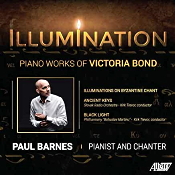 Once again we encounter a composer – and performer – whom we have not encountered before, and we are once again rewarded with some music that is interesting, entertaining, and uplifting. The American composer and conductor Victoria Bond (b. 1945) was the first woman to be awarded a doctorate in conducting from the Juilliard School and has composed eight operas, six ballets, two piano concertos, as well as other works. In her liner notes, Bond explains that the works included on this release stem from more than two decades of collaboration with the American pianist Paul Barnes (b. 1961). This temporal span is exemplified not only by the recording dates of the compositions (Ancient Keys, 1997; Black Light, 2003; Illuminations on Byzantine Chant, 2021) but also by dates of the composition that opens the program, Illuminations on Byzantine Chant, a work for solo piano in three parts: Potirion Sotiriu, 1999; Simeron Kremate, 2019; and Enite ton Kyrion, 2021.
The first two movements of Illuminations, Potirion Sotiriu and Simeron Kremate, are energetic and intense, with an Eastern flavor that is consistent with their roots in the Greek Orthodox tradition. The third movement, Enite ton Kyrion, is more meditative in mood, more peaceful and lyrical. Ancient Keys, a piano concerto in one movement, begins with a chant from pianist Barnes before the orchestra enters, followed by his piano. According to Bond, Ancient Keys is based on Potirion Sotiriu. “In expanding the solo piano work for piano and orchestra, I pictured an enormous space, like a great cathedral, gradually filling up with rich and sonorous bass [sic] tones that swirled around, echoing and disappearing like delicate smoke into the high dome.” (Given the way the piece opens, I’m pretty sure she meant “brass tones.”) Over its 17 minutes, this is a piece that provides drama and a sense of mystery. Impressive! Black Light is in three movements. Interestingly enough, Bond writes that “the title Black Light implies the light that shines from African American music, which has had a profound effect on my compositions.” The first movement is almost jarringly energetic – it is marked “Aggressively driving” and is certainly that. Not unpleasant, mind you, but something that will definitely wake you up. The second movement, marked “Forcefully,” is much less aggressive, and is said by the composer to be inspired by Jewish liturgical music. The final movement, marked “Presto,” said to be inspired by the scat singing of Ella Fitzgerald, is quite a fun romp. The program then ends in a completely different vein as Barnes performs four brief Byzantine chants, including the three that undergird the beginning of the program: Potirion Sotiriu, Simeron Kremate, and Enite ton Kyrion. All in all, then, what we have here is something of an unusual musical program, but nonetheless a recording that is coherent, stimulating, and satisfying, with more than satisfactory engineering and informative liner notes. Well worth an audition by the musically curious.
Schubert: Piano Sonatas D. 840, ‘Reliquie’ & D. 960. Jean-Marc Luisada, piano, La Dolce Volta LDV 93.
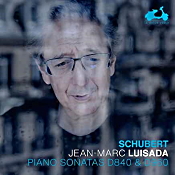 The Tunisian-born French pianist Jean Marc Luisada (b. 1958) offers performances of two piano sonatas by Schubert on this beautifully engineered recording that comes in a hardbound book-type bound format featuring liner notes in four languages: French, English, Japanese, and German. This is surely one one of the most imposing and impressive presentations that I have encountered in quite some time. The question that remains, then, is whether the musical performance is worthy of the engineering and packaging quality lavished upon it. To these ears, at least, the answer is affirmative.
Luisada plays only the first two movements of the Sonata in C major, D. 840, known as the “Relique” a name it was given because when it was first published it was mistakenly thought to be Schubert’s final work in piano sonata form. These first two movements, marked Moderato and Andante, being the only two that Schubert completed himself. By the way, although there are only two movements, they are substantial, taking up more than 28 minutes. There exists a longer version that includes later movements that were completed by Ernst Krenek. In Luisada’s view, “In Schubert’s case, incompletion is not a sign of impotence. It’s a deliberate gesture, because he has already said the essential, revealed the suffering of the moment.” As we listen to Luisada’s tenderly expressive performance and ponder his perspective on this work, we find ourselves confronting one of music’s – of art’s – paradoxes, how the expression of sorrow and suffering can at the same time be so beautiful and life-affirming.
Then it is on to the Sonata in B-flat major, D. 960, which truly was Schubert’s final piano sonata, of which Luisada comments “is a culmination, the completion of a life… Certain passages in the first movement of the sonata are among the highpoints of the whole nineteenth-century musical literature. Then there are the moments bathed in an immaterial atmosphere, when the Wanderer calmly accepts death in the C major modulation at the end of the second movement, the Andante sostenuto. This imposes a feeling of stillness, a sensation of eternity… In this recording, I play [the Scherzo] slower than usual and in the spirit of an angel dance with a certain reserve… In truth, nothing is improvised in Schubert. Sometimes he gives the illusion of improvisation, pulls the wool over our eyes. Everything is ‘orchestrated’ without ever reaching a climax, for he must constantly postpone the inevitable, gain time. Only the Faustian finale with its galloping theme and its syncopations in the left hand ends the Wanderer’s race to the abyss.”
For those who might be unfamiliar with this composition, it is an imposing work, but one that is ever so beautiful. The first movement is the longest; at 20 minutes or so, it could pretty much stand on its own as an independently satisfying work of art. (I must confess that there have been times when I have come to the end of the movement and then rather than going on to the next, have immediately returned to the beginning of the movement again, lingering with this music for another 20 minutes, because it is just so beautiful that I cannot bear to part from it.) But then comes the second movement, that Andante sostenuto, slow and tender for nearly 10 minutes, music to melt your heart, with Luisada playing it as expressively as can be imagined without ever taking it over the top. The relatively brief Scherzo follows, dancing along for less than five minutes before we come to the closing nine-minute Allegro, which bounces along until it seems to hesitate questioningly near the end before seeming to take a deep breath and conclude with a flourish. Overall, Luisada plays with great imagination and emotion, bringing out the drama in the music. D. 960 truly is one of the truly great piano sonatas, a work that every classical music listener should encounter at some point. A great place to start for those who have not yet heard the piece would be the recording by Mitsuko Uchida on Philips, a more straightforward but still quite beautiful performance; however, for those who are already acquainted with the piece, this new recording by Luisada offers a fascinating interpretation that is well worth an audition, and the pairing of both sonatas on one disc and the superb recorded sound make this an especially appealing choice.
Hovhaness: Invocations to Vahakn; Yenovk; Lalezar; Suite on Greek Tunes; Mystic Flute; Journey Into Dawn; Laona; Lake of Van Sonata; Vijag; Sonata “Hakhpat”. Sahan Arzruni, piano; Adam Rosenblatt, percussion. KALAN 773.
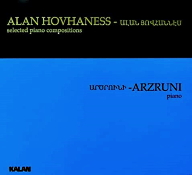 Many classical music fans are no doubt familiar with the orchestral works of the late American composer Alan Hovhaness (1911-2000), who wrote 67 symphonies as well as other symphonic works such as the symphonic poem And God Created Great Whales. With something like 464 works in his published catalog plus additional unpublished manuscripts, Hovhaness wrote not only for orchestra, but for other ensembles and solo instruments as well, including the piano. The Armenian pianist Sahan Arzruni (b. 1943) has studied the piano music of Hovhaness in preparation for recording this album of selected piano works by the composer. Clearly this was a work of love, for Arzruni points out that the majority of the compositions he chose to include are unpublished, existing in manuscript form only. Arzruni comments that Hovhaness “was a musician-mystic who rejected the materialistic values of the Machine Age. He explored, instead, the transcendental realm – using music as a link between the physical and metaphysical worlds. Hovhaness took non-Western cultures as his point of departure, while employing Western music as his frame of reference.” Arzruni goes on to quote the American composer and critic Virgil Thomson who wrote of Hovhaness in 1947 that “the music is at times strophic in phraseology and emotionally continuous, never climactic. Each piece is like a hand-made wallpaper. Its motionless quality is a little hypnotic. Its expressive function is predominantly religious, ceremonial, incantatory, its spiritual content of the purest.”
Even before reading the extensive liner notes in which Arzruni provides detailed background information on each track, you begin to get a sense of what Thomson was writing about even before you read it. The music does have a sense of the mystical about it, a feeling of striving for something beyond the notes. The occasional addition of percussion adds to the sense that the music is part of some sort of ritual. That is not to say, however, that it cannot be enjoyed purely as music, for it is music that is lively, energetic, and quite capable of capturing the imagination. On the back cover of the booklet is a quotation from Hovhaness himself that makes his intentions clear: “I propose to create a heroic, monumental style of composition simple enough to inspire all people, completely free from fads, artificial mannerisms and false sophistications, direct, sincere, always original but never unnatural.” That is a bold, ambitious statement, but for the music on this album at least, I would say that he pretty much succeeded, with the able assistance of Arzruni, Rosenblatt, and the engineering team. The booklet and disc are packaged in a sturdy box; all in all, this is a first-class production of some fascinating music that deserves to be heard. Highly recommended!
KWN
Illumination: Piano Works of Victoria Bond. Illuminations on Byzantine Chant; Ancient Keys*; Black Light**; Byzantine Chant. Paul Barnes, pianist and chanter; Kirk Trevor, *Slovak Radio Orchestra; Philharmony “Bohuslav Martinu”. Albany Records TROY1880.
The first two movements of Illuminations, Potirion Sotiriu and Simeron Kremate, are energetic and intense, with an Eastern flavor that is consistent with their roots in the Greek Orthodox tradition. The third movement, Enite ton Kyrion, is more meditative in mood, more peaceful and lyrical. Ancient Keys, a piano concerto in one movement, begins with a chant from pianist Barnes before the orchestra enters, followed by his piano. According to Bond, Ancient Keys is based on Potirion Sotiriu. “In expanding the solo piano work for piano and orchestra, I pictured an enormous space, like a great cathedral, gradually filling up with rich and sonorous bass [sic] tones that swirled around, echoing and disappearing like delicate smoke into the high dome.” (Given the way the piece opens, I’m pretty sure she meant “brass tones.”) Over its 17 minutes, this is a piece that provides drama and a sense of mystery. Impressive! Black Light is in three movements. Interestingly enough, Bond writes that “the title Black Light implies the light that shines from African American music, which has had a profound effect on my compositions.” The first movement is almost jarringly energetic – it is marked “Aggressively driving” and is certainly that. Not unpleasant, mind you, but something that will definitely wake you up. The second movement, marked “Forcefully,” is much less aggressive, and is said by the composer to be inspired by Jewish liturgical music. The final movement, marked “Presto,” said to be inspired by the scat singing of Ella Fitzgerald, is quite a fun romp. The program then ends in a completely different vein as Barnes performs four brief Byzantine chants, including the three that undergird the beginning of the program: Potirion Sotiriu, Simeron Kremate, and Enite ton Kyrion. All in all, then, what we have here is something of an unusual musical program, but nonetheless a recording that is coherent, stimulating, and satisfying, with more than satisfactory engineering and informative liner notes. Well worth an audition by the musically curious.
Schubert: Piano Sonatas D. 840, ‘Reliquie’ & D. 960. Jean-Marc Luisada, piano, La Dolce Volta LDV 93.
Luisada plays only the first two movements of the Sonata in C major, D. 840, known as the “Relique” a name it was given because when it was first published it was mistakenly thought to be Schubert’s final work in piano sonata form. These first two movements, marked Moderato and Andante, being the only two that Schubert completed himself. By the way, although there are only two movements, they are substantial, taking up more than 28 minutes. There exists a longer version that includes later movements that were completed by Ernst Krenek. In Luisada’s view, “In Schubert’s case, incompletion is not a sign of impotence. It’s a deliberate gesture, because he has already said the essential, revealed the suffering of the moment.” As we listen to Luisada’s tenderly expressive performance and ponder his perspective on this work, we find ourselves confronting one of music’s – of art’s – paradoxes, how the expression of sorrow and suffering can at the same time be so beautiful and life-affirming.
Then it is on to the Sonata in B-flat major, D. 960, which truly was Schubert’s final piano sonata, of which Luisada comments “is a culmination, the completion of a life… Certain passages in the first movement of the sonata are among the highpoints of the whole nineteenth-century musical literature. Then there are the moments bathed in an immaterial atmosphere, when the Wanderer calmly accepts death in the C major modulation at the end of the second movement, the Andante sostenuto. This imposes a feeling of stillness, a sensation of eternity… In this recording, I play [the Scherzo] slower than usual and in the spirit of an angel dance with a certain reserve… In truth, nothing is improvised in Schubert. Sometimes he gives the illusion of improvisation, pulls the wool over our eyes. Everything is ‘orchestrated’ without ever reaching a climax, for he must constantly postpone the inevitable, gain time. Only the Faustian finale with its galloping theme and its syncopations in the left hand ends the Wanderer’s race to the abyss.”
For those who might be unfamiliar with this composition, it is an imposing work, but one that is ever so beautiful. The first movement is the longest; at 20 minutes or so, it could pretty much stand on its own as an independently satisfying work of art. (I must confess that there have been times when I have come to the end of the movement and then rather than going on to the next, have immediately returned to the beginning of the movement again, lingering with this music for another 20 minutes, because it is just so beautiful that I cannot bear to part from it.) But then comes the second movement, that Andante sostenuto, slow and tender for nearly 10 minutes, music to melt your heart, with Luisada playing it as expressively as can be imagined without ever taking it over the top. The relatively brief Scherzo follows, dancing along for less than five minutes before we come to the closing nine-minute Allegro, which bounces along until it seems to hesitate questioningly near the end before seeming to take a deep breath and conclude with a flourish. Overall, Luisada plays with great imagination and emotion, bringing out the drama in the music. D. 960 truly is one of the truly great piano sonatas, a work that every classical music listener should encounter at some point. A great place to start for those who have not yet heard the piece would be the recording by Mitsuko Uchida on Philips, a more straightforward but still quite beautiful performance; however, for those who are already acquainted with the piece, this new recording by Luisada offers a fascinating interpretation that is well worth an audition, and the pairing of both sonatas on one disc and the superb recorded sound make this an especially appealing choice.
Hovhaness: Invocations to Vahakn; Yenovk; Lalezar; Suite on Greek Tunes; Mystic Flute; Journey Into Dawn; Laona; Lake of Van Sonata; Vijag; Sonata “Hakhpat”. Sahan Arzruni, piano; Adam Rosenblatt, percussion. KALAN 773.
Even before reading the extensive liner notes in which Arzruni provides detailed background information on each track, you begin to get a sense of what Thomson was writing about even before you read it. The music does have a sense of the mystical about it, a feeling of striving for something beyond the notes. The occasional addition of percussion adds to the sense that the music is part of some sort of ritual. That is not to say, however, that it cannot be enjoyed purely as music, for it is music that is lively, energetic, and quite capable of capturing the imagination. On the back cover of the booklet is a quotation from Hovhaness himself that makes his intentions clear: “I propose to create a heroic, monumental style of composition simple enough to inspire all people, completely free from fads, artificial mannerisms and false sophistications, direct, sincere, always original but never unnatural.” That is a bold, ambitious statement, but for the music on this album at least, I would say that he pretty much succeeded, with the able assistance of Arzruni, Rosenblatt, and the engineering team. The booklet and disc are packaged in a sturdy box; all in all, this is a first-class production of some fascinating music that deserves to be heard. Highly recommended!
KWN


