Showing posts with label Coleridge-Taylor. Show all posts

October 16, 2022

Violin Concertos by Black Composers Through the Centuries (CD review)

Music of Bologne, Lafitte, Coleridge-Taylor, and Price. Rachel Barton Pine, violin; Encore Chamber Orchestra, Daniel Hege, conductor; Royal Scottish National Orchestra, Jonathon Heyward, conductor. Cedille Records CDR 90000 214.

By John J. Puccio
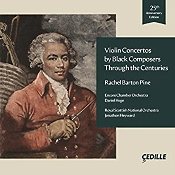
Cedille Records reached back into their archives for several of the items on this album and recorded a brand-new selection to wrap it up. Moreover, considering it represents the work of four different composers, it offers a generous playing time. It helps, of course, that each of the violin concertos offered here is fairly brief, but, still, we get over seventy-three minutes of music. And fine music it is, too. American violinist Rachel Barton Pine performs the first three pieces with the Encore Chamber Orchestra, Daniel Hege conducting, and the final piece with the Royal Scottish National Orchestra, Jonathon Heyward conducting.

Obviously, the purpose of the album is to showcase the talents of black composers through the past few centuries, composers who might otherwise go unnoticed or whose light may begin to fade without enough public exposure. It’s a delightful album, the selections arranged chronologically from the eighteenth through twentieth centuries, and it provides much for one to enjoy.

The first item on the program is the Violin Concerto in A major, Op. 5, No. 2, a piece written in 1775 by Joseph Bologne, Chevalier de Saint-Georges (1745-1799). Bologne was a French violinist, conductor, and composer whom the public considered the greatest violinist in France at the time; in fact, his fans called him “The Black Mozart.” (Ms. Barton-Pine notes, however, that he was older than Mozart by almost ten years and probably inspired the Austrian composer; therefore Mozart should rightly be called “The White Bologne.”) Whatever, Bologne’s concerto is charming, and Ms. Barton-Pine seems to enjoy it immensely.

After a typically lengthy classical introduction the violin enters sweetly, almost tenderly, and continues that way throughout. While it is not music that sticks long in memory, it is music to impress one at the time of listening, which it certainly does. What’s more, Maestro Daniel Hege and the Encore players show plenty of pizzazz accompanying her. A lovely, amiable Largo forms the center of the piece, and then it concludes with a lively Rondeau, gracious, courtly, yet playful.

The second selection is the Violin Concerto in F-sharp minor, written in 1864 by the Cuban-French violinist and composer Jose White Lafitte (1836-1918). The work is highly virtuosic, and as we might expect from a Romantic concerto, more dramatic than Bologne’s piece. Ms. Barton-Pine does it up in fine style. It, too, has a lengthy orchestral prelude before the introduction of the violin, but when Barton-Pine does enter it is with a striking flourish. Still, the piece is not overdone, not histrionic, just agreeably operatic in tone, with Barton-Pine smoothly negotiating its many twists and turns.

Next comes the little Romance in G major for Violin and Orchestra, Op. 39, written in 1899 by the British composer and conductor Samuel Coleridge-Taylor (1875-1912). Unlike Bologne and Lafitte, Coleridge-Taylor’s works, especially his Hiawatha cantatas, have remained popular to this day. The Romance projects a gracefully wistful mood, nicely captured by Ms. Barton-Pine’s artfully gentle playing, which never sentimentalizes the music.

The disc ends with the Violin Concerto No. 2, one of the last compositions (1952) by the American classical composer, pianist, and music teacher Florence Price (1887-1953). It is notable that Ms. Price was the first Black woman to be recognized as a symphonic composer and to have a work of hers played by a major symphony orchestra. Here, as befits a twentieth-century piece of music, Ms. Barton-Pine is accompanied by a larger ensemble, the Royal Scottish National Orchestra led by Maestro Jonathan Heyward. Accordingly, it sounds bigger than the previous three numbers. The mood throughout is elegant, warm, and tenderhearted, with Ms. Barton-Pine’s violin always a compassionate communicator.

Producer James Ginsburg and engineers Lawrence Rock, Hedd Morfett-Jones, and Bill Maylone recorded the music at the Chapel of St. John the Beloved, Arlington Heights, Illinois in June 1997 and (for the Price selection) Scotland’s Studio, Glasgow in January 2022. The sound in the first three numbers is mellifluously rounded and natural, with an especially good, resonant distancing and a healthy dynamic range to make it appear real. The Price concerto is done up closer than the earlier tracks, with a slightly greater emphasis on sonic detailing.

JJP

November 30, 2016

African Heritage Symphonic Series, Volume 1 (CD review)

Music of  William Grant Still, Samuel Coleridge-Taylor, and Fela Sowande. Paul Freeman, Chicago Sinfonietta. Cedille Records CDR 90000 055.


Look. I'm only going to say this one more time (or until I hear another disc from this source), so listen up. The folks at Cedille produce some of the best-sounding records in the industry. And as usual I'd like to commend engineer Bill Maylone for his contributions to the audiophile cause.


This 2003 release with the Chicago Sinfonietta under the directorship of its founder, Paul Freeman, is outstanding in every way. The sound is spectacularly wide, robust, dynamic, detailed, and wholly natural. Highs are sparkling, bass is deep and strong (with a drum rivaling the old Telarcs), depth perception is excellent, and imaging is superb. If the sonics have any weakness at all it's in the slightly soft midrange, yet even here it matches what I normally hear live in a concert hall.


But don't just buy the disc for its sound. The music is more than worthwhile, too. Volume One in Cedille's "African Heritage Symphonic Series," the album includes works by three prominent African American composers of the late nineteenth and early twentieth centuries. The program begins with two pieces by British-born Samuel Coleridge-Taylor (1875-1912), "Danse Negre" from his African Suite and Petite Suite de Concert. They are lightweight and highly accessible orchestral works from the man most famous for his big choral extravaganza, Hiawatha's Wedding Feast. Following them, we find an even more sprightly set of selections from Nigerian-born Fela Sowande (1905-1987), three movements from his African Suite.


Paul Freeman

Nevertheless, the Coleridge-Taylor and Sowande works are mere introduction to the disc's big number, William Grant Still's wonderful Symphony No. 1. Composer Still (1895-1978) came from a mixed background--African American, Native American, Anglo, and Hispanic--but never rejected his birth certificate identification as "Negro." His First Symphony from 1930, for those who've never heard it, will be a godsend for music lovers who enjoy Gershwin's Rhapsody in Blue, written half dozen years earlier. Still's symphony displays elements of blues, minstrel, ragtime, and Southern folk tunes, all fundamentally American idioms. The composer structured it in a traditional four-movement layout, with a big opening reminiscent of Rhapsody in Blue or Porgy and Bess, followed by a lovely Adagio, a brief but rousing Scherzo, and a surprisingly subdued but noble finale, all of which Maestro Freeman and ensemble play to perfection.


There is also a fine booklet essay on the three composers by music professor Dominque-Rene de Lerma included that does much to clarify the position of each man in the scheme of American musical life. All around, this disc was a sure crowd-pleaser to open Cedille's "African Heritage" series of recordings, and if you can find any of the series, I continue to highly recommend them.


JJP


To listen to a brief excerpt from this album, click on the forward arrow:


November 26, 2014

Coleridge-Taylor: Hiawatha's Wedding Feast (CD review)

Also, Dvorak: Symphonic Variations. Richard Lewis, tenor; Royal Choral Society; Sir Malcolm Sargent, Philharmonia Orchestra. IDIS 6672.


Samuel Coleridge-Taylor (1875-1912) was an English composer of such distinction in his relatively short musical life that some of his admirers at the time referred to him as the "African Mahler." Today, people hardly recognize him at all, or if they do, they confuse him with the English Romantic poet Samuel Taylor Coleridge, after whom the composer's mother named him.


In any case, in 1898 Coleridge-Taylor, with the help of conductor and composer Edward Elgar, premiered his cantata for chorus and orchestra Hiawatha's Wedding Feast, Op. 30, No. 1, which pretty much made his name. Apparently, Longfellow's poem "The Song of Hiawatha" inspired the composer (he would even later name his son Hiawatha), and with the success of Hiawatha's Wedding Feast, Coleridge-Taylor went on to write two sequels for a Hiawatha Trilogy.


Then, in the early 1920's, about a decade after Coleridge-Taylor's early death from pneumonia, the Royal Albert Hall began a series of yearly productions of the Hiawatha music, mostly conducted by Sir Malcolm Sargent, who recorded the material several times, the final one being the recording we have here. It's a 1962 studio recording, made on the fiftieth anniversary of the composer's death.


The disc presents Coleridge-Taylor's work in four sections: "Introduction: You shall hear"; "He was dressed in shirt"; "Onaway! Awake, beloved!"; and "Thus the gentle Chibiabos."


I doubt that anyone before or since has captured the spirit of Coleridge-Taylor's music better than Sir Malcolm in this '62 performance. Even today his interpretation sounds fresh and alive, the melodies carefully and lovingly presented. Most important, the chorus sings with feeling and precision, and tenor Richard Lewis sounds quite elegant in the famous aria "Onaway! Awake, beloved," which became something of a hit tune among tenors in the first half of the twentieth century.


The chorus sings with rigorous articulation and a zesty affection for the music. Sargent chooses moderate tempos throughout, one assumes speeds and phrasing well thought out and well tested over the years.


Sir Malcolm Sargent

One doesn't see many new recordings of this music anymore, which is a good reason why Sargent still has practically the field to himself. I suspect that modern audiences find the music rather old-fashioned, perhaps even corny, redundant, and dull; therefore, record companies are reluctant to record it. Meanwhile, we have Sargent's recording, which will suffice, no doubt, for many years to come.


In addition to Hiawatha's Wedding Feast, the disc contains a studio recording of Antonin Dvorak's Symphonic Variations, Op. 78, again with Sir Malcolm and the Philharmonia, this time from 1959. The Dvorak work begins very gently and proceeds from the tranquil main theme through twenty-seven variations, all of which Sir Malcolm negotiates with ease, nicely bringing out the Czech spirit of the piece. It's actually a delightful and probably underappreciated piece of music. I'm glad we have Sargent's reading around as a reminder how good it can be.


As I say, Sir Malcolm made the Coleridge-Taylor recording in 1962, and at the time EMI released it. I owned the vinyl LP for many years until it became a casualty of the CD era. I always figured to replace it, but when EMI finally did issue it on compact disc, I must have missed out. Since then, EMI and other record studios have reissued it on CD, and I believe it may still be available on Classics for Pleasure and a few other labels. Now, the folks at the Italian record company IDIS (Istituto Discografico Italiano) have come along with their 2013 remastering of the work.


The only snag: I'd swear both the Coleridge-Taylor and Dvorak works are in monaural. I'd also swear Sir Malcolm recorded the Coleridge-Taylor in stereo and that my old LP was in stereo. So what's going on? Nowhere on the IDIS packaging or on the disc itself could I find any indication of mono or stereo, and my e-mail to IDIS went unanswered. My conclusion: Either this remastering is in monaural, or it's the narrowest stereo I've ever heard.


That said, the sound quality (mono or stereo, who knows) is quite good in both pieces. It's full and rich, with no undue brightness in the upper midrange or treble and no edge on the voices. There is also a fairly wide dynamic range and fine transparency throughout, with only the faintest hint of background noise. The frequency response is a bit limited, though, and there is a slight softness to the upper treble; otherwise, the sound appears reasonably natural and well balanced.


JJP


To listen to a brief excerpt from this album, click here:


Meet the Staff

Meet the Staff
John J. Puccio, Founder and Contributor

Understand, I'm just an everyday guy reacting to something I love. And I've been doing it for a very long time, my appreciation for classical music starting with the musical excerpts on the Big Jon and Sparkie radio show in the early Fifties and the purchase of my first recording, The 101 Strings Play the Classics, around 1956. In the late Sixties I began teaching high school English and Film Studies as well as becoming interested in hi-fi, my audio ambitions graduating me from a pair of AR-3 speakers to the Fulton J's recommended by The Stereophile's J. Gordon Holt. In the early Seventies, I began writing for a number of audio magazines, including Audio Excellence, Audio Forum, The Boston Audio Society Speaker, The American Record Guide, and from 1976 until 2008, The $ensible Sound, for which I served as Classical Music Editor.

Today, I'm retired from teaching and use a pair of bi-amped VMPS RM40s loudspeakers for my listening. In addition to writing for the Classical Candor blog, I served as the Movie Review Editor for the Web site Movie Metropolis (formerly DVDTown) from 1997-2013. Music and movies. Life couldn't be better.

Karl Nehring, Editor and Contributor

For more than 20 years I was the editor of The $ensible Sound magazine and a regular contributor to both its equipment and recordings review pages. I would not presume to present myself as some sort of expert on music, but I have a deep love for and appreciation of many types of music, "classical" especially, and have listened to thousands of recordings over the years, many of which still line the walls of my listening room (and occasionally spill onto the furniture and floor, much to the chagrin of my long-suffering wife). I have always taken the approach as a reviewer that what I am trying to do is simply to point out to readers that I have come across a recording that I have found of interest, a recording that I think they might appreciate my having pointed out to them. I suppose that sounds a bit simple-minded, but I know I appreciate reading reviews by others that do the same for me — point out recordings that they think I might enjoy.

For readers who might be wondering about what kind of system I am using to do my listening, I should probably point out that I do a LOT of music listening and employ a variety of means to do so in a variety of environments, as I would imagine many music lovers also do. Starting at the more grandiose end of the scale, the system in which I do my most serious listening comprises Marantz CD 6007 and Onkyo CD 7030 CD players, NAD C 658 streaming preamp/DAC, Legacy Audio PowerBloc2 amplifier, and a pair of Legacy Audio Focus SE loudspeakers. I occasionally do some listening through pair of Sennheiser 560S headphones. I miss the excellent ELS Studio sound system in our 2016 Acura RDX (now my wife's daily driver) on which I had ripped more than a hundred favorite CDs to the hard drive, so now when driving my 2022 Accord EX-L Hybrid I stream music from my phone through its adequate but not outstanding factory system. For more casual listening at home when I am not in my listening room, I often stream music through the phone into a Vizio soundbar system that has tolerably nice sound for such a diminutive physical presence. And finally, at the least grandiose end of the scale, I have an Ultimate Ears Wonderboom II Bluetooth speaker for those occasions where I am somewhere by myself without a sound system but in desperate need of a musical fix. I just can’t imagine life without music and I am humbly grateful for the technology that enables us to enjoy it in so many wonderful ways.

William (Bill) Heck, Webmaster and Contributor

Among my early childhood memories are those of listening to my mother playing records (some even 78 rpm ones!) of both classical music and jazz tunes. I suppose that her love of music was transmitted genetically, and my interest was sustained by years of playing in rock bands – until I realized that this was no way to make a living. The interest in classical music was rekindled in grad school when the university FM station serving as background music for studying happened to play the Brahms First Symphony. As the work came to an end, it struck me forcibly that this was the most beautiful thing I had ever heard, and from that point on, I never looked back. This revelation was to the detriment of my studies, as I subsequently spent way too much time simply listening, but music has remained a significant part of my life. These days, although I still can tell a trumpet from a bassoon and a quarter note from a treble clef, I have to admit that I remain a nonexpert. But I do love music in general and classical music in particular, and I enjoy sharing both information and opinions about it.

The audiophile bug bit about the same time that I returned to classical music. I’ve gone through plenty of equipment, brands from Audio Research to Yamaha, and the best of it has opened new audio insights. Along the way, I reviewed components, and occasionally recordings, for The $ensible Sound magazine. Most recently I’ve moved to my “ultimate system” consisting of a BlueSound Node streamer, an ancient Toshiba multi-format disk player serving as a CD transport, Legacy Wavelet DAC/preamp/crossover, dual Legacy PowerBloc2 amps, and Legacy Signature SE speakers (biamped), all connected with decently made, no-frills cables. With the arrival of CD and higher resolution streaming, that is now the source for most of my listening.

Ryan Ross, Contributor

I started listening to and studying classical music in earnest nearly three decades ago. This interest grew naturally out of my training as a pianist. I am now a musicologist by profession, specializing in British and other symphonic music of the 19th and 20th centuries. My scholarly work has been published in major music journals, as well as in other outlets. Current research focuses include twentieth-century symphonic historiography, and the music of Jean Sibelius, Ralph Vaughan Williams, and Malcolm Arnold.

I am honored to contribute writings to Classical Candor. In an age where the classical recording industry is being subjected to such profound pressures and changes, it is more important than ever for those of us steeped in this cultural tradition to continue to foster its love and exposure. I hope that my readers can find value, no matter how modest, in what I offer here.


Bryan Geyer, Technical Analyst

I initially embraced classical music in 1954 when I mistuned my car radio and heard the Heifetz recording of Mendelssohn's Violin Concerto. That inspired me to board the new "hi-fi" DIY bandwagon. In 1957 I joined one of the pioneer semiconductor makers and spent the next 32 years marketing transistors and microcircuits to military contractors. Home audio DIY projects remained a personal passion until 1989 when we created our own new photography equipment company. I later (2012) revived my interest in two channel audio when we "downsized" our life and determined that mini-monitors + paired subwoofers were a great way to mate fine music with the space constraints of condo living.

Visitors that view my technical papers on this site may wonder why they appear here, rather than on a site that features audio equipment reviews. My reason is that I tried the latter, and prefer to publish for people who actually want to listen to music; not to equipment. My focus is in describing what's technically beneficial to assure that the sound of the system will accurately replicate the source input signal (i. e. exhibit high accuracy) without inordinate cost and complexity. Conversely, most of the audiophiles of today strive to achieve sound that's euphonic, i.e. be personally satisfying. In essence, audiophiles seek sound that's consistent with their desire; the music is simply a test signal.

Mission Statement

It is the goal of Classical Candor to promote the enjoyment of classical music. Other forms of music come and go--minuets, waltzes, ragtime, blues, jazz, bebop, country-western, rock-'n'-roll, heavy metal, rap, and the rest--but classical music has been around for hundreds of years and will continue to be around for hundreds more. It's no accident that every major city in the world has one or more symphony orchestras.

When I was young, I heard it said that only intellectuals could appreciate classical music, that it required dedicated concentration to appreciate. Nonsense. I'm no intellectual, and I've always loved classical music. Anyone who's ever seen and enjoyed Disney's Fantasia or a Looney Tunes cartoon playing Rossini's William Tell Overture or Liszt's Hungarian Rhapsody No. 2 can attest to the power and joy of classical music, and that's just about everybody.

So, if Classical Candor can expand one's awareness of classical music and bring more joy to one's life, more power to it. It's done its job. --John J. Puccio

Contact Information

Readers with polite, courteous, helpful letters may send them to classicalcandor@gmail.com

Readers with impolite, discourteous, bitchy, whining, complaining, nasty, mean-spirited, unhelpful letters may send them to classicalcandor@recycle.bin.

"Their Master's Voice" by Michael Sowa

"Their Master's Voice" by Michael Sowa