Showing posts with label Jazz. Show all posts

March 29, 2023

Recent Releases No.48 (CD Reviews)

 by Karl Nehring

Impromptus. Fauré: Impromptu No. 1 in E-Flat Major, Op. 25; Chopin: Impromptu No. 1 in A-Flat Major, Op. 29; Fauré: Impromptu No. 2 in F Minor, Op. 31; Chopin: Étude in F Minor, Op. 25; Fauré: Impromptu No. 3 in A-Flat Major, Op. 34; Chopin: Fantaisie-Impromptu in C-Sharp Minor, Op. 66; Fauré: Impromptu No. 4 in D-Flat Major, Op. 91; Chopin: Impromptu No. 2 in F-Sharp Minor, Op. 36; Fauré: Impromptu No. 5 in F-Sharp Minor, Op. 102: Chopin: Impromptu No. 3 in G-Flat Major, Op. 51; Fauré: Impromptu No. 6 in D-Flat Major, Op. 86; Chopin: Berceuse in D-Flat Major, Op. 57; Fauré: Improvisation in C-Sharp Minor, Op. 84; Ismaël Margain: Improvisation. Ismaël Margain, piano, naïve V7860


The French pianist Ismaël Margain (b. 1992) says in the liner booklet that the idea for this new recording first came about “when I chanced upon Fauré’s impromptus four years ago, when I was looking for a repertoire. It is astonishing to see how rarely this composer’s piano music is played in his own country, and the impromptus are, with the exception of the third, largely unknown. Compared to Debussy and Ravel, Fauré  is much less in the limelight. On reading the impromptus, I was immediately struck by their beauty, by a desire to play them, and by how close the first three were to the language of Chopin… So I looked again at Chopin’s impromptus with the idea of juxtaposing them with Fauré’s.” Chopin wrote a total of four impromptus, while Fauré wrote a total of six. Margain has organized his program around similar tonalities, and to further balance the program and ensure the strict alternation between the two composers, Margain also adds the Chopin Étude op.25 no.2 in F minorBerceuse op.57, and the Fantaisie-Impromptu

 My guess would be that many readers will also be less familiar with the piano music of Fauré (1845-1924) than they are with that of Chopin (1810-1849,). For those in that particular circumstance, this recording would serve as an excellent introduction to the charming, inviting work of the French master. Just listening to the first few bars of his Impromptu No. 1, which opens the program, should be enough to entice most listeners to want to hear more. With six impromptus by Fauré on the program, there is plenty more to hear, not to mention some excellent Chopin playing by the young Margain. The music of Chopin will no doubt sound familiar to many listeners, who will be pleased to discover that the Fauré pieces, although certainly different from the Chopin, do indeed blend seamlessly into the program, which is beautifully played by Margain and beautifully recorded by engineer/producer Alice Legros.


Margain closes out the program with an something out of the ordinary, an improvisation of his own – played as an encore as he might do in a concert performance. Margain says of this idea, “I wanted to do an improvisation if we had time at the end of the recording. After three days in the studio, with my head full of all of Chopin’s and Fauré’s music, I made a start, without really knowing how to approach it all. I didn’t want to make an exercise in style, nor did I want to include absolutely all the themes. In the end I began by taking up the theme of Chopin’s berceuse, which is just before this on the album, to play with it, transform it, and then mix it with other pieces of the program, sometimes merely hinted at, before gradually moving away from it.” It’s a delightful piece, by turns wistful and playful, clearly inspired by what has come before – especially Chopin – “I’m Always Chasing Rainbows” – but original and imaginative as well, adjectives that apply fittingly to this entire release.

Tomer Cohen: Not the Same RiverNot the Same RiverConnecting DotsHithadshut (Regeneration)Empty?;PasturesSunriseProbably More Than TwoFirst Laps. Tomer Cohen, guitar; Matt Penman, Bass; Obed Calvaire, drums. Hypnote Records HR028


The Israeli-raised New York-based guitarist-composer Tomer Cohen (b. 1996) makes his debut as a leader with Not the Same River, an album that serves as another example of how jazz can be viewed as a form of chamber music. Sometimes classical music folks have a misguided idea that jazz is mostly improvisation, played by people who really do not know much about music theory and are just kind of getting together and making it all up as they go along. This is most assuredly not the case; in fact, the majority of professional jazz musicians are well-versed in the nuances of music theory. Their ability to improvise grows out of their knowledge of chords, scales, modes, transpositions, key changes, meters, rhythms, and such – plus plenty of practice, practice, practice. And you’d be surprised at how many top jazz musicians are also fans of classical music. But I digress…

Although Cohen composed all of the selections on this recording, and his guitar takes the spotlight in term of melodic invention, Penman’s bass and Calvaire’s drums provide more than merely rhythmic support, as the three musicians listen to and play off each other with drive and intensity. Cohen plays his guitar with an unusual technique of playing single notes with a pick between his thumb and forefinger while simultaneously chording and playing counterpoint with his three remaining fingers, which allows him to play arpeggios and melody lines while comping for himself. This gives him a smooth, tuneful sound that has an easy, natural flow to it


There is a consistency of sound throughout the album, as Cohen does not strive for effects or far-out sounds from his guitar. He maintains a consistent guitar tone throughout. The overall mood of the tunes does not vary much, either. That is not to say they all sound the same; rather, that there is an overall feeling or mood to the album that seems to point to a point to a single vision. Cohen says of the album, “I used to play outside with my guitar, watching the fields and the blue sky. I believe some of that vibe is reflected in some of the tunes on this record.” For example, he points to the tune Pastures as an example of offering a sense of place. “I’m trying to get the listener to see the place where I wrote the song. Basically, I’m saying to the listener: ‘Close your eyes and imagine that you’re sitting on a high hill. You see the green fields and you can see the wind move them like the waves in the sea. Above you only cloudless blue skies. Far back you can see two rivers, one is a bit bigger than the other. On your right you see a green forest with some white birds flying above the trees.’ That’s the image I’m trying to convey in that piece. That’s exactly what I was trying to do on this record, trying to connect some stories, images and life philosophies that I have into one thing.” That’s an ambitious agenda, to be sure, but it certainly demonstrates a seriousness of purpose that belies the idea that jazz is just some guys just getting together and playing whatever happens to come into their heads. This is a fine album of well-crafted, tuneful, engaging music that should appeal to a wide-cross-section of jazz and classical fans alike.

March 1, 2023

Your Mother Should Know: Brad Mehldau Plays The Beatles (CD Review)

by Karl Nehring

I Am the WalrusYour Mother Should KnowI Saw Her Standing ThereFor No OneBaby’s in BlackShe Said She SaidHere, There, and EverywhereIf I Needed SomeoneMaxwell’s Silver HammerGolden SlumbersLife on Mars? Brad Mehldau, piano. Nonesuch 075597907407


The American pianist Brad Mehldau (b. 1970) is best known for his work in jazz, most notably as the leader of his own trio, but also for his work with musicians such as Pat Metheny, Chris Thile, and Josh Redman. However, his musical interests are not restricted to jazz alone. For example, he has composed songs and performed recitals with singers such as Renee Fleming and  Anne Sofie von Otter. Other examples of his wide musical interests and talents include: his solo piano album After Bach, which contains five selections from Bach’s The Well-Tempered Clavier plus some Mehldau pieces inspired by them; an album titled Taming then Dragon on which he plays a variety of electronic synthesizers teamed with drummer/percussionist Mark Giuliana; and an album where he performs what is essentially a piano concerto of his own composition, accompanied by the Orpheus Chamber Orchestra. Our review of that album, titled  Variations on a Melancholy Themecan be found here

His most recent effort comprises his solo piano interpretations of 11 songs, 10 of them by the Beatles and one by David Bowie. Please rest assured that were Mehldau simply to be banging these out on the keyboard as simple-minded pop tunes, I would not be posting a review of this album on Classical Candor. But as you might have gleaned from the above paragraph, Mehldau is a serious musician, and he takes this music seriously. We sometimes forget that our revered classical music composers were often interested in and sometimes inspired by the popular music of their own era. There is a Nonesuch website promotional website for the album that includes several short videos, one of which features Mehldau discussing how he views the “swing” inherent in some of the rock music of his day and his approach to playing the title tune from this album. If you are interested, you can find that website here.


One of the reasons that Mehldau came to appreciate the music of the Beatles is that it is music that has endured. Although the group disbanded more than 50 years ago, there is still a strong interest in their music. Mehldau begins his liner note essay by observing, “In his book The Western Canon: The Books and School of the Ages, the scholar Harold Bloom confronted the question of what makes particular books endure: ‘The answer, more often than not, has turned out to be strangeness, a mode of originality that either cannot be assimilated, or at so assimilates us that we cease to see it as strange. If we look at The Beatles and the multitude of artists who have been influenced by one or another facet of their oeuvre, this paradoxical recipe for longevity is one way to consider their ongoing footprint. For there is a good deal of strangeness to much of their music, particularly in the series of game-changing albums that begin with Rubber Soul through the release of their final record, Let It Be.” He goes on to mention music by the Beach Boys (the album Pet Sounds) and Zombies (the album Odyssey and Oracle) as embodying that same swinging “dotted feel” that he discussed in his video before going on to note that “what was new as well in all those ‘swinging’ songs from those three bands was a way of building the sounds around the piano, instead of the guitar – or some harpsichord-like variant of the piano. It gave the music a different kind of harmonic imprint, as it moved away from the bending blue notes of guitars towards a new variety of chordal progressions, often more reminiscent of Romantic-era classical music than rhythm and blues.”

From the opening notes of the first song, I Am the Walrus, you can hear that no, this is not going to be just a straightforward run-through of familiar simple melodies. Mehldau throws in some harmonic surprises, a few little dissonances here and there – not enough to be disturbing, but enough to add some zest. (Does anyone remember Angela from the television series The Office tearfully exclaiming, “jazz is stupid – why can’t they just play the right notes?”) And so it continues, as Mehldau brings not just his jazz sensibilities but also a hints of his classical leanings to his interpretations. A bit of boogie-woogie (I Saw Her Standing There), a blend of gospel and Romanticism (She Said She Said), some interesting modulations and harmonic shifts (Here, There, and Everywhere), counterpoint (If I Needed Someone), a kind of  harmonically ambiguous post-modern ragtime style (Maxwell’ Silver Hammer), a sweetly lyrical, somewhat ornamented approach (Golden Slumbers), then ending with a lyrical ballad style (Life on Mars?) to close the program with the one non=Beatles number. 


The recording was made over the course of a couple of live performances in Paris, so these is some audience noise and applause, although not enough that I would think most listeners would mind bothersome. The piano sound itself is robust, full on the bottom end and not harsh or clangy on top. Highly recommended to those looking for some top-quality piano music from outside the classical mainstream – and to all Beatles fans, too, of course. 


February 26, 2023

Recent Releases No. 44 (CD Reviews)

by Karl Nehring

American Stories. Richard Danielpour: Four Angels; James Lee III: Quintet; Ben Shirley: High Sierra Sonata; Valerie Coleman: Shotgun Houses. Anthony McGill, clarinet; Pacifica Quartet (Simin Ganatra, violin; Austin Hartman, violin; Mark Holloway, viola; Brandon Vamos, cello). Cedille CDR 90000 216


Anthony McGill is the principal clarinet for the New York Philharmonic and he plays with a strong, confident tone that is a wonder to behold. He is joined on this release by the multiple Grammy Award-winning Pacifica Quartet to play music by contemporary American composers.  McGill describes it as a project driven by the desire to “expand the capacity for art and music to change the world,” further observing that “as an artist you don’t often get to put together a collection of living composers that you love. I am in awe of every piece on this album and how each piece communicates with the other.” Each of the four composers contributes a liner note essay explaining the motivation behind their composition, with a common theme being the struggle for human dignity. Danielpour’s Four Angels pays tribute to the four young African-American girls killed in the 1963 Birmingham church bombing and civil rights advocates who refused to be intimidated by racial violence. Lee’s Quintet reflects on the Native American experience and contains elements of Native music. Ben Shirley’s High Sierra Sonata, which inspired the album’s cover art, evokes California’s Eastern Sierra Nevada mountains and the region’s annual high-altitude marathon. Coleman’s Shotgun Houses celebrates the life of Muhammad Ali and the West Louisville, Kentucky, neighborhood where she and the legendary boxer grew up. Throughout, McGill’s command of his instrument is nothing short of miraculous, and the Pacifica Quartet plays with both precision and passion. As usual, the Cedille sonics are beyond reproach.

Symphony: Jean-Michel Pilc. LeavingDiscoveryThe EncounterFirst DanceJust Get UpWay to GoUnderstandingWaltz for XoseNot Falling This TimeI’ll Be Back. Jean-Michel Pilc, piano. Justin Time Records JTR 8632-2


Some readers may be familiar with the music of the legendary pianist Keith Jarrett, who throughout his long career has released numerous live concert performance recordings of improvised solo piano music for the ECM label; a review of one of those releases, The Bordeaux Concertcan be read here. Moreover, Jarrett fans – and even those who are not necessarily Jarrett fans but who have an interest in beholding musical genius, not to mention a moving human interest story – should find this extended in-depth interview with Jarrett by the delightful YouTube musical personality and fount of information Rick Beato to be both illuminating and heartwarming. 

But now we have another recording of improvised solo piano music to audition and enjoy. In November, 2021, the French jazz pianist Jean-Michel Pilc (b. 1960), who now resides in Canada, had just finished a recording session in a Portuguese studio for an album by a Spanish saxophonist. He really liked the studio, the acoustics, the Steinway, and the overall vibe, so he asked whether he could take some extra studio time to improvise at the keyboard. The saxophonist gave the go-ahead and the sound engineer agreed to record while Pilc played. Pilc says of the session, “Without any intention other than making music, I started playing. When inspiration sets in, you leave the 'real world' and music leads you through a new universe of its own. That’s what happened, and when I stopped, everyone was so enthusiastic about the result that they generously offered to mix and master it carefully for a future release which they said was inevitable. After listening to it myself, I agreed with their assessment. So here it is, and I hope the listener will go on the same journey I did that day.” That journey is one of discovery, exploring harmonies on the keyboard, going down different melodic trails to see where they might lead, but along the way, never losing sight of the idea of melody. Although the header above reads like a list of songs, the album does not sound like that; rather, ideas shift, tempos change, but in general, the album has an overall flow to it that does not sound entirely like a collection of discrete songs. There are, of course, some abrupt shifts of mood from time to time, as between the nervous tension of Time to Go and the reflective serenity of Understanding. All in all, Pilc has produced a fascinating album of compelling improvisatory music that blurs the boundaries between classical and jazz.


February 18, 2023

Nikolai Kapustin: Concerto for Piano and Orchestra No. 5, Op. 72

by Karl Nehring

Also includes: Concerto for 2 Pianos and Percussion, Op. 104Sinfonietta for Piano Four Hands, Op. 49. Frank Dupree, piano; Dominik Beykirch, Rundfunk-Sinfonieorchester Berlin;  Adrian Brendle, piano; Meinhard “Obi” Jenne, drumset; Franz Bach, percussion. Capriccio C5495

Those who have followed Classical Candor for any length of time will recall that we have occasionally slipped in a review of a jazz album (most recently here), generally with the justification that some forms of jazz can be viewed as a kind of chamber music, and thus not that completely different in kind from then forms of music that we have come to lump together under the term “classical.” There are of course accepted “classical” compositions that have an undeniable connection to jazz, the most notable being Gershwin’s Rhapsody in Blue. But recently the music of the Ukrainian-born, Russian-trained composer and pianist Nikolai Kapustin (1937-2020) has begun to command attention primarily because of its masterly fusion of jazz and classical styles. Kapustin was an accomplished pianist who was classically trained in both performance and composition, but his real musical passion was jazz. As a result, he poured his energy into composing music that is classical in form but has much the same feel as improvised jazz – not an easy feat. 

This new release featuring the young German pianist Frank Dupree (b. 1991), who focused some his musical education on learning jazz percussion, features three highly entertaining works that truly do demonstrate how Kapustin was able to deftly weave his love of jazz into classical patterns. In the exuberant single-movement Piano Concerto No. 5, for example, there are passages where the piano and orchestra engage in call-and-response patterns similar to jazz ensembles; elsewhere, there are times when the percussion section of the orchestra sounds like the trap set of a jazz drummer, while at other times you can hear passages from the orchestra that echo the sound of a string bass in a piano trio. The piece never sounds entirely like a jazz composition, but it is surely a thoroughly jazz-infused yet completely serious concerto for piano and orchestra. Dupree is then joined at the keyboard by another young German pianist, Adrian Brendle (b. 1990), for the final two compositions on the program. For the first of these, the energetic three-movement Concerto for 2 Pianos and Percussion, the pair of pianists are joined by drummer Meinhard “Obi” Jenne (b. 1970) and percussionist Franz Bach (b. 1965), who add some tasty rhythmic and coloristic seasoning. 

The final piece finds both Dupree and Brendle together at the same keyboard in the Sinfonietta for Piano Four Hands, which is in four movements that vary considerably in mood and expression, starting with an opening movement that begins like an overture for a Broadway musical, a second movement one could imagine forming part of the soundtrack of an old black-and-white murder mystery, a third movement hinting of Gershwin with echoes of Rhapsody in Blue, and then it is on to the final movement, which brings more hints of Gershwin, this time with subtle echoes of I Got Rhythm. Bear in mind, though, these are hints and allusions, homages perhaps, tips of the cap. Or, as the liner notes say of Kapustin: “Most of his works are stylistically related to jazz and skillfully combine its elements with the classical music tradition from Bach to Prokofiev and Stravinsky. To paraphrase one of the most prominent representatives of symphonic jazz: one can speak of Kapustin as a ‘Russian in the footsteps of Gershwin’.” 


The liner notes, although relatively brief, are informative about both the music and the musicians; furthermore, the engineering is impeccable. By the way, Capriccio has previously released several other Kapustin CDs, two of them featuring Dupree: one of classical works, the other of music for jazz trio. Judging from the quality of this release, they too are no doubt well worth seeking out by classical and jazz lovers alike.


February 12, 2023

Recent Releases No. 43 (CD Mini-reviews)

by Karl Nehring

Theory of Becoming. Evgueni Galperine: This Town Will Burn Before Dawn; Cold FrontOumuamua, Space WanderingsSoudain, le vide; KaddishThe Wheel Has Come Full CircleLe letter d’un disparuAfter the StormDon’t TellLoplop im Wald. Evgueni Galperine, electronics, sampling; Sergei Nakariakov, trumpet; Sébastien Hurtaud, violoncello; Maria Vasyukova, voice. ECM New Series 2744 485 7282


This fascinating album is hard to categorize, lying as it does somewhere between classical, jazz, and electronica – but to these ears at least, it can reasonably be classified as classical, or at least as strongly classically influenced. Russian-born French composer Evgueni Galperine (b.1974) writes that “the sound world of this album can be regarded as a kind of ‘augmented reality of acoustic instruments.’ It is created from recordings I make from recordings I make with real and virtual instruments, which I subsequently alter. The numerous transformations the instruments undergo allow me to capture their acoustic nature while also adding techniques and colours that are completely impossible to produce in reality. This process leads to new and unexpected, yet organically grounded sounds.”  Not just the sounds, but the music also sounds organically grounded. Galperin provides brief notes on four of the tracks, explanations that make each piece sound as though it was conceived as a brief tone poem. Theory of Becoming is boldly imaginative, musically captivating, and sonically stimulating, regardless of how you decide to classify it. It’s classical enough for me.

 Gems from Armenia: Aznavoorian Duo. Komitas Vartabed: Chinar Es; Tsirani Tsar; Garoun A; Al Ailux; Krunk; Aram Khachaturian: Ivan Sings (arr. Antti Hakkarainen); Yerevan; Arno Babajanian: ElegyAria & Dance; Avet Terterian: Sonata for Cello and Piano; Serouj Kradjian: Sari Siroun Yar (Traditional); Alexander Arutiunian: Impromptu; Vache Sharafyan: Petrified Dance; Peter Boyer: Mount Ararat. Ani Aznavoorian, cello; Marta Aznavoorian, piano. Cedille CDR 90000 209


The Aznavoorian Duo comprises two sisters of Armenian descent who hail from the Chicago area. On this new Cedille release, they present compositions by seven Armenian composers, plus one composition by an American composer, Peter Boyer, who wrote Mount Ararat especially for this album and project. The Duo have been presenting concert programs based on the Gems from Armenia theme, and when they performed it in Chicago, Boyer was on hand to explain the inspiration for and ideas behind his composition to the audience. It is a dramatic piece, closing the program on a serious note after it had begun with much lighter fare. The opening tracks on the disc by Vartabed ((1869-1935), Khachaturian (1903-1978), and Babajanian (1921-1983) are all relatively brief, melodic, and folk-based. Two of the pieces, Garoun A by Vaerabed and the Elegy by Babajanian are for solo piano, played by Marta; all the other compositions are for both cello and piano. (The liner notes state, by the way, that Marta is a Steinway Artist, while “Ani proudly performs on a cello made in Chicago by her father, Peter Aznavoorian.”) The sonata by Terterian (1929-1994) is the longest selection (20:41), but it continues in the same populist musical spirit as the preceding pieces, suffused with melody, as are the next two tracks by Serouj Kradjian (b. 1973) and Alexander Arutiunian (1920-2012). The penultimate piece on the program, Petrified Dance by Vache Sharafyan, has a brooding, haunted quality to it, setting the stage for the dramatic opening bars of Boyer’s Mount Ararat. As usual with Cedille, the engineering is flawless and the liner notes are helpful.

Bohuslav Martinu: Concerto for Harpsichord and Small Orchestra; Hans Krása: Kammermusik for Harpsichord and 7 Instruments; Viktor Kalabis: Concerto for Harpsichord and String Orchestra, Op. 42. Mahan Esfahani, harpsichord; Prague Radio Symphony Orchestra, Alexander Liebreich, conductor. Hyperion CDA68397


This refreshing release presents unfamiliar music with energy and enthusiasm. Iranian-born harpsichordist Mahan Esfahani (b.1984) grew up in the United States and now lives in Prague. He has been a rising star on his instrument (he first came to my attention with his energetic recording of Bach’s Goldberg Variations) and he is a passionate advocate for its more widespread recognition. The most familiar figure among the three Czech composers represented on this release for most listeners will no doubt be Bohuslav Martinu (1890-1959), although this particular composition of Martinu’s will likely be unfamiliar to most. Despite being titled as a work for harpsichord and small orchestra, the piece opens sounding as if it is going to be a piano concerto. The harpsichord does eventually gain the spotlight, its distinctive sound seemingly offering a reflective commentary on what has come before. It is interesting to hear how the piano sound emanates from the left rear of the soundstage while the harpsichord is placed forward, but still the sound of the piano threatens to dominate. Musically, it is a sparkling piece, the diminutive sound of the harpsichord drawing the listener in closer to the heart of the music.

The relatively brief (14:24) two-movement Kammermusik for Harpsichord and Seven Instruments by Hans Krása (1899-1944), who was murdered at Auschwitz, another tragic victim of the Holocaust, is by turns jaunty, witty, tart, and playful (is that a bit of Bolero we hear being snuck in there?) as it moves energetically along through it exuberant first movement. The second movement begins slowly but soon picks up speed and becomes downright jaunty, with some energetic playing by Esfahani setting the pace, before finally ending more peacefully. Concerning the Concerto for Harpsichord and String Orchestra by Viktor Kalabis (1923-2006), Esfahani writes: “Of the three works on this recording – indeed, of all modern harpsichord works – Viktor Kalabis’s 1975 Concerto for Harpsichord and String Orchestra, Op. 42, is the most personal. It certainly has an intense personal connection for me ii I was, after all, the last student of the work’s dedicatee, who was herself the wife of the composer.” This is the work of the three that stands out most distinctly as a bona fide harpsichord concerto, and Esfahani makes a convincing case for it, playing exuberantly in the outer movements and more introspectively in the middle movement. All in all, this is an album that deserves to win a wider audience for both Esfahani and his chosen instrument, the harpsichord.


Last Decade: Benjamin Lackner. Where Do We Go from HereCircular ConfidenceCamino CieloHung Up on That GhostLast GhostLast DecadeRemember ThisOpen Minds LostÉmileMy People. Benjamin Lackner, piano; Mathias Eick, trumpet; Jérôme Regard, double bass; Manu Katché, drums. ECM 2738 389 9024


Last Decade is another of those ECM albums that exemplify the overlap between chamber music and jazz. Although it is clearly a jazz album, the way the musicians interact, the balance among the various parts, the way all seem to be working toward a common goal rather than trying to showcase their own individual talents – it calls to mind the interaction of, say, a string quartet and pianist getting together to perform the Brahms Piano Quintet. Although pianist Lackner is listed as the leader, his piano does not dominate. Eick on trumpet weaves some spellbinding melodies, but never to the extent of unleashing any kind of splashy virtuosic, attention-grabbing display. Nor does Lackner indulge in any flashy displays, but rather plays subtle, pastel melodic lines. For classical music fans who might want to widen their musical horizons, this is an album well worth an audition.  


February 5, 2023

Piano Potpourri No. 9 (CD Mini-reviews)

by Karl Nehring

The Future Is Female: Vol. 2, The Dance. Elisabeth Jacquet de la Guerre (1665-1729): Suite No. 1 in D minor: 1, IV, V, VIII, VI (from Les Pièces de Clavecin) [1687]; Clara Schumann (1819-1896): Variations, Op. 20 [1853]; Germaine Tailleferre (1892-1983): Partita [1957]; Zenobia Powell Perry (1908-2004): Rhapsody [1960]; Madeleine Dring (1923-1977): Colour Suite [1963]; Betsy Jolas (b. 1926): Tango Si [1984]; Elena Kats-Chernin (b. 1957): Peggy’s Rag [1996]; Meredith Monk (b. 1942): St. Petersburg Waltz [1997]; Gabriela Ortiz (b. 1964) Preludio y Estudio 3 [2011]; Theresa Wong (b. 1976): She Dances Naked Under Palm Trees [2019]. Sarah Cahill, piano. First Hand Records FHR 132

This is not just another piano recital recording, for Sarah Cahill is not just another pianist. Among other things, she is also a musical explorer, communicator, and advocate. Her radio show, Revolutions Per Minute, can be heard every Sunday evening from 6 to 8 pm in San Francisco. The program focuses on the relationships between classical music and new music, encompassing interviews with musicians and composers, historical performances, and recordings outside the mainstream. She is on the faculty of the San Francisco Conservatory and is a regular pre-concert speaker with the San Francisco Symphony and the Los Angeles Philharmonic. In 2018, she started working on her project, The Future is Female, which now encompasses more than 70 compositions. 


 “For decades I had been working with many living American composers,” Cahill explains, “including Pauline Oliveros, Tania León, Eve Beglarian, Mary D. Watkins, Julia Wolfe, Ursula Mamlok, Meredith Monk, Annea Lockwood, and many more, but felt an urgent need to explore neglected composers from the past, and from around the globe. Like most pianists, I grew up with the classical canon, which has always excluded women composers as well as composers of color. It is still standard practice to perform recitals consisting entirely of music written by men. The Future is Female, then, aims to be a corrective towards rebalancing the repertoire. It does not attempt to be exhaustive, in any way, and the three albums in this series represent only a small fraction of the music by women which is waiting to be performed and heard. At some point I would love to record Élisabeth Jacquet de la Guerre’s complete Suite in D minor and Madeleine Dring’s complete Colour Suite, but my main objective in this project is to be inclusive rather than exhaustive.”


What we have here is the second volume in the series (Vol. 1: In Nature was released in March, 2022), and as you can see from the track listing above, Cahill presents the works of 10 composers in chronological order of their composition, spanning the years from 1687 all the way up to 2019. Somehow it seems that you can sense that the earliest selections, five movements from Jacquet de la Guerre’s Suite No. 1 in D from her Les Pièces de Clavecin was indeed written for an instrument different from our modern piano; it just has that feeling of music meant to be played on the clavichord or harpsichord – not that it sounds wrong on the piano, just that the style of the music gives away that it was written for such an instrument – which of course it originally was. In any event, it’s a danceable delight. As we come next upon the music of Clara Schumann, the more stately, formal style of dance is served well by the full, rich sound of the modern piano (Steinway Model D) captured so well by engineer Matt Carr. 


And so the program continues with diverse forms of dance such as the “deconstructed” tango of Tango Si by Betsy Jolas or the gently swinging Peggy’s Rag by Elena Kats-Chernin. The stylistic range of the program that Cahill has assembled makes for an interesting program, and the dance theme, even though not all of the pieces sound like the kind of music that is going to make you just want to just get right up and dance, is enough to keep things lively and interesting. The most recent compositions, those by Gabriela Ortiz (Preludio y Estudio) and Theresa Wong (She Dances Naked Under Palm Trees) give Cahill particular opportunity to fly her fingers nimbly over the keyboard and emphasize some expressive dynamic contrasts. In addition to her playing, Cahill also supplies the liner notes, which give biographical information about all of the composers. The Future is Female, Vol. 3 is scheduled for release later in 2023. 


Federico Mompou: Música callada (“Silent Music”): Book One [1959]; Book Two [1962]; Book Three [1962]; Book Four [1967]. Stephen Hough, piano. Hyperion CDA68362


In his fascinating collection of essays titled Rough Ideas (reviewed here), the British pianist Sir Stephen Hough wrote of the Spanish composer Federico Mompou (1893-1967): “The music of Federico Mompou is the music of evaporation. The printed page seems to have faded, as if the bar lines, time signatures, key signatures, and even the notes themselves have disappeared over a timeless number of years. There is no development of material, little counterpoint, no drama nor climaxes to speak of; and this simplicity of expression – elusive, evasive and shy – is strangely disarming. There is nowhere for the sophisticate to hide with Mompou. We are in a glasshouse, and the resulting transparency is unnerving, for it creates a reflection in which our face and soul can be seen.” Hough also observed that of his musical education, “I knew Mompou before I knew Mozart,” which perhaps give him something of a different perspective on the composer’s output.

Mompou declared that Música callada was meant as a spiritual piece with an aim “to reach the profound depths of our soul and the hidden domains of the vital force of our spirits. This music is silent as if heard from within.” The music seems to exist somewhere behind the notes, drifting in and out of focus, or as Hough puts it, it “evaporates.” That does not mean that there are actual silences; no, it is not there are no notes, but rather there are times when the notes linger but the music seems to disappear. There are wisps of melody, but they seem to come and go as though they were scattered about hither and yon by the breeze. Hough has a tender touch at the keyboard, at times lingering, but then at other times snapping things back into focus with some sharply struck notes – those too, though, destined soon to evaporate.


Another way that I might try to explain this music would be to ask you to imagine keyboard music something like that of Debussy – dreamy, impressionistic, soft-edged; however, in this keyboard music by Mompou, there is much less of the lushness of Debussy’s music. Many of the notes have been subtracted, so that the music that remains is more subtle, more spiritual, more transparent. My guess is that some listeners will find the lack of hummable melodies a minus, while, others will find themselves entranced by the unique musical atmosphere evoked by Mompou’s writing and Hough’s performance, which has been captured in full, rich sound by the Hyperion engineering team. The customary top-quality liner notes and cover art that we have come to expect from Hyperion are the frosting on the cake.


Bordeaux Concert. Keith Jarrett, piano. ECM 2740 B0036120-02 


The American pianist Keith Jarrett (b. 1945) is most widely known as a jazz pianist, but that is not the extent of his recorded legacy. On the jazz side, some of his notable recordings include Forest Flower wlth Charles Lloyd; his American Quartet albums with Dewey Redman, Charlie Haden, and Paul Motian; his European Quartet albums with Jan Garbarek, Palle Danielsson, and Jon Christensen; his Standards Trio albums with Gary Peacock and Jack DeJohnette; and his numerous solo piano albums, including one of the most famous solo piano albums of all time, his Köln Concert. On the classical side, he has recorded music by Bach, Bartok, Mozart, Harrison, Hovhaness, Pärt, Shostakovich, and others. it is an incredible recorded legacy. Surprisingly enough, however, although he was nominated a dozen times, he has never received a Grammy (although Köln Concert was named a Grammy Hall of Fame recording in 2011). Tragically enough, in 2018 he suffered the first of several strokes that have left him unable to play the piano. As a longtime Keith Jarrett fan, that leaves me heartbroken. Thank goodness we have so many recordings to enjoy the beauty he has created throughout his remarkable career.

Bordeaux Concert documents a solo performance, the last that Keith Jarrett would give in France, at the Auditorium de l'Opéra National de Bordeaux on July 6, 2016. For this concert, the entire program was improvised – no segue into any familiar melodies, even at the end as an encore, as Jarrett would sometimes do at his concerts. Given the worldwide popularity of Köln Concert for well more than four decades, there may be readers whose familiarity with that recording might lead them to expect a similar style of music from Jarrett this time around. However, it would not take long for them to realize that this concert is not going to be the same gospel= and blues-tinged mix. From the almost random-sounding bunch of notes that opens his performance, Jarrett’s improvisatory inspirations in Bordeaux lead him down largely atonal paths. That is not to say that the resulting music is harshly dissonant or otherwise harshly voiced; there are, even within some of the more abstract sounding movements (the performance is divided into 13 Parts, of which Part I is the longest at 12:45, while Part X is the shortest at 2:54), there are often passages in which Jarrett’s lyrical impulses can be discerned. Part IV is simply tender and gorgeous throughout. Longtime Jarrett fans will know that he must have been particularly inspired during this part of the concert because of the groans picked up by the microphones – a Jarrett trademark. Some listeners hate it, some don’t mind, much as is the case with recordings by another keyboard legend, the late Glenn Gould.


The sound of Jarrett’s piano is captured quite closely by the microphones, so you hear plenty of detail, a few little warts and all (Jarrett’s occasional moans, some occasional creaks and bumps, some strings in the piano that occasionally just don’t sound quite right when struck hard). You can put recording on, close your eyes, and imagine you are hovering right above the keyboard as Keith Jarrett somehow manages to find all of these notes in his mind and fingers and use the piano to send wave after wave of energy into the auditorium on that night in France as once again you find yourself taking a moment to pause and reflect upon the miracle of high-fidelity sound reproduction and the magic of musical imagination. 


January 12, 2022

Piano Potpourri, No. 4 (CD reviews)

By Karl W. Nehring

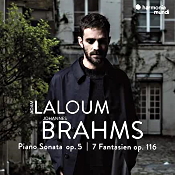
Brahms: Piano Sonata No. 3 in F minor, op. 5; 7 Fantasien, op. 116. Adam Laloum, piano. Harmonia Mundi HMM 902666. 

French pianist Adam Laloum (b.1987) brings us works from the early and late periods of Brahms’s writings for the keyboard. The composer produced his Piano Sonata No. 3 when he was only 20 years old. The liner notes marvel of the young Brahms that “even if his constricted, lower-middle-class family environment was not as miserable as frequently related, it remains incomprehensible how an eighteen-year-old buried entirely in his romantic dream world who had no contact at all to this ‘musical world,’ could invent at the kitchen table in his home, piano music that would astound Europe. And how it became known to the public is no less miraculous. As a nobody, he embarked in the spring of 1853 upon a journey that was supposed to be hardly more than a little concert tour, and ended it as an acclaimed ‘genius’ with the first printed works in his luggage. On this trip, which rather unexpectedly carried him to its turning point, the encounter with the Schumann family, the twenty-year-old Brahms wrote his Third Piano Sonata, which was to be his premature parting from this genre. This aspect, too, is mysterious.”

The sonata is a grand composition in five movements, spanning a total of nearly 40 minutes, with all the musical depth and complexity of a symphony. Speaking of symphonies, the attentive listener will hear occasional echoes of Beethoven’s Fifth as the sonata unfolds, that da-da-da-dum showing up every once in a while, almost spectrally in the opening movement, more forcefully in the fourth. This is truly a grand and glorious work, and Laloum plays it with both power and subtlety. Strangely and sadly enough, given the power and deep beauty of this grand sonata, it proved to be Brahms’s final composition in this genre.

However, Brahms did not abandon composing for the piano altogether; rather, he went on to compose other works for the keyboard, just no more sonatas. He completed his 7 Fantasien in 1892, nearly 40 years after composing his final sonata. They are much smaller in scale, the longest coming in at 4:34, the shortest at a mere 2:23. Four of the seven selections are intermezzi, which are especially lyrical, reflective, and calmingly beautiful (Bill Heck offers some insights about intermezzi in his review of a Brahms piano recording devoted to the genre: https://classicalcandor.blogspot.com/2021/04/brahms-intermezzi-cd-review.html); the other three are cappriccios, which are more, well, capricious. In both genres, Laloum;’ expressive playing is well-framed by the recorded sound, which is clear and full-bodied. All in all, this is a truly rewarding release that would serve as a fine introduction to the piano music of the amazing Johannes Brahms both the younger and the elder.

Vers Le Silence. Chopin: Polonaise in C minor, Op 40 No. 2; Bolcom: Twelve New Etudes for Piano, Book I - No. 1. Fast, furious | No. 2. Récitatif | No. 3. Mirrors; Chopin: Mazurka in C Major, Op. 68 No. 1; Mazurka in G minor, Op. 67 No. 2; Mazurka in A minor, “Emile Gaillard”; Bolcom: Twelve New Etudes for Piano Book II - No. 4. Scène d’opéra | No. 5. Butterflies, hummingbirds | Nocturne; Chopin: Waltz in B minor, Op. 69 No. 2; Waltz in A-flat Major, Op. 42; Bolcom: Twelve New Etudes for Piano, Book III - No. 7. Premonitions | No. 8. Rag infernal (Syncopes apocalyptiques) | No. 9. Invention; Chopin: Polonaise in A-flat Major, Op. 53; Bolcom: Twelve New Etudes for Piano, Book IV - No. 10. Vers le silence | No. 11. Hi-jinks | No. 12. Hymne à l’amour; Chopin: Mazurka in F minor, Op. 68 No. 4. Ran Dank, piano. AVIE Records AV2475. 

With this release we have releases by composers that most classical music fans would not be inclined to think of together, if for no other reason that they are far separated in time, but also because one is quite famous, especially for his piano music, while the other is, although certainly not obscure, far from widely known. As the Israeli-born (now residing in the United States) pianist Ran Dank (b. 1982) puts it, “At first glance, the musical worlds of Frédéric Chopin (1810-1849 and William Bolcom (b. 1938) seem disparate. The former, the national composer of Poland, who spent the lion’s share of his adult life in exile in the country of France, is one of classical music's most well-known and often-played composers, His writing style has become synonymous with pianistic elan and panache, with lush melodic lines in the bel canto style and brilliant bravura passage-work – all ensconced in sumptuous, romantic harmonies. The latter, a Seattle-born American composer, has become one of contemporary music’s most defining voices through boldness of invention and a nonpareil synthesis of musical languages and idioms that encompass the range of 20th-century music. As pianist-composers, they both share a perfect understanding of the human hand and the ability to use the piano to its full extent. They also possess an extraordinary ear for sounds and a keen sense of structure. All of these commonalities begin to unveil themselves when listening to these works side by side.”

As you can see from the track listing, Dank has chosen to intersperse selections of various types from Chopin’s catalog, including two Polonaises, four Mazurkas, and two Waltzes, amongst Bolcom’s 12 New Etudes for Piano. Bolcom began working on the Etudes in 1977, but put them aside when pianist Paul Jacobs, to whom they had been dedicated, passed away in 1983. However, Bolcom was persuaded to complete the work by pianists John Musto (b. 1954) and Marc-Andre Hamelin (b. 1961), so Bolcom set back to work and completed the set in 1986, expanding the dedication to include all three pianists. Although Dank opens and closes his program with Chopin, and devotes considerably more space in his liner note essay discussing the Chopin pieces he has chosen to include, he also writes, “At the core of this recording lie the Twelve New Etudes… The etudes as a whole exhibit all the traits of Bolcom’s writing: wonderfully eclectic, effortlessly moving between one musical idiom and another with seemingly endless ingenuity. The complete set won the Pulitzer Prize in 1988 and is one of the great etude sets in the pianistic repertoire… I would like to close with a few personal notes. With this debut recording, I have chosen to concentrate on two composers who have shaped my trajectory as a pianist and musician. The music of Chopin was, quite literally, the reason I began playing the piano. The waltzes of Chopin were the first musical pieces I remember hearing, and it was a recording of them that had me mesmerized by the age of 3. As a child of two Polish parents, the music of Chopin played a huge part in my upbringing, and every note of it resonates with me on an extremely personal level. Bolcom’s music was a much later discovery, but one that was equally valuable. Indeed, after having learned this set of etudes, I was so fascinated by it that I decided to write my doctoral dissertation on it. I have spent countless hours both playing, studying, and analyzing this text, and I hope to be able to impart some of my musical insights to the listener.”

It seems clear, then, that the primary purpose of the album is to present the Bolcom set, with the Chopin pieces being added for two main reasons: as a musical complement to the Bolcom based on Dank’s deep regard for both composers and to make the album easier to market and sell. Some might find the latter reason less than noble – either on my part for suggesting it or on the part of the producers for implementing it, if that is indeed the case. In any event, whatever the motivation, the end result is an entertaining album that succeeds in exposing music lovers to some music that they might otherwise might not ever have auditioned. The Bolcom Etudes are not going to be to everyone’s taste, but what music truly is? However, they are colorful, brief, spirited, imaginative, and varied. I will admit that they put me off a bit at first, but the more I listened, the more I came to enjoy them, and the more I came to appreciate Bolcom’s fascination with them. From the first of the dozen, titled “Fast, Furious,” which is just that, a shot of caffeinated keyboard adrenaline, we then go to “Recitatif,” a welcome island of calm. Another highlight is “Scene d’opera,” like some fantastic opera scene recalled in a dream. And so the Etudes continue, imaginative pianistic sketches, capturing moods and mental images, ending with the peaceful, reflective, perhaps resigned “”Hymne a l’amour” that completes the set. Dank then follows with a gentle performance of Chopin’s Mazurka in F Minor, op. 64, ending the album in a similar tone but offering a glimpse of hope, some light shining through the cracks. The engineering is by veteran engineer Judith Sherman, so the sound is first-rate, as you might expect. An unusual but rewarding release – try it, you might like it.

Nik Bärtsch: Entendre. Modul 58_12; Modul 55; Modul 26; Modul 13; Modul 5; Dejã-vu,Vienna. Nik Bartsch, piano. ECM 2703. 

Swiss pianist Nik Bartsch (b. 1971) has created an album of solo piano music that defies easy categorization. Although Bartach has led jazz groups that play music of a similar overall feel, the music on Entendre is not jazz; although it tends toward having a rhythmic pulse and a sense of repetitive buildup, it is not merely minimalism; and although it is in a sense composed and has titles (some of which have been played performed previously by his jazz groups), it is music that is not fully composed nor is it fully improvised. The music just seems to unfold as Bartsch plays patterns and then plays with those patterns, keeping a steady pulse but shifting accents, chords, riffs, finding “freedom in the groove” as he taps into the potential energy of the keyboard (and occasionally behind the keyboard) and channels it into kinetic energy that seems to chant and dance as it ebbs and flows. This is energetic music with an underlying sense of calm, music that can either stimulate or soothe, depending on the mood the listener brings to it. Something like a mash up of Philip Glass with Keith Jarretts Koln Concert, if that makes any sense to anyone besides me. Great driving music!

KWN

July 21, 2019

Brubeck: Time Out (UltraHD review)

Dave Brubeck Quartet. Sony Music 88843026022 (remastered).


Alto saxophonist and composer Paul Desmond once said of "Take Five," "It was never supposed to be a hit. It was supposed to be a Joe Morello drum solo." Desmond's composition became the biggest-selling jazz single in history.


Jazz pianist Dave Brubeck (1920-2012) formed his quartet in 1951, and they continued playing until his death. Their biggest album, of course, was "Time Out," recorded in 1959 and included "Take Five." The album and the single have become jazz classics, so it was good that the late record producer Winston Ma (FIM, First Impression Music) helped in the album's audiophile remastering in 2014. It is currently available in its remastered form from Sony Music.


Although members of the quartet changed over the years, the personnel for "Time Out" consisted of Dave Brubeck, piano; Paul Desmond, alto sax; Eugene Wright, bass; and Joe Morello, drums.


The album featured several innovative moves for a jazz presentation, chief among them (and here I'm quoting) "exotic time signatures," "compound time," "layering rhythms of counterpoint," and a "blending of three cultures: the formation of classical Western music, the freedom of jazz improvisation, and the often complex pulse of African folk music."


Which brings us to the first track on the program, "Blue Rondo a la Turk," essentially a blues number in classical rondo form, with a nod to Mozert's rondo "Alla turca." Its strong pulsating rhythms provide a good show opener. After that is "Strange Meadow Lark," which seems rather common by comparison to the opening piece but is still quite lovely. Third up is "Take Five," the only work on the album that wasn't written by Brubeck but by Paul Desmond, and the only track that hardly needs any explanation, since it's been a staple of jazz ever since.


Dave Brubeck

Next is "Three to Get Ready," which starts as a kind of waltz and soon segues into a set of variations. Then, there's "Kathy's Waltz," a tune Brubeck wrote for his daughter, Cathy, which merges several waltz times; "Everybody's Jumpin'" is quite pliant in its rhythms; and the closing track, "Pick Up Sticks," superbly highlights Brubeck's piano work.


Originally recorded by producer Teo Macero and engineer Fred Plaut for Columbia Records in June 1959 at 30th Street Columbia Studio, the album was here remastered by producer Winston Ma in 2014 for Sony Music using FIM and JVC's UltraHD (Ultra High Definition), "PureFlection" (Pure Reflection), 32-bit mastering process. The results are about as good as current compact disc technology gets, considering one can play it on a regular CD player.


Now, here's the thing. I've owned this album in one format or another for most of most of my life yet never considered a particularly great audiophile recording. Most of the sound is miked in the left and right channels, and if the sweet spot in your listening configuration is on one point of the proverbial triangle, you're apt to get a hole in the middle, a slightly empty space between the speakers. Toeing the speakers in more toward the listening position and moving them a little closer together helps mitigate this issue quite bit, so experimentation is in order. Indeed, the disc might prove a blessing in disguise if it helps to improve one's seating arrangement.


Anyway, that said, the new remastering is superb, its main claim to fame being its absolute smoothness. Sony's previous releases of this recording have always seemed to me a bit hard; not really edgy but not as flowing as real music should be. The new remastering takes care of that, providing sound that is as natural as possible. It also improves, though only slightly, the recording's dynamic impact and bass response, as well as its overall clarity. Most important, the new remastering sounds lifelike, as if four musicians are there in the listening room with you.


Again, these are incrementally small distinctions and should not be construed as night-and-day differences. For most folks, the regular CD may suffice nicely. It's for the audiophile with deep pockets that record companies make these kinds of meticulous remasterings, and for them it should be a pleasure.


You can find ARC products at some of the best prices at Elusive Disc: http://www.elusivedisc.com/


JJP


To listen to a brief excerpt from this album, click below:

January 29, 2017

Fausto Mesolella: Live at Alcatraz (XRCD review)

Fausto Mesolella, guitar and loop pedal; Ferdinanda Ghidelli, pedal steel. Master Music/JVC XRCD24-NT017.


It's an expensive proposition; remasterings such as this one always are. I suspect that the current album might appeal to one or more of four kinds of people: (1) lovers of guitar music; (2) fans of guitarist Fausto Mesolella; (3) folks who simply enjoy pop/jazz musical arrangements; or (4) audiophiles bent on obtaining the best possible recordings for their collection.


In the case of Fausto Mesolella: Live at Alcatraz, I would further speculate that it's the fourth option that might attract the most attention, since there is already a plethora of guitar music and pop/jazz music at much more reasonable prices and since Mr. Mesolella isn't exactly a household name. But as a purely sonic treat, this JVC XRCD24 isn't bad.


Italian guitarist, composer, arranger, and producer Fausto Mesolella began playing professionally in 1969, winning awards, performing solo as well as with a number of bands, making recordings, and working in his own studio. Here, he plays guitar and loop pedal while accompanied on some of the tracks by Ferdinanda Ghidelli on pedal steel guitar.


Incidentally, the Alcatraz of the album's title does not refer to Alcatraz Island in the San Francisco Bay or the famous federal prison once located there. This Alcatraz is a school in Italy. Disappointing, I know.


On this live recording, Mesolella plays mostly a fusion of pop and jazz, as I noted above. Mesolella's style is tight yet flexible, providing solid realizations of many old favorite numbers. He never showboats but presents the music with faithfully, with feeling, and on occasion with much intensity. While he may not display quite the virtuosity we find in some celebrated classical guitarists, the music hardly demands it.


Here's a rundown on the program:

1. Mesolella: "Sonatina Improvvisata D'Inizio Estate"

2. Rota: "Ai Giochi Addio" (from Romeo and Juliet)

3. Capurro/di Capua: "O Sole Mio"

4. Piazzolla: "Libertango"

5. Lennon: "Imagine"

6. Bottrell/Jackson: "Black or White"

7. Newton: "Amazing Grace"

8. Mesolella: "La Principessa"

9. Arlen: "Somewhere Over the Rainbow"


Fausto Mesolella

If there is any downside to all of this, beyond the relatively high price of the remastered album, it's that there isn't a lot of it at only forty-four minutes. And, for me, there's the business of the live recording, which I don't care for but which I understand many other listeners do. Be that as it may, let me reflect on a few of my favorite selections.


The first track, the "Sonatina Improvvisata D'Inizio Estate," is a good example of what's to come. Mesolella's playing is fluid and light, the music wafting over one as airily as a spring breeze. If you're a fan of Franco Zefferilli's Romeo and Juliet, you'll probably enjoy Mesolella's performance of the love theme Nino Rota wrote for the film. It's lovely, breezy, lilting, and enchanting. Although "O Sole Mio" and Piazzolla's tango come off a bit too sentimentally for me, Mesolella's version of John Lennon's "Imagine" appears sweet and appealing without being too cloying. And so it goes. The pedal steel in "Amazing Grace" sounds wonderful in its rich resonance, and Mesolella's version of Harold Arlen's "Somewhere Over the Rainbow" may leave you in tears. A fine album; I just wish there were more of it.


A final note on the album's presentation: JVC have packaged the disc in a beautiful, glossy, hard Digipak-type case, with the disc fastened to the inside back and booklet notes bound to the inside. It's unfortunate, though, that whoever translated the notes from Italian into English did such a slapdash job of it. Most of it seems as though an automated translation program did the writing, which is sometimes downright hard to decipher.


Fausto Mesolella recorded the album live at the University of Alcatraz, Santa Cristina di Gubbio, Italy, in August 2013. Producers Kazuo Kiuchi and Shizuo Nomiyama and engineer Tohru Kotetsu at the JVC Mastering Center, Japan, remastered the original analogue tape in February 2016, using XRCD processing, JVC's K2-24bit AD converter, and a digital K2 rubidium clock.


OK, so the first thing we have to get out of the way is the whole subject of live recording. Yes, there is no doubt a certain spontaneity involved in performing in front of an audience, a greater feeling of informality, naturalness, and ease. And for some listeners there is the fun of almost being in the crowd listening to the performance. Nevertheless, it comes with its own burdens: There is always audience noise, and there is the inevitable applause, which erupts before and after every number. For me, it becomes tiresome. For other listeners, it probably adds to the charm of the experience.


Beyond the noise, the album sounds terrific. The guitar rings out loud and clear, its vibrations resonating throughout the room in with light, realistic, natural bloom. It is, in short, one of the best guitar recordings I've ever heard. Of course, to obtain such a healthy sound, the engineers have miked the instrument rather closely, so it probably isn't a good idea to play the music too loudly. At the right level, though, this can be some of the best audiophile material available.


You can find JVC products at any number of on-line marketplaces, but you'll find some of the best prices at Elusive Disc: http://www.elusivedisc.com/


JJP


To listen to a brief excerpt from this album, click on the forward arrow:

July 21, 2015

Jazz Suite for Bassoon (CD review)

Daniel Smith, bassoon; The Caravaggio Ensemble; various musicians. Summit Records DCD 656.


According to Daniel Smith's Web site, "with his many critically acclaimed award-winning recordings and live performances, Daniel Smith is the most recorded bassoon soloist in the world, with a repertoire spanning music from jazz to classical and crossover. As the only bassoonist performing and recording in both jazz and classical, his unique career has been profiled in numerous publications; described as the 'Gerry Mulligan of the Bassoon' in the world of jazz, and the 'Rampal of the Bassoon' in classical music."


Smith tells us that in the mid Nineties, French jazz pianist Jacques Loussier, well known for his jazz arrangements of classical music, inspired his own pianist, Bruce Boardman, and him to try their own hand at redoing a few Baroque pieces for bassoon and jazz band. The success of these numbers led to several other selections on the present album, recorded some twenty years ago and remastered here. So the idea for the arrangements was neither new nor novel for Smith; the execution of the idea, however, is quite fetching, which is why, I suppose, we are getting the present disc in better-than-ever sound.


First up is Boardman and Smith's initial concept, Baroque Adaptations for Bassoon and Jazz Trio, featuring Smith on bassoon, Boardman on piano, Terry Davis on bass, and Martin Drew on drums. The adaptations include the Allegro from Antonio Vivaldi's Concerto in B-flat; William Byrd's Pavan: The Earl of Salisbury; Henry Purcell's Air on a Ground Bass; Vivaldi's Largo from the Concerto for Bassoon and Strings in C major; and J.S. Bach's Badinerie from the Orchestral Suite No. 2.


Next up, we get a surprise. Having just presented Baroque music from a modern jazz ensemble, Smith gives us a few Scott Joplin rags from a Baroque ensemble, The Caravaggio. The musicians here are Smith on bassoon; Jonathan Still, piano; Paul Manley, violin; Boguslaw Kosice, violin; Kate Musker, viola; Justin Pearson, cello; and Michael Brittain, double bass. The Joplin numbers include "The Chrysanthemum," "The Easy Winners," and "Original Rags."


The final item on the program the Jazz Suite for Bassoon, an original composition in three movements by Steve Gray. It combines the flavors of both old and new, classical and modern. The musicians here are Smith, bassoon; Steve Gray, piano; Mitch Dalton, guitar; Jim Lawless, vibraphone; Roy Babbington, bass; and Mike Smith, drums. Gray has titled the movements "Allegro," Ballade," and "Finale."


Daniel Smith

One can easily understand why fans love Smith's bassoon playing. The emotional impact alone should convince any listener of the man's talent, whether it's classical or pop tunes he's playing. The only drawback might be that this kind of crossover material may not appeal to diehard classical or jazz fans, both of whom could reject it as not being "pure" enough. I dunno. For me, it just sounded enjoyably laid-back, no matter what one calls it.


I've always thought of the bassoon as being to the reeds what the cello is to the strings. That is, it has a wonderfully mellow tone and can easily convey the nuances of the human voice. Therefore, the instrument sings most naturally and pleasantly, and Mr. Smith exploits these qualities throughout his playing.


The opening suite of Baroque tunes offers mostly relaxed, atmospheric interpretations that go a long way to soothe the soul. Oddly, I found the Joplin numbers a bit more disconcerting played by a classical ensemble than I did the Baroque material played by a jazz group. Be that as it may, after making a few mental adjustments, the listener should be able to enjoy the music, which again sounds easy and comfortable rather than fast or shrill. The closing jazz suite is really the only thing on the program approaching actual jazz, again laid-back, easygoing, and agreeable.


My only real complaint: The album's too short. At just over forty minutes it hardly gets started than it's over. I know we're looking at quality over quantity here, but still, for a program that makes some gestures toward the classical field, the classical listener probably expects more.


Daniel Smith produced the album in 1995-97 in London and engineer Tom Lazarus remastered it at StadiumRed Studios, New York City in 2015. I can see why the producers wanted to remaster the album; the sound is quite good. It's somewhat close-up, though, in a typically pop-recording style. But it's nicely defined, especially the low end, which has a crisp bite and taut definition, and the high end, which shows good extension. The bassoon rings out mellifluously, and the other instruments appear well defined as well, in a smooth, round manner. While the ensembles do sound close, as I say, there is plenty of air and space around them, with a warm ambience and a nice spacing for depth. The recording shouldn't disappoint anyone.


JJP


To listen to a brief excerpt from this album, click here:


Meet the Staff

Meet the Staff
John J. Puccio, Founder and Contributor

Understand, I'm just an everyday guy reacting to something I love. And I've been doing it for a very long time, my appreciation for classical music starting with the musical excerpts on the Big Jon and Sparkie radio show in the early Fifties and the purchase of my first recording, The 101 Strings Play the Classics, around 1956. In the late Sixties I began teaching high school English and Film Studies as well as becoming interested in hi-fi, my audio ambitions graduating me from a pair of AR-3 speakers to the Fulton J's recommended by The Stereophile's J. Gordon Holt. In the early Seventies, I began writing for a number of audio magazines, including Audio Excellence, Audio Forum, The Boston Audio Society Speaker, The American Record Guide, and from 1976 until 2008, The $ensible Sound, for which I served as Classical Music Editor.

Today, I'm retired from teaching and use a pair of bi-amped VMPS RM40s loudspeakers for my listening. In addition to writing for the Classical Candor blog, I served as the Movie Review Editor for the Web site Movie Metropolis (formerly DVDTown) from 1997-2013. Music and movies. Life couldn't be better.

Karl Nehring, Editor and Contributor

For more than 20 years I was the editor of The $ensible Sound magazine and a regular contributor to both its equipment and recordings review pages. I would not presume to present myself as some sort of expert on music, but I have a deep love for and appreciation of many types of music, "classical" especially, and have listened to thousands of recordings over the years, many of which still line the walls of my listening room (and occasionally spill onto the furniture and floor, much to the chagrin of my long-suffering wife). I have always taken the approach as a reviewer that what I am trying to do is simply to point out to readers that I have come across a recording that I have found of interest, a recording that I think they might appreciate my having pointed out to them. I suppose that sounds a bit simple-minded, but I know I appreciate reading reviews by others that do the same for me — point out recordings that they think I might enjoy.

For readers who might be wondering about what kind of system I am using to do my listening, I should probably point out that I do a LOT of music listening and employ a variety of means to do so in a variety of environments, as I would imagine many music lovers also do. Starting at the more grandiose end of the scale, the system in which I do my most serious listening comprises Marantz CD 6007 and Onkyo CD 7030 CD players, NAD C 658 streaming preamp/DAC, Legacy Audio PowerBloc2 amplifier, and a pair of Legacy Audio Focus SE loudspeakers. I occasionally do some listening through pair of Sennheiser 560S headphones. I miss the excellent ELS Studio sound system in our 2016 Acura RDX (now my wife's daily driver) on which I had ripped more than a hundred favorite CDs to the hard drive, so now when driving my 2022 Accord EX-L Hybrid I stream music from my phone through its adequate but not outstanding factory system. For more casual listening at home when I am not in my listening room, I often stream music through the phone into a Vizio soundbar system that has tolerably nice sound for such a diminutive physical presence. And finally, at the least grandiose end of the scale, I have an Ultimate Ears Wonderboom II Bluetooth speaker for those occasions where I am somewhere by myself without a sound system but in desperate need of a musical fix. I just can’t imagine life without music and I am humbly grateful for the technology that enables us to enjoy it in so many wonderful ways.

William (Bill) Heck, Webmaster and Contributor

Among my early childhood memories are those of listening to my mother playing records (some even 78 rpm ones!) of both classical music and jazz tunes. I suppose that her love of music was transmitted genetically, and my interest was sustained by years of playing in rock bands – until I realized that this was no way to make a living. The interest in classical music was rekindled in grad school when the university FM station serving as background music for studying happened to play the Brahms First Symphony. As the work came to an end, it struck me forcibly that this was the most beautiful thing I had ever heard, and from that point on, I never looked back. This revelation was to the detriment of my studies, as I subsequently spent way too much time simply listening, but music has remained a significant part of my life. These days, although I still can tell a trumpet from a bassoon and a quarter note from a treble clef, I have to admit that I remain a nonexpert. But I do love music in general and classical music in particular, and I enjoy sharing both information and opinions about it.

The audiophile bug bit about the same time that I returned to classical music. I’ve gone through plenty of equipment, brands from Audio Research to Yamaha, and the best of it has opened new audio insights. Along the way, I reviewed components, and occasionally recordings, for The $ensible Sound magazine. Most recently I’ve moved to my “ultimate system” consisting of a BlueSound Node streamer, an ancient Toshiba multi-format disk player serving as a CD transport, Legacy Wavelet DAC/preamp/crossover, dual Legacy PowerBloc2 amps, and Legacy Signature SE speakers (biamped), all connected with decently made, no-frills cables. With the arrival of CD and higher resolution streaming, that is now the source for most of my listening.

Ryan Ross, Contributor

I started listening to and studying classical music in earnest nearly three decades ago. This interest grew naturally out of my training as a pianist. I am now a musicologist by profession, specializing in British and other symphonic music of the 19th and 20th centuries. My scholarly work has been published in major music journals, as well as in other outlets. Current research focuses include twentieth-century symphonic historiography, and the music of Jean Sibelius, Ralph Vaughan Williams, and Malcolm Arnold.

I am honored to contribute writings to Classical Candor. In an age where the classical recording industry is being subjected to such profound pressures and changes, it is more important than ever for those of us steeped in this cultural tradition to continue to foster its love and exposure. I hope that my readers can find value, no matter how modest, in what I offer here.


Bryan Geyer, Technical Analyst

I initially embraced classical music in 1954 when I mistuned my car radio and heard the Heifetz recording of Mendelssohn's Violin Concerto. That inspired me to board the new "hi-fi" DIY bandwagon. In 1957 I joined one of the pioneer semiconductor makers and spent the next 32 years marketing transistors and microcircuits to military contractors. Home audio DIY projects remained a personal passion until 1989 when we created our own new photography equipment company. I later (2012) revived my interest in two channel audio when we "downsized" our life and determined that mini-monitors + paired subwoofers were a great way to mate fine music with the space constraints of condo living.

Visitors that view my technical papers on this site may wonder why they appear here, rather than on a site that features audio equipment reviews. My reason is that I tried the latter, and prefer to publish for people who actually want to listen to music; not to equipment. My focus is in describing what's technically beneficial to assure that the sound of the system will accurately replicate the source input signal (i. e. exhibit high accuracy) without inordinate cost and complexity. Conversely, most of the audiophiles of today strive to achieve sound that's euphonic, i.e. be personally satisfying. In essence, audiophiles seek sound that's consistent with their desire; the music is simply a test signal.

Mission Statement

It is the goal of Classical Candor to promote the enjoyment of classical music. Other forms of music come and go--minuets, waltzes, ragtime, blues, jazz, bebop, country-western, rock-'n'-roll, heavy metal, rap, and the rest--but classical music has been around for hundreds of years and will continue to be around for hundreds more. It's no accident that every major city in the world has one or more symphony orchestras.

When I was young, I heard it said that only intellectuals could appreciate classical music, that it required dedicated concentration to appreciate. Nonsense. I'm no intellectual, and I've always loved classical music. Anyone who's ever seen and enjoyed Disney's Fantasia or a Looney Tunes cartoon playing Rossini's William Tell Overture or Liszt's Hungarian Rhapsody No. 2 can attest to the power and joy of classical music, and that's just about everybody.

So, if Classical Candor can expand one's awareness of classical music and bring more joy to one's life, more power to it. It's done its job. --John J. Puccio

Contact Information

Readers with polite, courteous, helpful letters may send them to classicalcandor@gmail.com

Readers with impolite, discourteous, bitchy, whining, complaining, nasty, mean-spirited, unhelpful letters may send them to classicalcandor@recycle.bin.

"Their Master's Voice" by Michael Sowa

"Their Master's Voice" by Michael Sowa