Ravel: Le Tombeau de Couperin; Brahms: Variations on a Theme by R Schumann, Op. 9; Shostakovich: Piano Sonata No. 2 in B minor, Op 61; Brahms: 11 Chorale Preludes for Organ, Op. 122 (arr. for piano by F. Busoni) (excerpts) No. 10 in A minor, “Herzlich tut mich verlangen” (My heart is filled with longing); No. 11 in F major, “O Welt, ich muss dich lassen” (O World, I must leave you). Orion Weiss, piano. First Hand Records FHR128.
Ohio-born pianist Orion Weiss (b. 1981) has undertaken a recording project that will eventually yield three releases. My review of Arc I, the first release in the series, can be found here: https://classicalcandor.blogspot.com/2022/04/piano-potpourri-no-6-cd-reviews.html. In his liner notes for that album, Weiss explains that “the arc of this recital trilogy is inverted, like a rainbow’s reflection in water. Arc I’s first steps head downhill, beginning from hope and proceeding to despair. The bottom of the journey, Arc II, is Earth’s center, grief, loss, the lowest we can reach. The return trip, Arc III, is one of excitement and renewal, filled with the joy of rebirth and anticipation of a better future.” He goes on to give a quick preview and chronological overview: Arc I (Granados, Janacek, Scriabin) from before World War I; Arc II (Ravel, Shostakovich, Brahms) from during World Wars I and II, during times of grief; Arc III (Schubert, Debussy, Brahms, Dohnanyi, Talma) from young composers, times of joy, after World War I and after World War II.
Although the above might seem to indicate that the present release might be quite a morose listening experience, “grief, loss, the lowest we can reach,” such is not the case. Although this is not a collection of lighthearted pieces, it is not devoted to darkness and despair. As Weiss describes it, “this album strives to understand the varying ways composers comprehend grief, loss, and death. How did they cope, their hearts broken, their peace gone? In this compilation of works I have tried to follow the paths these great composers walked in their own grief. Their tracks lead us from death back towards life, from horror to hope.” We may be at the bottom of the arc, but Weiss already has us looking up, which is evident form the opening measures of Ravel’s Le Tombeau de Couperin. Weiss brings a sparkle to the familiar Prelude that makes it sound new and wonderful even if you have heard it so many, many times before in both piano and orchestral guise. To my ear, Weiss seem to let us hear what both his hands are playing, somehow making the music sound more complex and colorful, drawing your ears and imagination more deeply into the music. Perhaps he is aided in this by the engineering, which is superb. In any event, this is a first-class rendition of the Ravel.
Next up is the first of the music of Brahms to appear on this album, these “Short variations of a Theme by Him, Dedicated to Her,” (referring to Robert and Clara Schumann ) as the 20-year-old Brahms called this composition, which he wrote in the wake of Robert’s attempted suicide and subsequent institutionalization. Weiss characterizes it as “a homage to his friend and mentor, a first love letter to Clara and a book of condolences to the Schumann family.” Like the Ravel, then, it is music of varying moods, which Weiss communicates effectively with clarity and precision. The intensity level ratchets up several notches as Weiss next tackles a piece written nearly a century after the Brahms, Shostakovich’s Piano Sonata No. 2 from 1943, which Weiss describes as “emotional, romantic, wild, and raw.” This is not music for the faint of heart, and it is definitely not music for background listening. There are times when both hands are pounding out notes; at other times, the music is just a note at a time played by one hand. Weiss is well up to the challenge of delivering the emotional impact without taking it over the top.
Like a SCUBA diver returning slowly to the surface to avoid the bends, Weiss allows listeners the chance to decompress by returning to the music of Brahms for the final segment of the program. As Weiss points out, this is not the same Brahms whose music we encountered previously on this CD. “More than 40 years after Op. 9, Brahms was at the end of his life. Sick, weak, worried for the future of music, and bereft of his life-long friend Clara, his music took on increasingly religious themes. These organ settings of centuries-old Lutheran hymns (transcribed for piano by his longtime admirer Ferrucio Busoni) tighten the thread between himself and Bach, between himself and his faith. Brahms’ compositional epilogue dates from immediately after Clara’s funeral; the Chorale Preludes, grieving yet heartbreakingly accepting and courageous, were the last notes he ever wrote.” After the anxiety and tension of the Shostakovich, the calmly reflective music of Brahms, although tinged with sadness, offers emotional closure and peace. Weiss caresses the keyboard in these chorales, communicating hope amidst grief.
Arc III awaits.
Wolfert Brederode: Ruins and Remains Ruins I; Swallow: Remains; Cloudless; Ruins and Remains; Ka; Ruins II; Duhra; Ruins III; Retrouvailles; Nothing for granted; Dissolve; March; Ruins IV. Wolfert Brederode, piano; Matangi Quartet (Maria-Paula major, violin; Danile Torrico Menacho, violin; Karsten Kleijer, viola; Arno ven der Vuurst, cello); Joost Lijbaart, drums/percussion. ECM 2734 458 1864
Once again I present an album of music that can be seen as a hybrid of jazz and classical, an album for which the case can be made that it can be viewed as chamber music with a twenty-first century sensibility. The back story offered in the liner notes is that “originally commissioned to commemorate the one-hundredth anniversary of the end of the First World War, Ruins and Remains was premiered on Armistice Day in November 2018. Its pervading tone had drawn influence from the melancholic atmospheres of Philippe Claudel’s WWI novel Les Âmes grises, with its world of characters harbouring stark secrets. Over time, however, the suite has come to embody meanings broader and more personal, with wide-ranging resonances.’ At a number of levels, the piece has to do with grief and loss and learning to stand up again,’ Brederode says.”
Although the piece was originally composed by the Dutch pianist/composer Wolfert Brederode (b.1974) in 2018, this recording was not made until August, 2021, and the music evolved over that span. “Calling it an evolving suite gave me the liberty to change pieces and add pieces as we went along,” he explained. As the recording was made, with producer Manfred Eicher taking an active role in the proceedings, new sections were introduced, including two that were totally improvised, Nothing for granted and Dissolve. Brederode’s piano serves as the musical thread that ties most of the sound together, with the strings of the Matangi Quartet adding body and color while the drums and percussion provide sonic seasoning. Musical themes and phrases drift in and out of some of the pieces, offering a loose, almost dreamlike sense of unity to tbe proceedings. The music throughout sustains an atmosphere of introspection, mystery, and reflection; however, it is not without energy, nor is it without shape or form. The final selection, Ruins IV, ends inconclusively, leaving the listener suspended, free to draw her own inferences. The engineering is up the usual ECM benchmark, which is clear, clean, open, spacious sound.
Scenes in Tin Can Alley: Piano Music of Florence Price Scenes in Tin Can Alley; Thumbnail Sketches of a Day in the Life of a Washerwoman; Clouds; Village Scenes; Preludes; Cotton Dance; Three Miniature Portraits of Uncle Ned. Josh Tatsuo Cullen, piano. Blue Griffin Recording BGR615.
The American composer Florence Beatrice Price (1887-1953) was born in Little Rock, Arkansas. As a child in the South during that era, she was unfortunately rejected by her white teachers, so she received her first musical training from her mother. She showed remarkable musical talent, but because advanced musical training was largely unavailable to women of color in the South, her mother enrolled the 16-year-old Price in the New England Conservatory in Boston, majoring in organ and piano performance (while following her mother’s advice to present herself as being of Mexican descent). There she was taught music theory by the institution’s director, George Whitfield Chadwick, a leading figure of the so-called Second New England School of composers who had a special interest in African-American folk melodies and rhythms. Over the past couple of years there has been a spurt of interest in her life and works, resulting in a spate of recordings, several of which John Puccio and I have reviewed at Classical Candor:
https://classicalcandor.blogspot.com/2022/06/new-york-youth-symphony-cd-review.html
https://classicalcandor.blogspot.com/2022/04/recent-releases-no-27-cd-reviews.html
https://classicalcandor.blogspot.com/2022/10/violin-concertos-by-black-composers.html
Those recordings are all orchestral, while this new one is a collection of some of her compositions for piano. Like her orchestral music, this is music that is pleasant and downright fun to listen to. In his liner notes, pianist Josh Tatsuo Cullen makes a thought-provoking argument about Price’s writing for the piano. “As a person of mixed Japanese and European descent, I feel a strong connection to Price’s desire to elevate the marginalized people of her own mixed-race heritage in Scenes in Tin Can Alley, Thumbnail Sketches of a Day in the Life of a Washerwoman, and Three Miniature Portraits of Uncle Ned. Price’s treatment of these neglected subjects using the classical idiom is also very powerful to me because like Price, I began studying classical piano at an early age. Some critics have noted that Price speaks in a borrowed idiom, in the sense that she uses musical language reminiscent of Schumann and Chopin, and not a language she invented herself or that derives from the vernacular of her own heritage. But I would argue that this is precisely what makes it authentic to her: as the daughter of a well-trained singer and pianist, and educated at the New England Conservatory, the classical idiom was her idiom.”
Cullen clearly enjoys playing this music; from the opening measures of the title piece, Scenes in Tin Can Alley, the energy he brings to his playing sounds just right for portraying the emotions and characters that Price is trying to sketch in here scores. But neither Cullen’s playing nor Price’s music is all about energy and bounce; in contrast, the pieces Clouds and Village Scenes reveal a more introspective, impressionistic dimension that are the highlights of this well-played and well recorded album.
KWN
By Karl W. Nehring
LYS: Mari Samuelsen
Program includes: (1) Meredi: White Flowers Take Their Bath; (2) Dobinka Tabakova: Nocturne (arr. for violin & piano); (3) Hannah Peel: Signals; (4) Caroline Shaw: The Orangery; The Beech Tree; (5) Laura Masotto: Sol Levante; (6) Margaret Hermant: Lightwell; (7) Hildegard of Bingen: O vis eternitatis (arr. by Tormod Tvete Vik); (8) Beyoncé: Halo; (9) Lera Auerbach: Adagio sognando; (10) Hildur Guðnadóttir: Baer (arr. by Max Knoth); (11) Hannah Peel: Reverie (arr. for solo violin, strings, & electronics); (12) Hania Rani: La Luce; (13) Clarice Jensen: Love Abounds in Everything; (14) Anna Meredith: Midi (Arr. for solo Violin & electronics). Mari Samuelsen, violin; with support on the tracks indicated by Hania Rani, piano (12); Dobrawa Czecher, solo cello (12); Margaret Hermant, harp, violin, electronics (6); Fabien Leisure, electronics (6); Meredi, electronics (1); Clarice Jensen, electronics, cello, and artistic director (13); American Contemporary Music Ensemble (Ben Russell, violin; Laura Lutzke, violin; Isabel Hagen, viola; Paul Wiancko, cello) (13); Anna Meredith, electronics (14); Hannah Peel, electronics (3); 11; Erland Cooper, programming (11); Julien Quentin, piano (2, 9); Scoring Berlin (1, 3-7, 8, 10-12); Jonathan Stackhammer, conductor (1, 3-7, 6-8, 12). Deutsche Grammophon 486 2096.
Mari Samuelsen’s previous album for DG, titled simply “Mari,” was a 2-CD affair featuring a generous helping of work by contemporary composers plus a couple of works by Bach. You can read my review of that album here: https://classicalcandor.blogspot.com/2019/09/mari-cd-review.html Although it I must confess that it never occurred to me at the time, in the light of familiarizing myself with her new album it is now glaringly obvious that all the composers were male. To help restore some balance to the universe, all of the music on LYS (“light”) is the work of female composers; moreover, with the obvious exception of Hildegard, all are contemporary composers. As you can see, then, Ms. Samuelsen is vitally interested in presenting new music to the classical music listening public.
Do not fear, however, for all of the music on this album is quite listenable. There is nothing here that is dissonant or aurally challenging. On the contrary, this is music that is uplifting, hopeful, and engaging. Several of the composers provide brief notes about their compositions, this excerpt from Laura Masotto effectively capturing the spirit of the entire program: “Sol Levante was composed while holding in mind Mari’s discography and the way she plays the violin… While composing, I felt I wanted her and the string quartet to enjoy playing this piece, to have fun.” That sense of fun comes through not just on Marotto’s piece, but throughout the 52-minute recording. To hear such vibrant music from young musicians – players and composers alike – makes me feel confident about the future of what we still cling to calling “classical” music. Whatever you might choose to call it, it’s in good hands, folks.
Solus et una: Amit Peled
Bach: Suite No. 4 in E-flat Major for Violincello Solo, BWV 1010; Suite No. 5 in C Minor for Violincello Solo, BWV 1013; Brahms: Symphony No. 3 – Andante (arr. by Konstantin Blagojevic for eight cellos and piano)*. Amit Peled, cello; *Mount Vernon Virtuosi Cello Gang (Nick Pascucci, Natalia Vilchis, Lindsey Choung, Amit Peled, Mairéad Flory, Kyle Victor, Jiaoyang Xu, Álvaro Vázquez Osa, cellos); *Allison Freeman, piano. CTM Classics 95269 15090.
This is yet another of those recordings arising from the pandemic. Israeli-American cellist Peled (b. 1973) says of this recording that it “is a reflection on my musical journey during the COVID-19 pandemic. As my mentor Boris Pergamenschikov wrote: ‘The Bach Cello Suites is music that cleanses the soul, especially if you ply it just for yourself, preferably without any audience.” As with many of us cellists, I found myself spending a lot of time with the Bach Suites in my home studio during the long months of the lockdown. The two suites that attracted me the most were the fourth suite in E-flat Major, which represents triumph, daring, and heroism – all the qualities I found myself searching for while trying to make sense of the artistic dryness that we all experienced at the beginning of the pandemic. And in contrast, the monumental fifth suite in C Minor, which bubbled up in me about a year into the lockdown when questions about supernatural power, God, love, religion and a search for belonging to something bigger than just us here on earth emerged in me – all the elements one finds in that almost religious most philosophical suite.”
With so many recordings of the complete set of Bach cello suites available by so many celebrated cellists – in many cases, multiple sets by celebrated artists such as Yo-Yo Ma, for example, who has no fewer than three fine sets available to choose from – what is the appeal of a single CD from a less well-known artist that contains only two of the six suites? First of all, not everyone needs to have a recording of all six suites, at least not at first (after becoming familiar with this glorious music by means of this splendid release, they may well decide to take the plunge. If they really want to jump in deep, besides picking up a recording of the complete set, they might also want to take a look at British cellist Steven Isserlis’s recent book about the Bach cello suites).
Second of all, Solus et una (“alone and together”) is in itself a splendid introduction to the suites, with Peled delivering heartfelt performances that are captured in excellent sound. I did a quick comparison of Eled’s performance of No. 5 with Janos Starker’s venerable version on Mercury Living Presence and concluded that Eled’s version held its own. Again, for the listener new to classical music (or at least to the cello suites of Bach), Solus et una would certainly be a fine place to start.
Finally, Esed offers listeners a bonus: “As an encore track, I have included on this release the one piece that I was able to record during the lockdown with my dear cello students. Teaching during the pandemic, both online and in person, has been a source of hope, comfort and inspiration. Moreover, being able to make music with other people and with my own students was a real musical climax. For me, there’s nothing better to conclude this musical journey than the music of Brahms with its beauty of line and intimacy.” After the intensity of the Bach, the Brahms provides a relaxing change of pace. The sound quality is also different, with the instruments being more distant, the cellos blending into each other and the piano seeming to be a bit too far off in the distance to be completely effective musically. With the cellos not providing the treble parts that the violins would have provided in the original orchestral score, I had hoped the piano would have provided more of that sense, but the arrangement and engineering did not allow me to hear what I had hoped to hear. Still, as Esed writes, there does come through a sense of that Brahmsian beauty of line, even if it sounds a bit muffled. Perhaps I should not quibble about a bonus track recorded by students. All in all, this is a noteworthy release that is an excellent introduction to the wondrous world of the Bach cello suites.
Enfolding
Scott Wollschleger: Outside Only Sound; Anne Leilehua Lanzilotti: with eyes the color of time. Eli Spindel, Brooklyn String Orchestra. New Focus FCR331.
Although there is nothing about the music on this release that is dissonant or “in-your face” (quite the opposite, actually), I will point out at the outset of this review that this is a CD that is not like to appeal to a broad swath of classical music lovers. However, there are some who may well find it fascinating, so for you folks (you know who you are, or at least I hope you will if you read on for a few more minutes), let me do my best to give you a quick thumbnail of these two compostions. The liner notes are quite skimpy, almost nonexistent, but if you are interested, you can find out more about the music at newfocusrecordings.com.
There you will discover that “Scott Wollschleger’s Outside Only Sound was written upon request from the String Orchestra of Brooklyn to facilitate performance under lockdown restrictions. Wollschleger was asked to write a work that would require only a few minutes of rehearsal and could be performed outside. His answer was to write a work where each player is like an insect in a swarm; making sounds independently that are coordinated in accordance with time stamps in the score to create a mass of sound that moves in waves across the fourteen and half minute score. Bells, triangles, string harmonics, scratch tones, and cymbals merge with the sounds of an outdoor park, replete with laughing voices and the backing up signal of a truck. By the time the work is finished, one can sense the transformation of the public space into something shared and contemplative.” Well, for pretty much the first three minutes, the predominant sounds on the recording are ambient sounds, e.g., traffic noise, people talking, and so forth, with the instrumental sounds being way in the background. The instrumental sounds move to the foreground for the next nine minutes or so, but never really establish much in the way of melody, not that the sounds are in any way offensive. With about two minutes left, the background sounds begin to take back over. The whole effect is dreamlike, perhaps best enjoyed on headphones.
Anne Leilehua Lanzilotti’s with eyes the color of time, which was a finalist for the 2022 Pulitzer Prize in music, is said to be inspired by a series of works on display at The Contemporary Museum (Spalding House) in Honolulu. Although the notes on the lable’s website describe it as a nine-movement piece, there are only eight movements/tracks on the CD. Go figure. But while Wollschleger’s composition was recorded live in a park (and sounds like it, as described above), with eyes the color of time was recorded in a studio and although still not abounding with melody in the traditional sense, sounds more like composed music. The composer is able to evoke a variety of moods and sounds from the assembled strings and percussion, especially in the final two movements, titled “mahina” and “enfolding,” which are both more than seven minutes in duration. The latter movement in particular is quite spellbinding, closing the program on a seemingly metaphysical plane evoked by haunting sounds that lead the mind of the listener inevitably inward. No, this is not an album for everyone, but there are certainly some who will find it fascinating.
KWN
By Karl W. Nehring
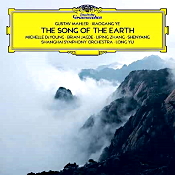
Gustav Mahler | Xiaogang Ye: The Song of the Earth. CD1 Mahler: Das Lied von der Erde (symphony for teneor, alto, and orchestra, text after Hans Bethge’s Die chinesischesche Flote); CD2 Xiaogang Ye: The Song of the Earth op. 47 (for soprano, baritone, and orchestra; text, Chinese poems of the Tang Dynasty). Michelle DeYoung, mezzo-soprano; Brian Jagde, tenor (Mahler); Liping Zhang, soprano; Shenyang, baritone (Xiaogang Ye); Long Yu, Shanghai Symphony Orchestra. Deutsche Grammophon 483 7452.
This release consists of two CDs. The first contains a performance of Gustav Mahler’s Das Lied von der Erde (“The Song of the Earth”), a work that should be familiar to most classical music lovers. The second contains a 21st century homage to and reimagining of Mahler’s opus by the Chinese composer Xiaogong Ye (b. 1955), who had been commissioned by conductor Long Yu to compose a new symphonic work based on the same poems that Mahler had used in creating Das Lied. But whereas Mahler created his German text based on Hans Bethge’s German translation of a French translation of Chinese poetry, Ye created his Chinese text based on those same Chinese poems. The liner notes include some observations by Yu about the similarities and differences between the two compositions. “Close comparisons are possible, with people able to see the double picture – how Europeans feel about love, pleasure, and death, and how the Chinese feel about the same things. In this project, you can hear that the last piece of the Mahler, Der Abscheid – ‘The Farewell’ – and the last piece in the Chinese work both purvey exactly the same emotion. [Though not through the same textures.] Mahler creates oil paintings, while Xiaogang Ye paints in watercolour. But the juxtaposition of these two pieces allows fruitful comparisons.”
As far as the performance on the Mahler disc goes, in all honesty I would have to say that it is satisfactory, but not one for which I could work up much enthusiasm. There are simply too many truly excellent versions available such as Klemperer on EMI, Oue on Reference Recordings, and Haitink on Philips, to name just a few from my personal pantheon (the Klemperer recording, with singers Fritz Wunderlich and Christa Ludwig, is one of the transcendent glories of recorded music – but I digress…) to keep me from making a strong recommendation for this one. In short, it is okay, but there are better versions to be had.
The main focus of interest for this release is the Chinese composition. Here we enter a different sound world from that of Mahler, based on different scales, a different language, and even several different instruments. Still, the overall feeling is not radically different, given that we are still listening to an essentially standard symphony orchestra, even though the language and some of the instrumentation might sound unfamiliar. The bottom line is that although this is not an essential recording, it is certainly an interesting recording. Mahler fans with a special fondness for Das Lied von der Erde might well gain additional appreciation for and insight into Mahler’s achievement by hearing this unique Chinese perspective on Mahler’s original source of inspiration. Moreover, one need not be a Mahler fan to enjoy this fascinating, colorful, at times exotic-sounding new composition by this relatively unknown (at least in the West) Chinese composer. A word of caution, however: for those new to the world of classical music, this well-engineered two-CD set could well be a gateway drug to mainline Mahler addiction.
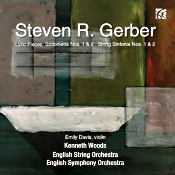
Gerber: Sinfonietta No. 1 (Piano Quintet, 1991) arr. Daron Hagen; String Sinfonia No. 1 (String Quartet No. 4, 1995) arr. Adrian Williams; Two Lyric Pieces for Violin and Strings (2005); String Sinfonia No. 2 (String Quartet No. 6, 2011) arr. Adrian Williams; Sinfonietta No. 2 (String Quartet No. 5, 2000) arr. Adrian Williams. Emily Davis, violin. Kenneth Woods, English String Orchestra, English Symphony Orchestra. Nimbus Alliance NI 6423.
As the liner notes point out, “most of the music on this recording consists of arrangements of chamber music pieces by Steven Gerber (1948-2015), commissioned by the Gerber Trust to help make performances of his music more accessible for chamber orchestras, smaller symphony orchestras and string orchestras. Taken together with Gerber’s beautiful Two Lyric Pieces for Violin and Strings, they provide a fascinating overview of Gerber’s development as a composer over most of the last two years of his working life.” That pretty well provides a succinct overview of this release, to which I would of course like to add a few thoughts and observations from my little listening enclave on this side of the pond.
For many music lovers, this is quite likely the first time they have ever heard of the late American composer Steven Gerber, nor are they likely familiar with any of his music. However, conductor Kenneth Woods, a Wisconsin native now living in the UK (who, by the way, wields a mean Fender Telecaster as well his conductor’s baton) has made it one of his personal and professional priorities to record works by lesser-known composers whose music he believes deserves wider exposure. This generously filled (73:07) disc is one of the fruits of his endeavors.
The program begins and ends with chamber pieces arranged for chamber orchestra, opening with Sinfonietta No. 1, an arrangement of Gerber’s Piano Quintet from 1991 and closing with Sinfonietta No. 2, an arrangement of his String Quartet No. 5 from 2000. The former is like a miniature symphony in four brief moments that total not much more than 15 minutes, the first three movements sounding somewhat spiky and playful, the fourth more dramatic. The latter, although in only two movements, is longer at just over 18 minutes. The first movement, marked Fantasy, is bold and dramatic, while the second movement consists of a remarkable set of theme and variations that highlight both Gerber’s ability to write interesting melodies and arranger Adrian Williams’s ability to bring them to colorful life.
Between the two Sinfoniettas we have as the centerpiece the only Gerber work on this CD that is performed in its original form, his Two Lyric Pieces for Violin and Strings, which as you might guess from the title are the pieces which tug most strongly at the heartstrings. Indeed, this is a composition so compelling that I was amazed never to have encountered it before. Violinist Emily Davis plays with heartfelt expression, but never cloyingly, with sensitive support from the strings of the English String Orchestra under the baton of Maestro Woods. What a wonderful musical discovery!
Preceding and following the Lyric Pieces are String Sinfonias Nos. 1 and 2, which are arrangements by Adrian Williams of Gerber’s String Quartets Nos. 4 and 6, respectively. These are more serious in tone than the other works on the program, more inwardly focused and intense. Evidently these were string quartets more along the lines of, say, Shostakovich rather than Haydn or Mozart. That is not to say the Sinfonias are difficult works, or especially prickly, it is simply that they are not as immediately engaging to to the ear as the other works on the program.
The overall sound quality is fine. Tonal balance leans a bit toward the warm side, but to my taste at least is a sound I prefer to overly bright and clinical. I can recall the days when the Nimbus label on a CD meant that it was recorded in “Ambisonic” sound, intended for multichannel playback, and often sounding distant and overly reverberant in two-channel systems. Those days are far behind us, thank goodness. For those looking for music off the beaten path but not too far out, Gerber is well worth an audition, especially the Two Lyric Pieces for Violin and Strings, a heretofore undiscovered gem.
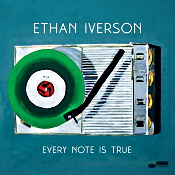
Every Note Is True. The More It Changes; The Eternal Verities; She Won’t Forget Me; For Ellen Raskin; Blue; Goodness Knows; Had I But Known; Merely Improbable; Praise Will Travel; At The Bells and Motley. Ethan Iverson, piano; Larry Grenadier, bass; Jack DeJohnette, drums. Blue Note B003473002.
Pianist Ethan Iverson first came to my attention as the pianist in the iconoclastic jazz trio The Bad Plus back around 2003 when I heaped praise on their major label debut album These Are the Vistas in my “More Jazz Than Not” column in The $ensible Sound. Could that really have been nearly 20 years ago? (I can imagine Iverson asking himself the same question from time to time…) I was less enamored of the group’s subsequent albums and did not think that much of it when I read about Iverson leaving the group in 2017. In 2018, I enjoyed an ECM album he recorded as part of a quartet with trumpeter Tom Harrell (Common Practice, ECM 2643), and somewhere over the past year or two I started following him on Twitter, where I discovered that in addition to his talents as a musician, Iverson has also blossomed into a writer, critic, interviewer, and blogger of note; I would strongly suggest those with an interest in jazz to check out his website at ethaniverson.com.
The moment I saw on Twitter that he was coming out with a new trio album on the venerable Blue note label with Larry Grenadier on bass and none other than drum grandmaster Jack DeJohnette, I immediately pre-ordered it and began counting the days before it would show up in my mailbox. The Blue Note “First Look” promotional video (https://www.youtube.com/watch?v=Aj8JCkxUQdU) ratcheted up my anticipation even higher. When it arrived, though, would it live up to my expectations?
In a word, indeed. I have always been a big fan of jazz piano trio albums, and this one is something special. The opening little vocal ditty, “The More It Changes,” with lyrics written by Iverson’s wife, the writer Sarah Deming, and performed by Iverson on the piano with vocals by Iverson, Deming, and a host of their friends (phoned in), is something I thought would wear on me after a few listens, but the more I listen, the more it touches me. Perfect for the pandemic, I guess. And then we get to the trio music. A few notes from Iverson, a flourish from DeJohnette, and then we are off, and right away there is a sense of a classical music vibe. There are echoes of Bach, but yet it is clearly jazz. As the program proceeds, the interplay among the three musicians is fascinating. None of them is showing off, but each of them is exhibiting mastery. The music just flows out of them. Gradually, the influence of baroque and classical gradually shifts until by the time we get to the final track, “At the Bells and Motley,” we are in blues territory.
Adding to the appeal of the album is the top-notch engineering. It was recorded by Andreas K. Meyer with the assistance of Shubham Mondal at the Clubhouse in Rhinebeck, NY, and is simply one of the finest-sounding trio recordings I have ever auditioned. I have argued before that jazz can be thought of as a form of chamber music; this album is a prime example and I recommend it with utmost enthusiasm.
The more it changes, the more it stays the same
We pass the ball to other ages, it’s how we play the game
You never sing alone when the rhythm catches you
The song goes on when the band goes home
And every note is true…
KWN
By Karl W. Nehring
Mozart: Piano Concerto No. 25 in C Major, K. 503; Rondo in A Minor, K. 511; Piano Concerto No. 20 in D Minor, K. 456. Jeremy Denk, piano and conductor; The Saint Paul Chamber Orchestra. Nonesuch 075597916874.
The American pianist Jeremy Denk (b. 1950), recipient of a MacArthur Foundation “Genius” Fellowship, is not a pianist who releases a lot of recordings; however, when he does release a recording, it is well worth checking out, as is this new Mozart album on Nonesuch. I have only one other recording by Denk in my collection, his rendition of Bach’s Goldberg Variations. Not only is it a fine performance, but the album includes a fascinating DVD with Denk discussing the music and playing examples at the keyboard. You can see an excerpt from that lecture here: https://www.youtube.com/watch?v=NEuaKv4sGrQ. This new Mozart release does not include a DVD, but it does include extensive liner notes by Denk himself that offer insight into the compositions as well as his thoughts and feelings about them. For example, of the concerto that opens the program, Denk reflects, “As I write these words … the world as it used to be has vanished, a pandemic world has settled in, and—as we keep telling ourselves—we have to live with uncertainty. Which has always seemed to me one of the key messages of this great concerto, so different from the rest, and so full of the love of its creator… 503 has very few tunes… this may explain why it is not one of the most popular of his concertos … you feel that Mozart is instructing you to listen more deeply, away from ornament, behind the frills, to realize that music is more than an assembly of charming and diverting tunes, to think about ideas beneath the surface, forces and principles.” His comment about “very few tunes” is an interesting one. One the one hand, it is true that there are no instantly memorable melodies, but on the other hand, this is Mozart, after all, so the music just seems to flow along like water in a mountain stream. I will confess to being unfamiliar with K. 503, but this recording has won me over. It is a piece and a performance that simmers with power. I want to hear it again and again.
Sandwiched between the two concertos on the program is a work for solo piano. Denk writes of Mozart’s Rondo in A minor, K. 511, “Mozart wrote so many sad songs in his short life: laments of ardent young tenors, of innocent maids, of jilted Countesses, sorrows across the human spectrum, across class and age and mindset, giving voice to regrets vast and small. But in this case I’d argue he does something different—a piece about the nature of melancholy, a sadness (if you like) about sadness.” It is a pensive piece, reflective for sure; whether you find it actually a reflection on or of sadness depends, to my mind at least, upon what your mind and mood bring to your listening session. And even if you do find it sad, you will almost certainly find both the music and the performance undeniably moving and beautiful.
After giving us two less-familiar works, Denk closes his recording with a Mozart concerto that will be much more familiar to most classical music lovers, his No. 20 in D Minor, K. 456, of which Denk notes, “is a far more famous and popular piece than 503, partly because it is what it promises to be. If 503 proposes grand, certain chords and then undermines them, 466 takes the opposite approach: it starts from a distilled unease which accumulates into chords and statements, outbursts of anger. A purer tragedy—and a clearer narrative.” Indeed, I have heard this piece so many times that as soon as it began, I found myself humming along and then trying to restrain myself from playing an imaginary keyboard once Denk started playing. His is a performance I would describe as crisp and powerful in the opening movement, crisp but lyrical in the second movement, and crisp and dramatic in the finale. You can hear an excerpt of his performance here: https://www.youtube.com/watch?v=LKzaJo31TP4
The recording quality is excellent overall. Yes, the piano seems a bit supersized, but that is typical of concerto recordings. Overall, the frequency balance is excellent, the imaging is believable (other than the huge piano, of course), and my only quibble is that the CD seems to be mastered a bit on the hot side, several decibels louder than one might expect. Perhaps this is becoming the New Normal as streaming and earbud listening take over from the traditional home stereo listening setup favored by fogies such as your truly. In any event, this is a richly rewarding recording that I recommend with utmost enthusiasm.
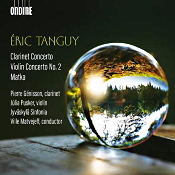
Tanguy: Clarinet Concerto; Matka; Violin Concerto No. 2. Pierre Génisson, clarinet; Júlia Pusker, violin; Ville Matvejeff, Jyväskylä Sinfonia. Ondine ODE 1390-2.
Let us once again sail into uncharted musical waters and listen to the music of a composer we have not heretofore discovered as we explore these three compositions by Éric Tanguy (b. 1968), one of the leading composers in contemporary French music. Once again we encounter truly international music-making, with music by a French composer being played by a Finnish orchestra and conductor, with soloists from France and Hungary, recorded on a Finnish label and manufactured in Germany. But the story gets even more international than that. French clarinetist Pierre Génisson (b. 1986) and the composer were in fact both living in Los Angeles in 2014 when, as Tanguy recounts, “Pierre communicated to me his wish that I write a score for him that he would be able to play >>in mirror<< in a concert including Mozart’s concerto. I of course accepted his project with a great deal of enthusiasm.” The concerto sounds nothing like Mozart’s, as you might expect, but it is quite listenable and enjoyable. Tanguy notes that “in this work there is a clearly consonant , melodic, and lyrical aspect that in no way excludes drama and melancholy.” As an old clarinetist (very old, very mediocre) myself, perhaps I am overly partial to the sweet sound of the “licorice stick,” but to my ears, Tanguy’s Clarinet Concerto (completed in 2017) is a true delight, capturing the imagination with its blend of dramatic gesture, tender reflection, and lyrical exuberance.
Next on the program is the relatively brief (11:28) tone poem Matka, which Tanguy composed in 2015 at the request of conductor Ville Matvejeff for the 150th anniversary of Sibelius, to be commissioned and premiered by the Jyväskylä Sinfonia. Of the title, Tanguy explains that “the Finnish title, ‘Matka,’ refers both to the idea of traveling in Finland, but at the same time to an inner journey and introspection.” Of the music itself, he continues, “Although there is no specific stylistic reference to Sibelius, I wanted to pay a spiritual tribute to the composer whose works fascinated me at a time when I was looking for my own way, thirty years ago.” It is a fascinating piece, one that pleases the ear and engages the imagination. As usual, I listened to it a few times before reading the liner notes, enjoyed it, and thought I heard a hint of Sibelius. After reading the notes, I heard even more hints, as you might expect.
Adding an additional dimension to the international aspect of the production is Hungarian violinist Júlia Pusker (b. 1991), who takes the spotlight in Tanguy’s Violin Concerto No 2. This piece was originally written in 1997 at the request of Phillipe Aïche, concertmaster of the Orchestre de Paris, and is dedicated to him. Later, however, Tanguy felt as though the piece would benefit from having the orchestral part rescored for smaller forces, so he modified it in 2003, and that is the version that has been performed in concert ever since and is the version recorded here. The concerto is in the traditional three movement form, which Tanguy succinctly (and to my ears, quite accurately) characterizes as a first movement with a contrasted lyrical and dramatic color, a second movement with a very mysterious and suspended atmosphere, and a finale that is very virtuosic, challenging both for the orchestra and the soloist. The opening measures might be a bit off-putting to conservative ears, but once you get past that, your ears will be rewarded, especially by the thrilling cadenza that Júlia Pusker plays in the final movement, which is virtuosic indeed! Excellent engineering and solid liner notes make this an easily recommendable release for those listeners looking to take a chance on contemporary composers whose names may be far less than familiar.
Remembering. Norgard: Between – Cello Concerto No. 1*; Remembering Child – Viola Concerto No. 1 (adapted for cello by Jakob Kullberg)**; Saariaho: Notes on Light for cello and orchestra***. Joakob Kullberg, cello; *Michael Francis, BBC Philharmonic; ** Szymon Bywalec, Sinfonia Varsovia; ***John Storgards, BBC Philharmonic. BIS-2602.
This release features some amazing playing by the Danish cellist Jakob Kullberg (b. 1976) in three cello concertos, two by Danish composer Per Norgard (b. 1932), with whom Kullberg has had a close musical relationship for may years, the other by Finnish composer Kaija Saariaho (b. 1952). Continuing the theme of musical internationalism, Varsovia Sinfonia and its conductor Szymon Bywalec both hail from Poland, the recordings were done for a Swedish label, only one of them (Remembering Child) in Poland and the other two in England. I suspect that for many listeners, the “make-or-break” point for their acceptance or rejection of this disc will be the first track, In Between, the opening movement of Norgard’s Cello Concerto No. 1. In my own listening sessions, I found it frustrating, because the rest of the program was enjoyable, but I could never quite relax and enjoy that first movement no matter how much I tried. I took some solace, though, when I finally turned to the liner notes, which said of this concerto, “The title mainly refers to the first movement, in which the cello is unable to unite with the orchestral sound, and instead belongs in the interstices.” The other two movements seem much more musically integrated, and through them all, even that problematic first movement, Kullberg’s playing is a marvel.
Thankfully enough, the remainder of the program on the disc, although still contemporary in character, falls easier upon the ear, including Norgard’s Remembering Child, which closes the program on a more agreeable note than it had begun. However, the highlight of this release is Notes on Light by Kaija Saariaho (b.1952), the longest work on the program, coming in at more than 33 minutes. Ms. Saariaho has cast her composition in five movements: I. Translucent, secret II. On fire III. Awakening IV. Eclipse V. Heart of Light. Perhaps I was influenced by the title, but I did find the music to possess a luminous quality, a sense of shimmering and reflecting that was quite fascinating. The liner booklet, by the way, includes a photo of Kullberg, Norgard, and Saariaho gathered together looking as though they are going over a score together, which is a nice touch. The transparent sound quality typical of the BIS label adds to the overall appeal of this release. Recommended, but with the reservation that the first track might be tough going for some listeners.
KWN
By Karl W. Nehring
Arnold: Complete Symphonies and Dances. (CD1) Symphonies Nos. 1 & 2; (CD2) Symphonies Nos. 3 & 4; (CD3) Symphonies Nos. 5 & 6; (CD4) Symphonies 7 & 8; (CD5) Symphony No. 9; Sir Malcolm Arnold in Conversation with Andrew Penny; (CD6) English Dances, Set 1; English Dances, Set 2; Four Scottish Dances, Op. 59; Four Scottish Dances, Op. 91; Four Irish Dances; Four Welsh Dances. Andrew Penny, National Symphony Orchestra of Ireland (Symphonies), Queensland Symphony Orchestra (Dances). Naxos 8.506041.
October 21, 2021, marked the 100th birthday of the late British composer Sir Malcolm Arnold, one of the greatest yet most overlooked composers of the 20th century. Even in the UK, his music is seldom performed in concert, which is a shame. I was going to say that I first became acquainted with his music thanks to a recommendation by the late Harry Pearson of The Absolute Sound, who wrote with enthusiasm of an EMI LP featuring Arnold conducting the City of Birmingham Symphony Orchestra in Arnold’s Symphony No. 5 and Peterloo Overture, the first LP I ever ordered from England. But that was not, as I now recall, my first exposure to the music of Arnold; instead, my first exposure had actually come many years before, when my father took me to see the film The Bridge on the River Kwai, for which Arnold had composed the memorable score. (The film featured a young Alec Guinness, who many years later I would take my own kids to see play the role of Obi-Wan Kenobi, and would some years after that delight me with his portrayal of George Smiley.) Thanks to Naxos, though, who have decided to mark the occasion of this centennial year with a budget-priced boxed set of his complete symphonies and dances, music lovers now have the chance to immerse themselves in the symphonic music of this most remarkable composer for a most reasonable price.
Arnold had played trumpet in the London Symphony Orchestra; he knew orchestras and loved writing music for them. His symphonies contain melodies and tunes that musicians enjoy playing and listeners enjoy hearing. But no, his music is not simple. It is varied and complex, shifting from mood to mood, sometimes turning on a dime, but never leaving the listener behind. It can go from a tickle to a tear within a matter of measures. But it is always listenable, always colorful, ever imaginative. In a nutshell, the first couple of symphonies are on the bold and brash side, yet not without their moments of reflection. Nos. 3 and 4 are a bit more exotic sounding, especially No. 4., which makes lively use of percussion in places.
Symphony No. 5, the work that Harry Pearson raved about, is often considered Arnold’s masterwork; indeed, it is a symphony that cannot help but make an indelible impression. Its sound is rich and varied, with memorable contributions especially from the brass section, with some trombone parts that will haunt your memory. It is the quintessential Arnold symphony, packed with gorgeous melodies but still managing to be tense, restless, and disturbing under the surface. It is a great work, one that deserves a place in the concert hall. Its discmate, No. 6., is a shorter work (24:41) in three movements, said to be inspired by jazz but communicating a more serious, focused tone than his previous symphonies.
Nos. 7 and 8 are even more serious in tone, but still display that same Arnold sound, that ability to weave phrases and melodies that linger in the memory and tug at the heartstrings of the listeners without ever sounding cloying or sentimental, punctuated with bursts of energy, especially from the bass drum. The opening measures of No. 8 will definitely give both your speakers and your emotions a workout! But then the second movement Andantino will ply on your emotions in a quieter but no less powerful way, setting the stage for the final movement, and energetic romp that by now you will recognize sounds like pure Malcolm Arnold as it shifts gears and moves merrily along. Then we come to Symphony No. 9, Arnold’s most enigmatic symphony. The April 2021 issue of BBC Music Magazine featured an article on Arnold, and displayed his portrait on the cover, alongside which was a teaser that read, “Malcolm Arnold: Was the talented but troubled composer England’s Shostakovich?” That’s the kind of thing you expect to see while standing in the checkout line at the grocery store, and a bit of baloney overall, but listening to the 9th does admittedly invite the comparison to the great Russian composer. Its structure is unusual and yes, Shostakovich-like: three relatively short movements followed by a long (23:10) Lento finale that is serious and brooding. But still, as much as it might remind one of Shostakovich, it remains clearly a work by Arnold. A welcome bonus is the appended interview, in which conductor and composer discuss the work. Much different in mood and most rousingly Arnold-like are the sets of Dances gather together on the final disc in this set. These works are an unabashed delight, tuneful and tasty. It was certainly generous of Naxos to include them here along with the symphonies.
Please rest assured that although this is a budget release, the playing and the engineering are all first-rate. The booklet included in the box gives some background on the symphonies and is prefaced with a reflection about the music and the composer by conductor Andrew Penny. I will confess to being a huge fan of Arnold’s music; I have previously purchased recordings of all of his symphonies (and numerous other works) by several orchestras on several labels, including the individual Naxos discs as they were released during the 1990s. To have this set together in one box, along with the complete Dances (the first time all of his Dances have been recorded together), so well done and at a reasonably low price, makes this set a must-have. Arnold’s music is a musical universe begging to be explored by those who have not yet entered it, and now Naxos has provided the portal key. Enter and enjoy!
Of All Joys. Arvo Pärt (b. 1935): Summa; Luca Marenzio (c. 1535-1599): Solo e pensoso; John Dowland (1565-1626): Flow My Tears (Lachrimae); Orlando Gibbons (1583-1625) Fantasia a 6 in d minor; Philip Glass (b. 1937): String Quartet No. 3 “Mishima”; John Bennet (c. 1575 - c. 1615): Weep, O Mine Eyes; Jacobus Clemens non Papa (c.1510 - c. 1555): Ego Flos Campi a 7; Pärt: Fratres. Attacca Quartet (Amy Schroeder and Domenic Salerni, violins; Nathan Schram, viola; Andrew Yee, cello). Sony Classical 19439936062.
The Attacca Quartet have assembled a musical program of works from the 16th and 20th centuries that flows seamlessly from one musical delight into another, truly testifying to the listener of all joys indeed: the joys of life, the universe, and everything. The disc begins and ends with string quartet arrangements of familiar works by the beloved Estonian composer Arvo Pärt, Summa and Fratres. As with much of Pärt’s music, both pieces have a spiritual dimension to them. That feeling of calm and inwardness carries throughout the program, which is not always quiet and soporific, but in general has a feeling of grace about it. It is revealing to hear how naturally the music of Philip Glass blends so seamlessly into the program. Yes, listeners familiar with his compositional style will recognize that pulsing undercurrent, but they will also come to hear that over 500 years, music still remains music, the tones and the rhythms and the attendant emotions are still there, still flowing, still touching our hearts and minds. The Attacca Quartet’s violinist Domenic Salerni remarks of Glass’s music that “using an extreme economy of means, he creates moments and momentums out of simple whole-number harmonic ansd rhythmic ratios that can leave one feeling resigned and despairing, uplifted and filled with joy, or simply at peace and transported to a place of beauty.” The liner notes go on to assert that “this album seeks to replicate such emotional breadth. And while the textures and harmonies of Glass were a natural and obvious fit, the record is a project that began with the quartet listing off their favorite minimalist and Renaissance pieces, and considering how modern works resonate with what came before.” The end result is an album that should resonate with listeners seeking to engage with the beauty that can be found in simple music with surprising depth.
Vince Mendoza: Freedom Over Everything. Concerto for Orchestra: American Noise; Concerto For Orchestra: Consolation; Concerto For Orchestra: Hit The Streets; Concerto For Orchestra: Meditation; Concerto for Orchestra: Justice And The Blues; Freedom Over Everything; Concerto For Orchestra: Finale; To The Edge Of Longing; New York Stories (Concertino for Trumpet and Orchestra). Antonio Sanchez, drums; Joshua Redman, tenor saxophone; Derrick Hodge, bass; Jan Hasenohrl, trumpet; Tariq Trotter (a.k.a. Black Thought), vocals; Julia Bullock, vocals; Alexej Rosik, violin; Vince Mendoza, Czech National Symphony Orchestra. Modern Recordings 538668092.
This recent release from the Grammy award-winning American composer, arranger, and conductor Vince Mendoza (b. 1961) features music that hovers in a space that is not quite classical, not quite jazz, not quite film music, not quite protest music, but which blends elements of all those genres and more into a program of energetic and entertaining orchestral music mingled with other styles and voices. The featured work is his Concerto for Orchestra, about which he explains, “My approach is a departure from the traditions of an orchestra concerto. For me, it was more about having an arc that tells a particular story, but also incorporates rhythmic and melodic aspects of African American music and improvisation… Coinciding with the composition of the concerto was the 2016 saga of the election of ‘45’ and the resulting tremendous discord in the U.S. during that time. While writing this piece, the events happening in our country invaded my artistic space. For the first time I felt I couldn’t really write music and be removed from what was going on in our environment. I started seriously considering the importance of an artist to reflect the times and how I could make my music a reflection not only of what I was witnessing but what I hoped would occur. So that’s when the arc of this concerto started to take shape. I sought to design the structure of the concerto to be inspired by M.L. King’s remarks on the moral universe, that the arc is long, but it bends toward justice. The beginning of the concerto (the first movement is called ‘American Noise’) reflects the discord that began leading up to the 2016 election. Of course, it pales in comparison to what we dealt with in 2020 and now 2021, but the arc of the composition goes through that process of pure noise, much needed consolation and the need for ‘hitting the streets’. The end of the concerto seeks to reflect justice and the hope for a peaceful resolution to what we were only entering in 2016. Arguably in 2021 we still haven’t quite gotten there.”
The Concerto is in six relatively short movements, the longest being the opening American Noise at 9:47, all the way down to the Finale at only 2:17. Between the fifth movement (Justice and the Blues) and Finale, there is a brief (1:27) interlude (Freedom over Everything) featuring rapper Black Thought. Drummer Antonio Sanchez, who has played with guitarist Pat Metheny and other jazz notables as well as leading ensembles of his own, adds a complex texture to the music as he comes in to join the orchestra along with electric guitar and later, the saxophone of veteran reedman Joshua Redman. The music has plenty of drive and energy, even in its less boisterous moments, with a kinetic feeling of motion to that suggests it would serve well as the score for a modern dance presentation.
Following the turmoil of his Concerto, Mendoza then presents music meant to calm, a setting of verse from the German poet Rilke titled To the Edge of Longing, featuring the rich soprano voice of Julia Bullock accompanied by the solo violin of Alexej Rosik and the orchestra. It truly is a beautiful work, flowing and melodic. The program concludes with New York Stories, a brief concertino for trumpet and orchestra that finds Mendoza returning to the jazz-tinged sound of the Concerto. The drums return, and on the whole, there is something of a film score vibe to this music, especially the sound of the orchestral strings. The end result is pleasant, but at least to these ears, not as striking as the other two works on the program. As far as the engineering goes, frequency balance and imaging are fine; however, be forewarned that this CD is mastered at a level that is clearly several dB higher than the norm for classical recordings, so you will want to back off a few notches on your volume control when auditioning it for the first time. You can always turn it up later, and well you might want to for such exuberant music, but better safe than sorry at the start…
Bach: The Art of Fugue. Les InAttendus (Vincent Lhermet, accordion; Marianne Muller, 7-string bass viol; Alice Piérot, violin). Harmonia Mundi HMM 905313.
Although modern scholarly consensus is that Bach’s The Art of Fugue was originally intended by the composer to be played at the keyboard, as with many other of Bach’s compositions, there have been many other transcriptions and arrangements performed and recorded over the years. Although my favorite is the organ and piano version by Glenn Gould, I have also enjoyed a string quartet version by the Emerson String Quartet, and have at times enjoyed and at other times loathed that infamous Bach/Malloch Sheffield production titled The Art of Fuguing. This new release for the unusual combination of violin, accordion, and bass viol gives the music a baroque sonority, yet because of the unfamiliar element of the accordion blending with the strings, there is a freshness to the sound that makes it piece seem new again. No, this is not a CD for everyone, but for devoted fans of J.S. Bach, it is well worth an audition.
Bonus Recommendation:
How Shostakovich Changed My Mind. Johnson, Stephen. Notting Hill Editions Ltd (2018).
Especially for – but certainly not only for – fans of the music of the great Russian composer Dmitri Shostakovich, this brief book of just over 150 pages offers some fascinating insights into his music. It does so not by presenting dry academic musicological analyses, but rather by offering penetrating personal insights into not only the composer and his music, but also into the effects his music can have upon those who listen with real purpose. As the note on the back cover explains, “music broadcaster and composer Stephen Johnson explores how Shostakovich’s music took shape under Stalin’s reign of terror, and how it gave form to the fears and hopes of an oppressed people. Johnson writes of the healing effect of music on sufferers of mental illness and tells of how Shostakovich’s music lent him unexpected strength in his struggle with bipolar disorder. Through interviews conducted with surviving members of Soviet orchestras, through his reading of philosophers, psychoanalysts, and neurologists, Johnson paints a compelling picture of one man’s music and its power to validate and sustain another man’s life.”
Now, that talk of philosophers and neurologists and psychoanalysts might make it sound as if this book might be a dense, heavy read, quite the opposite is true. Instead, Johnson is a skilled storyteller, and he weaves together a number of different threads – his own story, accounts of his interviews, his accounts of some of Shostakovichs’s compositions (including the Cello Concerto No. 1, String Quartet No. 8, Symphonies Nos. 4, 8, and 11) and how they affected his mental health and overall well-being – into a compelling story that is not just about Shostakovich, or music, but about the human condition and the challenges we all face as we make our way through life. Especially fascinating – offering insights both musical and psychological – are some interviews and analyses that reveal some of the hidden messages that Shostakovich wrote into his music, his way of taunting his tormentors without exposing himself openly to further persecution. This is a little volume that can easily be read in a day or two, but with a message that will resonate in readers’ hearts and minds for far longer.
KWN
By Karl W. Nehring
Labyrinth: Khatia Buniatushvili, piano. Morricone: “Deborah's Theme” from Once Upon a Time in America; Satie: Gymnopédie No. 1; Chopin: Prélude in E minor Op. 28/4; Ligeti: Arc-En-Ciel, No. 5 from Études pour piano - Book I; Bach: Badinerie – from Orchestral Suite (Overture) No. 2 in B Minor, BWV 1067 arr. for piano four hands (with Gvantsa Buniatushvili); Bach: Air on the G String - from Orchestral Suite (Overture) No. 3 in D Major, BWV 1068; Rachmaninov: Vocalise, Op. 34/14; Serge Gainsbourg: La Javanaise; Villa-Lobos: Valsa da dor; Couperin: Les Barricades Mystérieuses, from Pièces de clavecin - Book II; Bach (after Vivaldi): Sicilienne from Organ Concerto in D minor, BWV 596; Brahms: Intermezzo in A major Op. 118/2; Pärt: Pari Intervallo for piano four hands (w/Gvanstsa Buniatushvili); Glass: I'm Going to Make a Cake from The Hours; Scarlatti: Sonata in D minor, K. 32; Liszt: Consolation (Pensée poétique) in D-flat major S 172/3; Cage: 4'33"; Bach: Adagio from Keyboard Concerto in D minor BWV 974.. Sony Classics 19339743772.
Classical music lovers who are conversant with rock music will be familiar with the term “concept album,” examples of which include Tommy, The Wall, and Sergeant Pepper’s Lonely Heart’s Club Band. These were albums whose various cuts were tied together by some overarching theme or story (the concept) in an attempt to make the album something more than just a collection of songs. With her new release Labyrinth, Georgian-born pianist Khatia Buniatushvili has taken that same approach to this album of compositions for piano by various composers. “The labyrinth is our mind, memories of our childhood from an adult’s perspective, the past, the present, not the future, for life is an instant whose following one is unknowable, and the labyrinth is life… The labyrinth is our fate and creation, our impasse and deliverance, the polyphony of life, senses, reawakened dreams, the neglected present, the evasive future… the labyrinth of our mind.” For each of the selections included in the album, she writes a brief narrative, starting with this sentence for the character of Deborah (from “Deborah’s Theme”): “At the ruins of her dreams she could see her childhood, which reminded her of everything she thought she should have had from life, whereas in reality it was in her and she had lost it” and ending with (for the Bach Adagio), “If she hadn’t been absent, she would have been walking bare-foot on the warm earth, she would have thought, ‘Someone else’s spring is also pleasant to watch’.” Wait, what? To be honest, had I read through her complete liner notes while still at the library where I obtained this CD, I most likely never would have would have checked it out. Suffice it to say that writing is not her strong suit. Instead, I took a look at the program printed on the back cover, thought it looked varied and interesting, and auditioned the disc without having given the booklet a glance – thank goodness! The musical program is quite satisfying. Many of the pieces are relatively tranquil in nature, and on top of that, Buniatushvili tends plays some them, such as the opening Morricone and the Pärt, at what seem to be exaggeratedly slow tempi. The end result is an album that really does lend itself to relaxation and reflection, although there are lively enough moments to be found, especially in some of the Bach. And yes, the penultimate selection in her program really is John Cage’s infamous 4’33”; indeed, it is hard to top that as a piece conducive to relaxation and reflection. In the end, I find it hard not be of two minds about this release. Part of me (the part that read the liner notes and contemplates the inclusion of the Cage) finds it an over-the-top, overly woo-woo exercise in immaturity, while the other part (the part that just sits down and enjoys the interesting program and beautiful sounds emanating from the speakers) finds it an enjoyable and entertaining recording. Just caught in the labyrinth, I guess…
Francisco Coll: Violin Concerto; Hidd’n Blue; Mural; Four Iberian Miniatures; Aqua Cinerea. Patricia Kopatchinskaja, violin; Gustavo Gimeno, Orchestre Philharmonique du Luxembourg. Pentatone PTC 5186 951.
The young Spanish composer Francisco Coll (b. 1985) has had the good fortune to encounter excellent advocates for his music early in his career in violinist Patricia Kopatchinskaja (born in Moldova in 1977, now a resident of Switzerland), a passionate advocate of new music, and Spanish-born conductor Gustavo Gimeno (b. 1976), who besides his gig in Luxembourg is also Music Director of the Toronto Symphony Orchestra. In his liner note remarks, Coll relates that “in recent years, my development as a composer – not to mention my development as a human being – could not be understood without the presence of Gustavo Gimeno, Patricia Kopatchinskaja and the Orchestre Philharmonique du Luxembourg. Together with them, I had some of the most exhilarating experiences of my creative life. They have been a huge inspiration for me, and my worldview has grown side-by-side with theirs. When my works are on their music stands, I know that something wonderful is going to happen.” The program on this generously filled disc (80:57) kicks off with Coll’s Violin Concerto, which Coll wrote for and dedicated to Ms. K. In fact, the author of the liner notes, Jesús Castañer, remarks that the work is “intimately linked to the the figure of Kopatchinskaja, not only because in its second movement he quotes his own Hyperlude IV – the work which brought them together – but also because the whole piece is in a sense a portrait of the violinist; from the explosive fury of the first movement, through the sensuality of the second, to the youthful and unpredictable character of the third.” OK, then, moving back to the music… Regarding the opening movement of the concerto, when I played it for an old Belgian friend, he observed with a twinkle in his eye, “Ah, mon ami, surely that is the fiddling most energetic, n'cest pas?” Far be it from me to argue with the world’s greatest detective: the opening movement truly is a whirlwind of virtuosic energy. The second movement starts off more slowly and mysteriously, but builds in intensity, ending with a cadenza for the violin. The third and final movement opens dramatically and features some significant contributions from the percussion section. Hidd’n Blue is a brief (4:44) piece for orchestra that features some colorful ideas (no pun intended) expressed in some fluttering sounds that come to an abrupt ending. Mural was written for a large orchestra and is a longer composition (24:25) of five movements. From the rhythmic, at times even manic opening moment, the more ordered second movement, through the more brooding, almost dreamlike third movement that gives way to the more energetic fourth movement – which still has is its dreamy moments, to the finale, which starts moodily, proceeds in waves, builds in energy and then finally fades away, this truly is a restless piece overall, never feeling settled or static. The Four Iberian Miniatures for violin and chamber orchestra are something of a tongue-in-cheek romp, alluding to Spanish dance rhythms but never quite in a straightforward way. The mood is capricious and energetic – I can imagine the players smiling as they play their way through these 13 minutes of breathless whimsy. The program closes with Aqua Cinerea, Coll’s Opus 1. It is marked in the program as being composed from 2005-2019, which I presume means it was originally composed in 2005 and then touched up a bit in 2019. To my ears at least, it is the weakest piece here, never really coming into focus. It starts in the strings, then along comes percussion, then lower brass – there is plenty of orchestral color, lots of interesting sounds, but things just never quite seem to cohere. To be fair, maybe they are actually not supposed to, and I am simply missing the point of the piece. In any event, even if you do not find this final cut to be enjoyable, that still leaves more than 70 minutes of rewarding music on this well-engineered disc, which is certainly a darned good deal. Besides, many listeners might enjoy Aqua Cinerea more than I did. And hey, I did not actively dislike it, I just found it to be one of those pieces that simply did nothing for me. Your mileage may vary. This is a release that highlights a young contemporary composer with a bright future ahead of him; it is well worth an audition.
Bayou: Thomas Strønen, drums/percussion; Ayumi Tanaka, piano; Marthe Lea, clarinet/voice/percussion. ECM 2633 072 4298.
This is another of those adventurous ECM albums that resides in that zone where jazz, chamber music, folk music, and musical imagination combine, create, and captivate. Norwegian drummer Thomas Strønen has appeared on numerous previous recordings for ECM and other labels both as sideman and leader. Ayumi Tanaka is a Japanese pianist and composer who resides in Norway and often works with Norwegian musicians, while Marthe Lea is a Norwegian clarinetist and singer who leads a jazz quintet, sings Norwegian folk music, and has studied Indian classical music. They have come together on this album to record music born from spontaneous improvisation and interaction rather than from composition. Other than the opening title cut, Bayou, derived from a Norwegian folk song and sung by Lea, briefly reprised later on the album as Bayou II, the rest of the selections were mixed down from music the trio recorded spontaneously in one studio session. The music is spare, haunting, probing, and utterly fascinating. The liner pictures show the musicians during the session, and especially startling to see is the huge drum that forms part of Strønen’s setup. Its impressive bass note provides a firm sonic underpinning to the music from time to time, but is never used for mere effect. As huge as it is, it never draws more attention to itself than the brushes Strønen draws gently over his snare. Piano, clarinet, and percussion gently interact with each other, weaving a spell that seduces and enchants. This is a beguiling release that merits repeat listening to reveal more of its hidden charms.
KWN
By Karl W.
Nehring
Albores: Dino Saluzzi, bandoneon. ECM 2638 774
7754.
Dino Saluzzi
(b. 1935) is a master of the bandoneon, an accordion-like instrument most often
associated with the tango. However, the music on Albores, consisting of
nine compositions by Saluzzi, is not tango music, as we can infer from a glance
at the back cover. The title of the first track, Adiós Maestro Kancheli, is
a reference to Georgian composer Giya Kancheli (1935-2019), whose music was
sprawling, eruptive, disruptive, and highly charged. Saluzzi’s dedication
reads: “Dear Maestro and friend, your wonderful music will always remain with
me. It was a great honor to get to know you.” This and the other eight
compositions on Albores are in a serious, probing, deeply reflective
vein, drawing the listener in as if listening to an intense movement from a
late Beethoven string quartet or Schubert piano sonata. Saluzzi is not dashing
off tunes for mere entertainment, but making music for contemplation and
aesthetic uplift. Beautiful, inspiring music; however, every rose has its thorn
– the sound of the bandoneon, while rich and complex in its own way, also
includes clicking and popping from the keys and buttons that may cause you to
think your CD player is mistracking at times. If you can get past that, you
will be richly rewarded.
Arvo Pärt: Miserere.
Which Was the Son of…; Festina lente; Tribute to Caesar; Sequentia;
The Deer’s Cry; Miserere; And I Heard a Voice…. Howard
Arman, Chor des Bayerischen Rundfunks; Münchner Rundfunkorchester;
oestereichisches ensemble fuer neue music. BR Klassik 900527.
One of the
consolations of having to spend so much time at home because of the pandemic
has been the opportunity to have more time to enjoy beautiful recordings such
as this. The choral music of Estonian composer Arvo Pärt (b. 1935) is always a
joy to hear, and especially so when it is so expertly performed and recorded as
it is on this new collection featuring the Bavarian Radio Chorus. And speaking
of the pandemic, the liner notes explain the ‘Happy Birthday, Arvo Pärt!’ was
the title of the first choir subscription concert of the 2020/21 season, at
which Pärt’s 85th birthday was to have been celebrated – with the
composer himself actually present. Indeed, it could have been a double
birthday, since the Bavarian Radio Chorus is also celebrating its 75th
anniversary. But everything turned out differently. Arvo Pärt stayed at home,
as did the concert audience. The singers and their artistic director Howard
Arman remained at their posts, albeit with the respectful social distancing
required by the coronavirus. Also on hand behind their glass screens, were the
sound engineer and his team, who recorded a significant part of the present CD
edition.” Although it may have been a big disappointment not to have a live
concert, in the end we music lovers at home have ended up being the
beneficiaries, as the resultant recording, with all but the performance of Miserere
being captured in studio settings rather than live concert performances,
are extremely well recorded, making this release a sonic as well as musical
delight. The excellent liner booklet that includes texts makes this a
first-class release in every respect.
Glass: Les
Enfants Terribles; Etudes Nos. 17 and 20. Katia and Marielle LaBéque,
piano. Deutsche Grammophon 4855097.
Katia (b.
1950) and Marielle (b. 1952) Labèque are French sisters who have been making
recordings and performing for more than five decades across a variety of
genres, even including a stint with jazz guitarist John McLaughlin, with whom
Katia was romantically linked for several years in the 1980s. The sisters have played jazz, baroque, ragtime, and both
mainstream and contemporary classical music. In 2005, they performed the world
premiere of Philip Glass’s Double Concerto for two pianos, which the
composer dedicated to the sisters. More recently, Glass requested that his
longtime collaborator and arranger Michael Riesman put together a two-piano
suite based on Glass’s opera Les Enfants Terribles. Those familiar
with the music of Philip Glass know that he falls into the “minimalist” camp;
however, this suite for two pianos is in places boisterous, dramatic, and
exciting, played with flair and power, while at other times reflective and
brooding, played with sensitivity and finesse. For a video glimpse of the
sisters playing this music, you can catch a glimpse here. The
program is rounded out with solo performances by Marielle of Glass’s Etude
No. 17 and Katia of his Etude No. 20. The former is charming,
expressive – Glass’s piano music shows him at his best – while the latter seems
to reveal another dimension of expression that transcends minimalism, Glass’s music
extending into another dimension and bringing the listener along for the
ride.
Songs
from Home: Fred
Hersch, piano. Palmetto PM2197.
This is
another of those musical efforts that in some respects we owe to the COVID-19
pandemic. Jazz pianist Fred Hersch recorded this solo piano album in his own
home on his own piano and is now sharing it with us for our enjoyment while we
are still trying to get the upper hand in our ongoing battle with the
coronavirus. This truly is an entertaining collection of music both familiar,
with renditions of tunes including but not limited to “Wouldn’t It Be Loverly,” “Wichita Lineman,” Joni Mitchell’s “All
I Want,” and an original by Hersch. The piano he uses is not perfect, but the
resultant sound just adds to the personal feel. The music is familiar, although
played with a personal flair, and the overall feeling is one of great intimacy
and direct communication. I played it one evening when my wife was at home, and
from the other room she commented, “that CD you’re playing makes me feel like
we are having a nice dinner at a fancy restaurant with a really good piano
player taking requests and making sure everybody is having a memorable evening.
That’s really nice – who is it?” Yes, Songs from Home truly is a
feel-good CD, and by the time you get to the final cut, “When I’m Sixty-four,”
you will have had a memorable listening experience thanks to the musical
mastery and communicative spirit of Maestro Hersch.
Vida
Breve:
Bach/Busoni: Chaconne from Partita No 2 in D minor BWV 1004; Chopin: Piano
Sonata No. 2 in B flat minor; Liszt: Funérailles from Harmonies
poétiques et religieuses; Bagatelle sans tonalite; Busoni: Kammer-Fantasie
über Carmen; Hough: Piano Sonata No. 4 ‘Vida Breve’:
Traditional/Hough: Arirang. Steven Hough. Piano. Hyperion CDA68260.
As you might
be led to infer by the titles of the CD itself and some of the selections, and
the inclusion of the Chopin funeral march, this program by British pianist
Stephen Hough is not all sweetness and light. That said, there is beauty to be
found here, in the music, the playing, and in the recorded sound, which is a
bit on the distant but warm side, which seems just right for the reflective
mood that Hough seems to be inviting us to enter as we contemplate one of the bedrock
certainties of life, as he explains: “People are often reluctant to talk about
death… but in the world of the arts – in painting, literature, and music –
death has always been a central subject resulting in the most exalted and
inexhaustible expression, the image of a dead man hanging on a cross arguably
the fundamental icon of Western culture… On this recording I wanted to explore
some pieces that have this theme as part of their identity or inspiration.” But
no, you do not have to ponder your mortality as you listen to this recording,
for this is beautiful music that can be enjoyed for what it is, beautiful
music, beautifully performed and recorded, bringing joy to your life for 78
beautiful minutes.
Villa-Lobos: Choral
Transcriptions. Mendelssohn: Lieder ohne Worte, Book 2-No.9 in E major;
Bach: Prelude and Fugue No. 8 in E flat minor/D sharp minor BWV 853;
Schumann: Traumerei; Bach: Fugue No. 1 in C major, BWV 846;
Schubert: Ständchen; Bach: Fugue No. 21 in B flat major, BWV 866;
Chopin: Waltz No. 7 in C sharp minor; Bach: Prelude No. 22 in B flat
minor, BWV 867; Rachmaninov: Prelude in C sharp minor; Bach:
Prelude no. 14 in F sharp minor, BWV 883; Massenet: Élégie; Bach: Fugue
No. 5 in D major, BWV 874; Beethoven: Piano Sonata No. 8 ‘Pathétique’ –
II. Adagio cantabile; Villa-Lobos: Bachianas Brasileiras No. 9 (version
for choir). Valentina Peleggi, São Paulo Symphony Choir. NAXOS 8.574286.
From 1933 to
1935, Brazilian composer Heitor Villa-Lobos (1887-1959) created a number of
transcriptions of classical music compositions by other composers in
arrangements for a cappella choir, especially of the Preludes and Fugues
from Bach’s The Well-Tempered Clavier. As you can see from the
selections listed above, this recording by the São Paulo Symphony Choir under
the direction of Italian conductor Valentina Peleggi places an emphasis on the
latter, with a number of Bach selections seasoned with some selections by other
familiar figures, and ending with a choral version of one of Villa-Lobos’s own
Bach-inspired compositions, his Bachianas Brasileiras No. 9, which the
composer dedicated to American composer Aaron Copland. Most of the
arrangements are for wordless choir; only the Schubert and the Massenet
selection feature lyrics, which are presented in the liner booklet. Although
some readers might be led to think of something like the old Swingle Singers
recordings of Bach, this is something much different, as the choir is much
larger and the arrangements are much more complex and nuanced than those of the
Swingles (not to knock them, they were great fun). Having the Bach arrangements
run as a thread throughout the program gives it weight and body, while having
the other arrangements provides variety and color. Hearing a melody with which
you are familiar from having heard on the piano (for me, it was the Rachmaninov
Prelude in C sharp minor) sung by this large choir is a transcendent
moment, sure to bring a shiver and a smile. This is a truly delightful
recording that should appeal to a wide variety of music lovers. The recording
quality is just fine, offering a sense of space without the overly resonant
muddiness that mars some choral releases.
KWN
John J. Puccio, Founder and Contributor
Understand, I'm just an everyday guy reacting to something I love. And I've been doing it for a very long time, my appreciation for classical music starting with the musical excerpts on the Big Jon and Sparkie radio show in the early Fifties and the purchase of my first recording, The 101 Strings Play the Classics, around 1956. In the late Sixties I began teaching high school English and Film Studies as well as becoming interested in hi-fi, my audio ambitions graduating me from a pair of AR-3 speakers to the Fulton J's recommended by The Stereophile's J. Gordon Holt. In the early Seventies, I began writing for a number of audio magazines, including Audio Excellence, Audio Forum, The Boston Audio Society Speaker, The American Record Guide, and from 1976 until 2008, The $ensible Sound, for which I served as Classical Music Editor.
Today, I'm retired from teaching and use a pair of bi-amped VMPS RM40s loudspeakers for my listening. In addition to writing for the Classical Candor blog, I served as the Movie Review Editor for the Web site Movie Metropolis (formerly DVDTown) from 1997-2013. Music and movies. Life couldn't be better.
Karl Nehring, Editor and Contributor
For more than 20 years I was the editor of The $ensible Sound magazine and a regular contributor to both its equipment and recordings review pages. I would not presume to present myself as some sort of expert on music, but I have a deep love for and appreciation of many types of music, "classical" especially, and have listened to thousands of recordings over the years, many of which still line the walls of my listening room (and occasionally spill onto the furniture and floor, much to the chagrin of my long-suffering wife). I have always taken the approach as a reviewer that what I am trying to do is simply to point out to readers that I have come across a recording that I have found of interest, a recording that I think they might appreciate my having pointed out to them. I suppose that sounds a bit simple-minded, but I know I appreciate reading reviews by others that do the same for me — point out recordings that they think I might enjoy.
For readers who might be wondering about what kind of system I am using to do my listening, I should probably point out that I do a LOT of music listening and employ a variety of means to do so in a variety of environments, as I would imagine many music lovers also do. Starting at the more grandiose end of the scale, the system in which I do my most serious listening comprises Marantz CD 6007 and Onkyo CD 7030 CD players, NAD C 658 streaming preamp/DAC, Legacy Audio PowerBloc2 amplifier, and a pair of Legacy Audio Focus SE loudspeakers. I occasionally do some listening through pair of Sennheiser 560S headphones. I miss the excellent ELS Studio sound system in our 2016 Acura RDX (now my wife's daily driver) on which I had ripped more than a hundred favorite CDs to the hard drive, so now when driving my 2022 Accord EX-L Hybrid I stream music from my phone through its adequate but not outstanding factory system. For more casual listening at home when I am not in my listening room, I often stream music through the phone into a Vizio soundbar system that has tolerably nice sound for such a diminutive physical presence. And finally, at the least grandiose end of the scale, I have an Ultimate Ears Wonderboom II Bluetooth speaker for those occasions where I am somewhere by myself without a sound system but in desperate need of a musical fix. I just can’t imagine life without music and I am humbly grateful for the technology that enables us to enjoy it in so many wonderful ways.
William (Bill) Heck, Webmaster and Contributor
Among my early childhood memories are those of listening to my mother playing records (some even 78 rpm ones!) of both classical music and jazz tunes. I suppose that her love of music was transmitted genetically, and my interest was sustained by years of playing in rock bands – until I realized that this was no way to make a living. The interest in classical music was rekindled in grad school when the university FM station serving as background music for studying happened to play the Brahms First Symphony. As the work came to an end, it struck me forcibly that this was the most beautiful thing I had ever heard, and from that point on, I never looked back. This revelation was to the detriment of my studies, as I subsequently spent way too much time simply listening, but music has remained a significant part of my life. These days, although I still can tell a trumpet from a bassoon and a quarter note from a treble clef, I have to admit that I remain a nonexpert. But I do love music in general and classical music in particular, and I enjoy sharing both information and opinions about it.
The audiophile bug bit about the same time that I returned to classical music. I’ve gone through plenty of equipment, brands from Audio Research to Yamaha, and the best of it has opened new audio insights. Along the way, I reviewed components, and occasionally recordings, for The $ensible Sound magazine. Most recently I’ve moved to my “ultimate system” consisting of a BlueSound Node streamer, an ancient Toshiba multi-format disk player serving as a CD transport, Legacy Wavelet DAC/preamp/crossover, dual Legacy PowerBloc2 amps, and Legacy Signature SE speakers (biamped), all connected with decently made, no-frills cables. With the arrival of CD and higher resolution streaming, that is now the source for most of my listening.
Ryan Ross, Contributor
I started listening to and studying classical music in earnest nearly three decades ago. This interest grew naturally out of my training as a pianist. I am now a musicologist by profession, specializing in British and other symphonic music of the 19th and 20th centuries. My scholarly work has been published in major music journals, as well as in other outlets. Current research focuses include twentieth-century symphonic historiography, and the music of Jean Sibelius, Ralph Vaughan Williams, and Malcolm Arnold.
I am honored to contribute writings to Classical Candor. In an age where the classical recording industry is being subjected to such profound pressures and changes, it is more important than ever for those of us steeped in this cultural tradition to continue to foster its love and exposure. I hope that my readers can find value, no matter how modest, in what I offer here.
Bryan Geyer, Technical Analyst
I initially embraced classical music in 1954 when I mistuned my car radio and heard the Heifetz recording of Mendelssohn's Violin Concerto. That inspired me to board the new "hi-fi" DIY bandwagon. In 1957 I joined one of the pioneer semiconductor makers and spent the next 32 years marketing transistors and microcircuits to military contractors. Home audio DIY projects remained a personal passion until 1989 when we created our own new photography equipment company. I later (2012) revived my interest in two channel audio when we "downsized" our life and determined that mini-monitors + paired subwoofers were a great way to mate fine music with the space constraints of condo living.
Visitors that view my technical papers on this site may wonder why they appear here, rather than on a site that features audio equipment reviews. My reason is that I tried the latter, and prefer to publish for people who actually want to listen to music; not to equipment. My focus is in describing what's technically beneficial to assure that the sound of the system will accurately replicate the source input signal (i. e. exhibit high accuracy) without inordinate cost and complexity. Conversely, most of the audiophiles of today strive to achieve sound that's euphonic, i.e. be personally satisfying. In essence, audiophiles seek sound that's consistent with their desire; the music is simply a test signal.
Mission Statement
It is the goal of Classical Candor to promote the enjoyment of classical music. Other forms of music come and go--minuets, waltzes, ragtime, blues, jazz, bebop, country-western, rock-'n'-roll, heavy metal, rap, and the rest--but classical music has been around for hundreds of years and will continue to be around for hundreds more. It's no accident that every major city in the world has one or more symphony orchestras.
When I was young, I heard it said that only intellectuals could appreciate classical music, that it required dedicated concentration to appreciate. Nonsense. I'm no intellectual, and I've always loved classical music. Anyone who's ever seen and enjoyed Disney's Fantasia or a Looney Tunes cartoon playing Rossini's William Tell Overture or Liszt's Hungarian Rhapsody No. 2 can attest to the power and joy of classical music, and that's just about everybody.
So, if Classical Candor can expand one's awareness of classical music and bring more joy to one's life, more power to it. It's done its job. --John J. Puccio
Contact Information
Readers with polite, courteous, helpful letters may send them to classicalcandor@gmail.com
Readers with impolite, discourteous, bitchy, whining, complaining, nasty, mean-spirited, unhelpful letters may send them to classicalcandor@recycle.bin.


 Arc II
 Wolfert Brederode: Ruins and Remains
 Scenes in Tin Can Alley: Piano Music of Florence Price